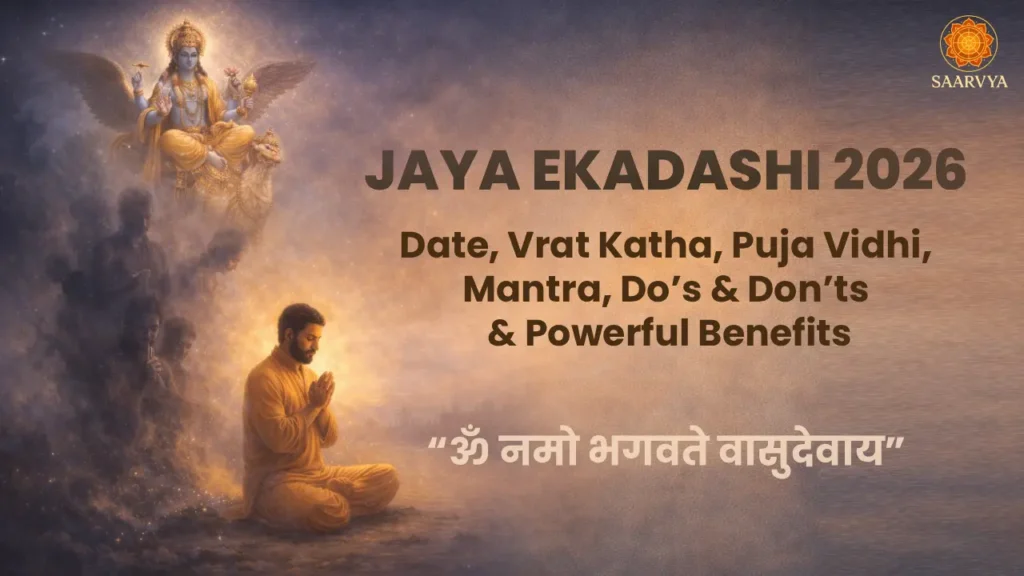

Jaya Ekadashi is observed during the bright half of the Magh month (Magh Shukla Ekadashi) and is regarded as one of the most powerful and purifying Ekadashis in the Sanatani tradition. Also known in some regions as Bhishma Ekadashi or Bhoumi Ekadashi, this vrata is traditionally believed to destroy even the gravest karmic burdens and protect the soul from falling into ghostly or pishacha states after death. It is especially recommended for those seeking liberation from past karmic baggage, freedom from negative influences, inner peace, and stability in family and career life.
Jaya Ekadashi 2026 will be observed on Thursday, 29 January 2026 (Magh Shukla Ekadashi). On this day, devotees fast by avoiding grains and tamasic food, worship Vishnu–Lakshmi, listen to the Jaya Ekadashi Vrat Katha, and complete the fast during Dwadashi Parana on 30 January. This vrata is traditionally believed to destroy even grave sins, protect the soul from ghostly or pishacha yonis, and grant peace, prosperity, and spiritual upliftment.
Date, Tithi Duration & Parana Time
Jaya Ekadashi falls in the Magh month during Shukla Paksha, a period associated with clarity, victory over inner darkness, and spiritual purification. In 2026, the Ekadashi tithi begins on 28 January at around 4:35 PM and ends on 29 January at around 1:55 PM. Accordingly, the fast is observed on Thursday, 29 January 2026.
As with all Ekadashi vratas, Parana (breaking the fast) must be done on Dwadashi, strictly after sunrise and after Hari Vasara ends. For Jaya Ekadashi 2026, Parana falls on Friday, 30 January 2026, within the morning Dwadashi window. Since sunrise and Hari Vasara timings vary by location, devotees should always verify city-specific Parana timings through a trusted local panchang.
Jaya Ekadashi 2026
| Detail | Information |
|---|---|
| Ekadashi name | Jaya Ekadashi (also called Bhishma / Bhoumi Ekadashi) |
| Month & Paksha | Magh month, Shukla Paksha |
| Vrat date (fast) | Thursday, 29 January 2026 |
| Ekadashi tithi | 28 Jan 2026, ~4:35 PM – 29 Jan 2026, ~1:55 PM |
| Parana date | Friday, 30 January 2026 |
| Parana time (Delhi) | ~7:10 AM – 9:20 AM (after Hari Vasara) |
| Presiding deity | Lord Vishnu with Goddess Lakshmi |
| Core focus | Destruction of sins, freedom from ghostly yonis, peace, prosperity |
Note: Timings above are indicative. Always consult your local panchang for exact sunrise and Parana windows applicable to your city.
Meaning of “Jaya” and Status Among Ekadashis
The word Jaya means victory not merely outer success, but victory over forces that bind the soul to suffering. Jaya Ekadashi is therefore understood as the Ekadashi that grants triumph over sins, negative karmic residues, inner enemies, and lower states of consciousness. Among all Ekadashis, it holds a particularly formidable position because of what it is said to purify.
Scriptural sources, especially the Padma Purana, describe Jaya Ekadashi as capable of destroying even sins compared to brahma-hatya a term traditionally used to denote the gravest moral transgressions. This does not imply casual absolution, but rather highlights the transformative potential of sincere repentance, restraint, and devotion when aligned with this tithi. Because of this intensity, Jaya Ekadashi is often recommended for devotees who feel weighed down by long-standing guilt, repeated failures, or patterns they struggle to overcome despite effort.
Unlike Ekadashis that primarily emphasise prosperity or wish-fulfilment, Jaya Ekadashi is about liberation first liberation from inner darkness, fear, and the karmic momentum that pulls one toward suffering. Material wellbeing and peace are described as natural outcomes once this inner victory is established.
Liberation from Ghostly and Pishacha Yonis
A unique and striking feature of Jaya Ekadashi is its repeated association with freedom from preta, bhuta, and pishacha yonis states of existence described in traditional texts as restless, hungry, fearful, and disconnected from divine remembrance. Scriptures state that one who observes Jaya Ekadashi with faith does not fall into such conditions after death.
On a literal level, this reflects a cosmological belief system present in Puranic literature. On a subtler level, many acharyas interpret these “yonis” as symbolic of intense psychological suffering chronic fear, obsession, addiction, guilt, or unresolved trauma that leaves the mind trapped in loops of distress even while alive.
This is why Jaya Ekadashi is often recommended for people who experience:
- persistent fear or anxiety without clear cause
- recurring nightmares or intrusive thoughts
- a sense of being “stuck” in negative cycles
- ancestral disturbances or unresolved family grief
The vrata combines fasting, vigilance, mantra, and sacred storytelling to help the devotee reclaim inner sovereignty. By reducing sensory intake and increasing remembrance of Vishnu, the mind is gradually lifted from compulsive patterns toward clarity and steadiness.
In this sense, Jaya Ekadashi represents victory over inner ghosts habits, fears, and impressions that feed on attention and weaken discernment. The promise of the vrata is not fear-based, but empowering: when awareness is restored, darkness loses its grip.
Classic Vrat Katha Outline (Malyaavan & Pushpavati Version)
The Jaya Ekadashi Vrat Katha is narrated by Bhagwan Krishna to Yudhishthira and is one of the most vivid stories illustrating how disrespect, distraction, and unrestrained desire can pull even exalted beings into suffering and how Ekadashi can reverse that fall.
The Setting in Indra’s Court
The story begins in Indra’s heavenly court, where devas are assembled for a sacred performance. Gandharvas and apsaras are invited to sing and dance in honour of the divine assembly. Among them are Gandharva Malyaavan and apsara Pushpavati, renowned for their beauty, talent, and closeness to Indra’s court.
The atmosphere is solemn and sacred. Such performances are not mere entertainment; they are offerings meant to uphold cosmic harmony and reverence toward the devas.
Distraction, Desire, and the Curse
During the performance, Malyaavan and Pushpavati become overcome by mutual attraction. Instead of maintaining focus and respect, their minds turn toward each other. Their singing falters, their awareness slips, and their behaviour subtly but clearly violates the sanctity of the occasion.
Indra, who represents order, vigilance, and responsibility, notices this lapse. Angered not by romance itself but by disrespect during a sacred duty, he pronounces a curse. Both Malyaavan and Pushpavati are stripped of their divine status and cast down to earth, condemned to be born as pishachas ghostly beings trapped in hunger, fear, and ugliness.
The curse reflects a core dharmic principle: loss of awareness during sacred responsibility leads to loss of status and freedom.
Life as Pishachas: Suffering and Despair
Reborn as pishachas, the once-glorious beings now wander through a dense forest. Their existence is described as deeply miserable they are ugly, constantly hungry and thirsty, exposed to extreme cold and heat, and tormented by fear. They cannot access proper food or water, nor can they rest peacefully.
This stage of the story symbolises what happens when consciousness is ruled entirely by impulse and distraction. Pleasure-seeking without restraint eventually results in restlessness, deprivation, and suffering, even if it begins in seemingly harmless attraction.
The Accidental Observance of Jaya Ekadashi
After wandering in this state for a long time, fate brings them near a hermitage during the month of Magh. Unknowingly, it is the night of Magh Shukla Ekadashi Jaya Ekadashi.
Weak, terrified, and exhausted, the two pishachas remain awake throughout the night, unable to sleep due to cold and fear. They also consume no food or water, simply because none is available. From a distance, they hear holy discourse, chanting of Vishnu’s names, and devotional sounds emanating from the hermitage.
Without intention, without knowledge, they fulfill the three core elements of Ekadashi:
- Upavasa (fasting)
- Jagran (wakefulness)
- Shravana of Hari-nama (hearing Vishnu’s name)
Redemption and Return to Heaven
As dawn breaks, a profound transformation occurs. The pishacha forms dissolve, and Malyaavan and Pushpavati regain their radiant divine bodies. Freed from the curse, they are carried back to heaven in celestial vehicles.
Indra, astonished by their sudden return, asks how such liberation was achieved. They reply that it was through the power of Jaya Ekadashi, observed unknowingly but perfectly due to circumstance. Hearing this, Indra himself praises the Ekadashi tithi.
Krishna concludes the Katha by declaring that conscious observance of Jaya Ekadashi yields far greater merit than accidental fasting, granting freedom from even the gravest sins and ensuring the soul never falls into lower states of existence.
Spiritual Interpretation
Malyaavan and Pushpavati represent the danger of inattentiveness in sacred responsibility how even elevated beings can fall when awareness is lost. Their ghostly suffering symbolises the inner torment caused by unchecked desire and distraction.
Their accidental fasting shows the raw potency of Ekadashi tithi itself. When observed knowingly with discipline, devotion, and intention its effect is magnified many times over.
Jaya Ekadashi thus teaches that victory (jaya) comes not by suppression, but by vigilance. By turning attention away from impulse and back toward Vishnu, the devotee conquers inner demons and restores dignity, clarity, and peace.
Dashami Preparation (Day Before – 28 January 2026)
Preparation for Jaya Ekadashi begins on Dashami, and this preparatory phase is especially important because the vrata is associated with deep purification and liberation from heavy karmic impressions. The day before is meant to calm the senses and set a disciplined rhythm for the Ekadashi tithi.
On the evening of 28 January 2026, devotees are advised to take a simple, sattvic meal before sunset. This meal should exclude non-vegetarian food, alcohol, onion, garlic, and excessively spicy or oily items. The purpose is not dietary punishment but gradual withdrawal from tamasic influence, allowing the mind to become lighter and more receptive.
Dashami is also the time to mentally commit to the type of fast you will observe on Jaya Ekadashi:
- Nirjala upavasa (only for healthy and experienced devotees),
- Water-only fast, or
- Phalahar / Ekadashi-friendly foods such as fruits and milk.
Gather all puja items in advance to avoid distraction on Ekadashi day: a clean image or idol of Vishnu–Lakshmi or Narayan, a kalash, ghee diya, incense, flowers, tulsi leaves (collected earlier), fruits for naivedya, and items intended for charity. Preparation itself is part of the vrata, as it reflects seriousness and respect for the sacred tithi.
Ekadashi Morning – Snan & Sankalpa (29 January 2026)
Snan, Shuddhi & Basic Setup
On 29 January 2026, devotees should wake up before or around sunrise. A ritual bath is taken to symbolise purification of both the physical body and subtle impressions. Many households add a few drops of Ganga jal to the bathing water as a symbolic act of sanctification.
After bathing, wear clean, modest clothes traditionally light or calm colours and prepare the altar. The puja space is cleaned thoroughly, flowers are arranged, and the image or idol of Vishnu–Lakshmi is placed on a clean asana. The atmosphere should be quiet and undisturbed, reflecting the introspective nature of Jaya Ekadashi.
Sankalpa (Vow for Jaya Ekadashi)
Sankalpa gives direction to the vrata. Sitting calmly, facing East or North, the devotee takes water in the right palm and states either aloud or mentally the following elements:
- Name and lineage (gotra, if known),
- Place and date (Magh Shukla Jaya Ekadashi, 29 January 2026),
- Intention: destruction of sins, freedom from negative karmas and lower yonis, peace for ancestors, prosperity, and steady devotion to Vishnu.
This conscious articulation distinguishes a mechanical fast from a spiritually aligned observance. Jaya Ekadashi is particularly about victory over inner darkness, and sankalpa anchors the mind in that purpose.
Main Worship Steps
Begin the puja by lighting a ghee diya and incense, followed by achamana and brief dhyana of the Guru and chosen deity. Vishnu–Lakshmi are then worshipped with panchopachara or shodashopachara, depending on household custom.
Offerings include:
- Gandha, akshata, flowers, and tulsi leaves (never plucked on Ekadashi),
- Dhoop and deep,
- Naivedya prepared without grains, such as fruits or simple vrat items.
Tulsi is especially important on Ekadashi, as it is considered dear to Vishnu and symbolises pure devotion. After offerings, devotees engage in path and japa reciting the Vishnu Sahasranama, selected verses from the Bhagavad Gita, or continuous Hari-nama japa such as “Om Namo Bhagavate Vasudevaya” or the Hare Krishna mantra.
Listening to or reading the full Jaya Ekadashi Vrat Katha is an essential part of the worship. The puja concludes with aarti and pranam, sealing the devotional focus of the day.
Day-long Vrat & Bhakti
Throughout the day, the fast is maintained according to one’s chosen method. While nirjala upavasa is ideal in traditional texts, fruits, milk, or Ekadashi-friendly foods are fully acceptable when health or duty requires moderation.
Daytime sleeping is discouraged, as Jaya Ekadashi emphasises alertness and vigilance the very qualities lost by Malyaavan and Pushpavati in the Katha. Instead, devotees are encouraged to spend time in mantra-japa, bhajan, scripture reading, or quiet reflection, consciously avoiding gossip, arguments, and negative speech.
The day is also suitable for charity, especially feeding the poor, cow seva, or offering support to temples and families in need. Acts of giving reinforce the Ekadashi’s purifying effect by loosening ego and attachment.
Dwadashi Parana (30 January 2026)
The vrata is completed on Friday, 30 January 2026, the Dwadashi tithi. Before breaking the fast, a brief Vishnu puja is performed again in the morning, expressing gratitude for the observance.
Parana must be done after sunrise and after Hari Vasara has ended. For New Delhi, the indicative window is around 7:10 AM to 9:20 AM, but devotees must verify city-specific timings from a local panchang.
The fast is broken gently starting with water, followed by fruit or milk, and then a light, sattvic meal. Traditional rules advise avoiding overeating, honey, urad dal, eating in another person’s house, oil massage, and the use of bell-metal plates on Dwadashi. These restraints maintain the purity gained through the vrata.
Jaya Ekadashi Vrat Diet
Diet rules on Jaya Ekadashi are not simply about “allowed vs not allowed.” The deeper intention is to reduce heaviness in the body and agitation in the mind, so the day becomes a clean space for inner victory (jaya)—victory over cravings, impulsive speech, and mental restlessness. This is why Ekadashi traditions emphasise two layers of discipline:
- No grains and pulses, because they are considered to increase heaviness and distract the mind on this tithi.
- Avoid tamasic foods and habits, because Jaya Ekadashi is especially linked to purification from negative karmic residue.
Even if a devotee cannot keep a very strict fast, maintaining the grain-free rule is usually treated as the minimum essential discipline.
Allowed vs Avoided Foods on Jaya Ekadashi
| Category | Allowed on Jaya Ekadashi | To Avoid on Jaya Ekadashi |
|---|---|---|
| Grains & pulses | Completely avoid | Rice, wheat, barley, dal, beans, peas, breads, biscuits |
| Vegetables | Light vrat vegetables (potato, sweet potato, arbi) as per sampradaya | Onion, garlic, very spicy or mixed tamasic sabzis |
| Fruits & nuts | Fresh fruits, coconut, dry fruits, makhana | Canned / preserved fruits with additives |
| Dairy | Milk, curd, ghee, paneer in moderation | Very heavy sweets, overeating dairy |
| Drinks | Water, lemon water, mild herbal teas (if permitted) | Alcohol, soft drinks, energy drinks, intoxicants |
A helpful way to plan your day is to choose one of these options based on health and work schedule:
- Nirjala: only if you are healthy, accustomed, and not under medical risk.
- Water-only: often manageable for devotees used to fasting.
- Phalahar: fruits + milk + nuts; suitable for most people.
- Ekadashi-friendly meal: one simple grain-free meal if needed (especially for elderly or those doing physical work).
Health note: Children, pregnant women, the elderly, diabetics, and people with medical conditions should consult a doctor and keep a milder fast. On Jaya Ekadashi, devotion and purity of mind carry more weight than physical extremity.
Do’s (For Maximum Purification & “Jaya”)
The word Jaya implies victory over what drags the soul down. So the “do’s” on this Ekadashi are not only ritual steps they are spiritual strategies for reclaiming inner sovereignty.
1. Observe fast as per capacity, but strictly avoid grains and tamasic food.
This is the baseline discipline. The purpose is to reduce sensory dominance so the mind becomes more receptive to remembrance.
2. Perform Vishnu–Lakshmi puja with sincerity.
Worship of Vishnu with Lakshmi is significant here: Vishnu represents inner purification and protection, Lakshmi represents stability, harmony, and auspiciousness. Together, they are invoked for both spiritual cleansing and balanced prosperity.
3. Read or listen to the full Jaya Ekadashi Vrat Katha.
This Katha is not optional storytelling; it gives the psychological code of the day—how distraction leads to downfall, and how remembrance leads to liberation.
4. Practice charity.
Even small charity matters: feeding the poor, temple support, cow seva, or helping a needy family. Charity is a concrete way to reduce ego and attachment—two major roots of karmic accumulation.
5. Spend the day in mantra-japa, satsang, and reflection.
Jaya Ekadashi is ideal for sincere self-review: what fears, habits, or mistakes keep repeating? What do you want to release at Vishnu’s feet?
Don’ts (Scriptural Warnings & Subtle Rules)
Traditional texts and vrata guides include several cautions for Jaya Ekadashi. These are not meant to create fear; they are meant to preserve the inner purity built during the day.
1. Avoid association with cheating, exploitation, or adharmic activities.
Some texts go far enough to say that intentionally mixing with such influences weakens vrata-shakti. The subtle logic is simple: the mind absorbs what it stays around. If unavoidable, tradition recommends taking Vishnu’s name and re-centering awareness.
2. Abstain from sex on Ekadashi and Dwadashi.
The aim is to preserve sattva and redirect energy toward prayer and clarity, especially on a purification-focused Ekadashi.
3. Do not sleep excessively during the day.
Daytime sleep is discouraged because Jaya Ekadashi is about alertness. The Katha itself shows liberation through jagran and remembrance.
4. Avoid bragging about your vrata.
Many traditions consider pride a direct leak of spiritual merit. The inner victory should deepen humility, not ego.
5. On Dwadashi, follow traditional cautions if you can.
Commonly mentioned rules include: do not eat in another person’s house, avoid honey and urad dal, avoid oil massage, avoid bell-metal plates, and keep meals simple and sattvic. Some families follow these strictly, others moderately what matters is maintaining the spirit of purity and restraint.
Spiritual & Karmic Benefits
Jaya Ekadashi is remembered not just as a day of fasting, but as a day of deep karmic cleansing and spiritual rescue. In many Ekadashis, the benefits are framed around prosperity, fulfilment, and blessings. In Jaya Ekadashi, the primary benefit is described as liberation from heavy karmic residue the kind of inner burden that keeps repeating suffering even when a person tries to improve.
Traditional texts describe this Ekadashi as capable of destroying sins compared to the most severe categories. The purpose of such language is not to create fear, but to underline one message: no matter how deep the past is, transformation is possible when sincerity meets discipline. This is why Jaya Ekadashi is recommended for people who feel they are carrying something “too heavy” to dissolve long-standing guilt, regret, unresolved wrongs, or repeated patterns that keep pulling them back.
Another distinctive benefit associated with Jaya Ekadashi is protection from falling into preta, bhuta, and pishacha yonis. In literal Puranic cosmology, these are post-death states of restlessness, hunger, and disconnection from divine remembrance. In symbolic interpretation, they represent inner states where a person feels trapped fearful, compulsive, unstable, and unable to rest.
By combining grain-free fasting, mantra-japa, sacred story-hearing, charity, and restraint, the vrata works like a spiritual reset. It reduces sensory dominance, increases self-awareness, and encourages surrender. This combination is what makes the day “Jaya”—a victory over what is unseen but powerful.
Finally, because this Ekadashi is dedicated to Vishnu with Lakshmi, devotees also seek blessings for:
- peace and stability in the home
- protection from misfortune
- steady prosperity without chaos
- clarity in decisions and relationships
In dharmic thought, prosperity is auspicious only when it is accompanied by peace and righteousness. Jaya Ekadashi is considered especially good for restoring that balance.
Emotional, Mental & Practical Benefits
At the emotional level, Jaya Ekadashi fosters discipline, courage, and inner honesty. Many people carry guilt and fear in subtle ways through overthinking, self-sabotage, anger, or escapism. The vrata asks the devotee to pause and confront what has been avoided.
Fasting itself builds self-control, but what makes Jaya Ekadashi psychologically powerful is the theme of victory over inner darkness. The Katha shows that even beings who fell into terrifying states were freed through Ekadashi alignment. For the devotee, this creates a hopeful framework: “If my mind feels haunted, I can still rise.”
Another practical benefit is a sense of closure and release. Many devotees dedicate Jaya Ekadashi to peace for ancestors or relatives believed to be in unsettled conditions. Whether one takes this literally or symbolically, the act of praying with seriousness and discipline often brings emotional resolution reducing fear, strengthening faith, and restoring stability in family mindset.
At a day-to-day level, spending one full day avoiding gossip, arguments, and over-stimulation often results in noticeable:
- calmness
- reduced impulsive speech
- improved patience
- better self-awareness
This is not magical; it is the psychological effect of combining restraint with meaning.
Fasting & Mental Detox on Jaya Ekadashi (Scientific & Psychological Angle)
From a modern perspective, Ekadashi fasting resembles a gentle form of intermittent fasting practiced fortnightly. When done safely, lighter intake and avoidance of heavy foods can support:
- reduced digestive load
- improved metabolic flexibility
- better insulin regulation (in some individuals)
- cellular repair processes often discussed under autophagy
However, the more relevant “science” for Jaya Ekadashi is not only metabolic—it is neurological and behavioural. When you reduce food stimulation, limit sensory indulgence, and repeat mantras, the nervous system often shifts toward calm and regulation. Many people experience:
- lower mental noise
- reduced impulsive cravings
- improved ability to focus
- emotional steadiness
This aligns closely with the traditional goal: victory over the restless mind.
“Negative Energy” as Psychological Load
Jaya Ekadashi’s language around “ghostly and pishacha states” can be understood in two complementary ways:
- Literal belief, as per Puranic worldview
- Symbolic parallel, where ghostliness reflects psychological captivity
In symbolic terms, “pishacha” resembles a state where the mind becomes hijacked by:
- addictions
- compulsive habits
- intrusive fears
- unresolved trauma
- intense guilt or shame
- destructive anger
These patterns feel like something “outside” controlling the person, even though they are rooted inside. Ritual fasting, combined with prayer and story-hearing, creates a structured method to regain control almost like a spiritual form of behavioural reset.
Also, community practices like satsang, kirtan, or even simply hearing the Katha provide a stabilising social and moral framework. That reduces isolation, strengthens hope, and often improves emotional resilience.
Caution: People with diabetes, pregnancy, serious illness, eating disorders, or heavy medication should avoid strict fasting and consult doctors. Jaya Ekadashi can still be observed through puja, charity, and mantra without physical strain.
Powerful Mantras for Jaya Ekadashi
Mantra-japa on Jaya Ekadashi is not meant to be hurried or mechanical. This Ekadashi emphasises vijaya victory over inner darkness so mantra repetition should be slow, attentive, and sincere, even if the count is modest. The power lies in remembrance with awareness, not numerical excess.
Core Vishnu Mantra (Primary)
“ॐ नमो भगवते वासुदेवाय”
This is the most widely recommended mantra for Jaya Ekadashi. It invokes Vishnu as the indwelling reality (Vasudeva), helping dissolve fear, guilt, and karmic heaviness.
- Recommended count: 108 times (minimum)
- Advanced or experienced devotees may chant 1008 times
- Best time: early morning after snan, or during evening quiet hours
The mantra is especially suited for those seeking forgiveness of past actions, purification of intent, and mental steadiness.
Hare Krishna Mahamantra (Widely Followed on Ekadashis)
“हरे कृष्ण हरे कृष्ण,
कृष्ण कृष्ण हरे हरे,
हरे राम हरे राम,
राम राम हरे हरे”
This mantra is commonly chanted on Ekadashis across Vaishnava traditions. On Jaya Ekadashi, it is associated with breaking the grip of fear, obsession, and restlessness, as reflected in the Vrat Katha.
- Can be chanted aloud or mentally
- Ideal during long japa sessions, bhajan, or evening jagran
- Particularly helpful for devotees experiencing anxiety or mental turbulence
Post-Katha or Closing Prayer
After reading or listening to the Jaya Ekadashi Vrat Katha, many devotees offer a short, heartfelt prayer asking for inner freedom rather than material gain. A simple form is:
“हे भगवान विष्णु,
ज्ञात-अज्ञात सभी पापों को क्षमा करें।
भय, भ्रम और अज्ञान से मेरी रक्षा करें।
मुझे धर्म, शांति और भक्ति के मार्ग पर स्थिर रखें।”
This prayer aligns closely with the core promise of Jaya Ekadashi—liberation through awareness and surrender.
Frequently Asked Questions
When exactly is Jaya Ekadashi in 2026 and what is the Parana time?
Jaya Ekadashi 2026 is observed on Thursday, 29 January 2026. Parana is performed on Friday, 30 January 2026, after sunrise and after Hari Vasara ends. City-specific timings should always be checked in a local panchang.
What sins and problems are especially addressed by Jaya Ekadashi vrat?
Jaya Ekadashi is traditionally associated with the destruction of grave sins, release from heavy karmic patterns, and protection from preta, bhuta, and pishacha yonis. At a practical level, it is observed by those seeking freedom from fear, guilt, repeated negative cycles, and deep mental unrest.
Is nirjala fasting mandatory on Jaya Ekadashi?
No. Nirjala fasting is not mandatory. Fruits, milk, water, or ekadashi-friendly grain-free foods are fully acceptable, especially for those with health concerns. Sincerity and restraint matter more than physical extremity.
Can Jaya Ekadashi help with fear, nightmares, or “negative energy” issues?
Traditionally, yes. Jaya Ekadashi is specifically recommended for protection from negative influences. Psychologically, the combination of fasting, mantra, silence, and sacred storytelling can reduce anxiety, intrusive thoughts, and fear-based patterns.
What should be avoided on Ekadashi and Dwadashi to keep the vrat pure?
On Ekadashi, avoid grains, tamasic food, alcohol, anger, gossip, and excessive sensory indulgence. On Dwadashi, avoid breaking the fast too early, overeating, eating in others’ homes, honey, urad dal, and oil massage, as per traditional guidance.
Can pregnant women, elderly people, or those with illness still gain benefits?
Yes. Such individuals should avoid strict fasting and instead focus on puja, mantra-japa, charity, and mental restraint. Jaya Ekadashi is about inner victory, not physical hardship.