
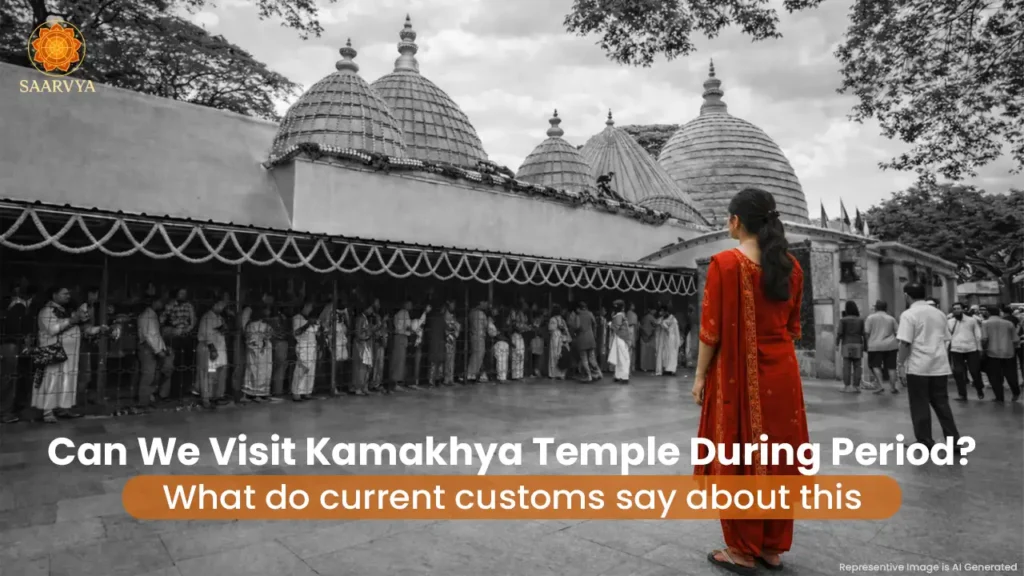

Understanding “can we visit Kamakhya Temple during period” becomes especially meaningful at a shrine where menstruation itself is considered sacred. Kamakhya is the revered Kamakhya Shakti Peeth where Sati’s yoni is worshipped, and the goddess’s annual menstruation is celebrated as Ambubachi Mela. Yet, this raises an intriguing paradox: a temple that sanctifies menstruation traditionally discourages menstruating women from entering certain spaces. This article explores that complexity with sensitivity and depth.
What Do Current Customs Say About Visiting Kamakhya TempleDuring Periods?
At a sacred site as ancient and symbolically rich as Kamakhya Devi temple, customs are shaped by centuries of lived tradition, oral memory, and Tantric philosophy. When visitors seek clarity on “can we visit Kamakhya Temple during period?“, they encounter guidance that is not rooted in judgment or stigma, but in traditional understandings of ritual balance, personal energy, and the sanctity of the inner sanctum. These customs are followed out of respect, not exclusion.
On Ordinary Days – Local Practice and Notices
Across travel accounts, priestly guidance, and local notices inside the temple premises, one finds a consistent message:
Menstruating women are traditionally discouraged from entering the inner sanctum (the garbhagriha).
Key points to understand:
- This is a customary religious practice, not a government-enforced rule or civil law.
- Notices at or near the temple often request women to avoid entering the sanctum during their periods.
- Guides and local devotees commonly advise the same, based on long-standing tradition.
- The intention is not to stigmatize women, but to align with ritual norms observed at many ancient temples.
In Shakta and Tantric settings, the inner sanctum is viewed as an extremely powerful energetic space. Traditional belief holds that both the devotee and the environment must be in a particular energetic alignment before approaching it. The rationale is rooted in spiritual logic, not social prejudice.
It is also important to emphasize that outside the sanctum on the hilltop, in outer courtyards, and surrounding open spaces, women are free to sit, meditate, or pray if they wish. Restrictions, when followed, apply specifically to the core pitha, the most sacred point of the temple.
During Ambubachi Mela – When the Goddess Herself Menstruates
Ambubachi Mela is the most spiritually significant festival at Kamakhya and a key part of the Kamakhya temple menstruation tradition. During this time:
- The temple remains completely closed for 3 – 4 days.
- This closure applies to everyone: men, women, children, locals, and pilgrims.
- The closure marks the goddess’s annual menstruation, a deeply revered moment in Shakta worship.
During these days, devotees across Assam and neighboring regions also observe symbolic seclusion at home:
- No cooking of certain foods
- No performing of household pujas
- No reading of scriptures
- No farming or earth-turning activities
These observances mirror traditional menstrual rest, reflecting the belief that the earth, like the goddess, is renewing herself.
After the days of seclusion, the temple reopens with great celebration. Prasadam in the form of blessed red cloth associated with the yoni-spring is distributed. Devotees see this as a moment of profound renewal, an embodiment of the fertility and creative power that Kamakhya represents as a fertility temple in India.
Thus, whether in personal cycles or during the goddess’s own, the customs surrounding menstruation at Kamakhya are shaped by reverence, symbolism, and spiritual alignment, not exclusion.
Why Are Menstruating Women Traditionally Restricted?
For many seekers, it feels contradictory that a temple celebrating the goddess’s own menstruation would discourage women from entering during theirs. But within the spiritual, symbolic, and Tantric worldview of Kamakhya Devi Shakti Peeth, this practice emerges from layers of metaphysical logic rather than stigma or impurity. The guiding principles are rooted in respect for the devotee, for the goddess, and for the energetic balance of the sacred space.
Ritual Purity, Energy, and Tantric Explanations
Traditionally, menstruation is seen as a time when a woman’s energy turns inward. Her body is in a natural state of rest, renewal, and heightened sensitivity. In Tantric vocabulary, this inward-flowing energy is often described as:
- Apana vayu – a downward-directed energy
- A phase of internal cleansing and release
- A time of heightened but inward-oriented Shakti
At the same time, the inner sanctum of the Kamakhya temple, especially the garbhagriha housing the yoni-pitha, is believed to radiate strong upward and outward energies, drawing the devotee into active worship, attention, and offering.
According to Tantric interpretation, followed by some practitioners at Kamakhya:
- When a woman is menstruating, she is considered a living embodiment of Shakti.
- Her inner energy is powerful but directed inward, toward physical and emotional grounding.
- Entering a high-energy temple core may create an energetic dissonance, not harmful but misaligned.
Some priests express it symbolically:
“During periods, a woman becomes the goddess herself. One who is in the state of the Devi does not need to come before the Devi.”
This explanation emphasizes respect rather than restriction. It does not treat menstruation as impure, rather, as so potent that it warrants its own sanctity.
This is why women are often asked, with humility and honour, to wait until after their cycle before approaching the innermost pitha. It reflects a worldview where menstruation is acknowledged as:
- Sacred
- Powerful
- Energetically distinct
Social Taboos vs. Kamakhya’s Unique View of Menstruation
It is important to distinguish Kamakhya’s customs from broader societal taboos prevalent in many parts of India.
Across society, menstruation has often been mislabeled as “impure,” leading to exclusion and restrictions that lack spiritual reasoning. But Kamakhya’s tradition stands apart from these notions. Here:
- The goddess herself menstruates during Ambubachi.
- Menstruation is celebrated publicly with festivals, offerings, and devotional gatherings.
- Cloth believed to carry the blessing of the goddess’s cycle is treated as powerful prasadam.
Kamakhya’s perspective challenges stigma, not reinforces it.
However, despite this empowering symbolism, the temple still observes specific rituals regarding menstrual entry, not because menstruation is unclean, but because:
- The inner sanctum is a highly charged ritual space.
- Menstruation is considered a time of introspection, not outward ritual engagement.
- Traditional Tantric practices place emphasis on energetic harmony between devotee and deity.
This creates a unique duality:
- Society may stigmatize menstruation as impure.
- Kamakhya elevates it as divine.
- Yet, certain ritual protocols request menstruating women to refrain from entering deeply sacred zones.
Thus, the tradition is not rooted in inequality, but in the complex intersection of:
- Symbolism
- Ritual metaphysics
- Tantric cosmology
- Respect for the natural cycles of the body
In essence, at Kamakhya, menstruation is not a reason for exclusion—it is a reason for reverence.
Experiences and Opinions – What Devotees and Writers Say
Beyond philosophy and tradition, a very real part of answering can we visit Kamakhya Temple during periods comes from listening to people who have actually gone there—devotees, local guides, and travellers. Their accounts show how these customs are lived on the ground: sometimes with unquestioned acceptance, sometimes with quiet negotiation, and sometimes with open questioning, especially among younger visitors.
Travel Bloggers and Devotees’ Accounts
Many travel writers who document the Kamakhya Devi temple share similar observations:
- Women are often advised by guides or priests not to enter the inner sanctum if they are on their period.
- Some mention signboards or verbal instructions that politely state this expectation.
- A few note that this guidance is usually given gently, without interrogation or humiliation.
These bloggers often frame their advice practically:
- If you want the full inner darshan experience at Kamakhya Shakti Peeth, it is easier to plan your visit for a time when you are not menstruating.
- The queues can be long, the climb is reasonably steep, and the hilltop can be crowded and warm, conditions that might feel physically demanding during heavy bleeding.
Some women write that, on trips where their dates coincided with a visit:
- They chose to stay in the outer courtyard, offer prayers from a distance, and explore the surroundings of Shaktipeeth in Assam.
- They still spoke of feeling deeply connected to Kamakhya Devi, even without entering the garbhagriha.
- A few described a sense of peace in simply being present on Nilachal Hill, feeling that the goddess understands their intention more than their exact physical location.
These lived experiences help paint a nuanced picture:
- The custom exists and is actively followed by many.
- Enforcement is often based on self-disclosure and personal honesty rather than strict checking.
- Visitors who observe the tradition generally do so out of respect, not fear.
Debates in Online Communities
In online spaces, discussion forums, Q&A sites, and social platforms, questions like “can we visit Kamakhya Temple during periods?” come up frequently. The responses are quite diverse:
- Some participants strongly support following traditional rules exactly as they have been passed down, seeing them as part of the temple’s spiritual fabric.
- Others, especially younger devotees, question whether these customs should evolve in light of changing views on menstruation, equality, and the goddess’s inclusive nature.
- A few voices argue that since Kamakhya is a fertility temple in India that openly honours menstruation, women should not be restricted at all.
It is important to remember:
- These are personal opinions, not official decrees of Kamakhya temple authorities.
- They reflect a genuine desire among devotees to honour both tradition and dignity.
- The diversity of thought shows that Kamakhya continues to be a living spiritual space, not a static museum piece.
What remains consistent in most respectful discussions is this:
Whatever one’s personal stance, people agree that Kamakhya Devi and her temple deserve a posture of humility, not confrontation. Even those who wish for more inclusive practices often suggest engaging through dialogue, inner reflection, and gradual change rather than conflict at the gates of a sacred site.
Practical Guidance for Women Planning a Visit
Given all of this, how can a woman practically decide whether and when to visit Kamakhya Temple during periods? There is no single rule that fits everyone, because belief, comfort, and body awareness differ from person to person. The aim of this section is not to instruct, but to offer gentle, balanced guidance.
Checking Temple Guidelines and Local Advice
If you are planning a trip and are unsure how your dates may line up, a few simple steps can help:
- Check current guidelines:
Before your visit, try to look up recent instructions from temple boards, official websites, or reliable local travel operators for the Kamakhya Devi temple. - Ask on arrival, respectfully:
You can discreetly speak to a local priest, guide, or information counter. They usually share the customary stance on Kamakhya temple periods in a straightforward, non-judgemental way. - Plan inner darshan accordingly:
If you wish to follow local norms fully, consider planning your garbhagriha darshan for days when you are not on your period. You can always visit the hill, outer courtyards, and other nearby shrines of Kamakhya Devi Shakti Peeth before or after.
Remember that in traditional understanding, following these customs is seen as part of receiving the benefits of visiting Kamakhya Temple not in a transactional way, but in the sense of aligning yourself with the rhythm and etiquette of a place that has been revered for centuries.
Respecting Tradition While Honouring One’s Own Body
Beyond external rules, it’s essential to listen to your own body and conscience:
- Physical comfort:
Visiting the Kamakhya temple can involve long waits, heat, monsoon humidity, and steep steps. If your flow is heavy or you are in pain, pushing yourself may not be kind to your body, regardless of rules. - Personal belief:
Some women feel completely comfortable entering temples during their periods; others prefer not to. Your inner alignment matters. If you personally feel that menstruation is sacred and does not prevent you from connecting with the goddess, that belief is also a form of devotion. - Respect for a living tradition:
Even if your personal view allows entry, being mindful of local customs is a way of respecting the Kamakhya temple as a living space of faith for millions. Avoid confrontations at the gate or with priests; such moments help neither the devotee nor the sanctity of the place.
A balanced approach can be:
- Honour your body.
- Honour your personal spiritual understanding.
- Honour the tradition of Kamakhya Shakti Peeth by keeping your choices humble, considerate, and kind both to yourself and to others.
In the end, devotion is not measured only by how close you stand to the Kamakhya temple idol or pitha, but by the sincerity with which you remember the goddess, whether at the hilltop, at its base, or from your own home.
Frequently Asked Questions
1. Can women on their periods enter Kamakhya Temple?
Traditional practice at Kamakhya Devi temple discourages menstruating women, especially from entering the inner sanctum where the yoni-pitha is located. Many local guides and notices communicate this expectation. Some women still visit the hill and outer areas, but those who wish to fully follow custom generally avoid inner darshan during their cycle.
2. Is there any official written ban?
Publicly available information and visitor accounts describe this as a customary religious restriction, not a civil law. Women usually encounter it through signboards, priestly advice, or guide instructions, rather than through any government regulation.
3. Why does a temple that celebrates menstruation restrict menstruating women?
In Tantric and ritual explanations, a menstruating woman is seen as highly charged and inwardly focused, embodying Shakti in a very direct way. The tradition holds that during this time, she symbolically “is” the deity rather than a visitor. The restriction is thus framed as honouring her state and maintaining energetic balance, rather than labelling her impure.
4. What is the best time for women to visit Kamakhya?
For a smoother experience, it is best to:
● Avoid the Ambubachi Mela closure days, when the temple is completely shut.
● For those choosing to follow custom, plan the main inner darshan for days when they are not menstruating.
● Check yearly festival calendars and local guidance in advance to make the most of the spiritual benefits of visiting Kamakhya Temple.