
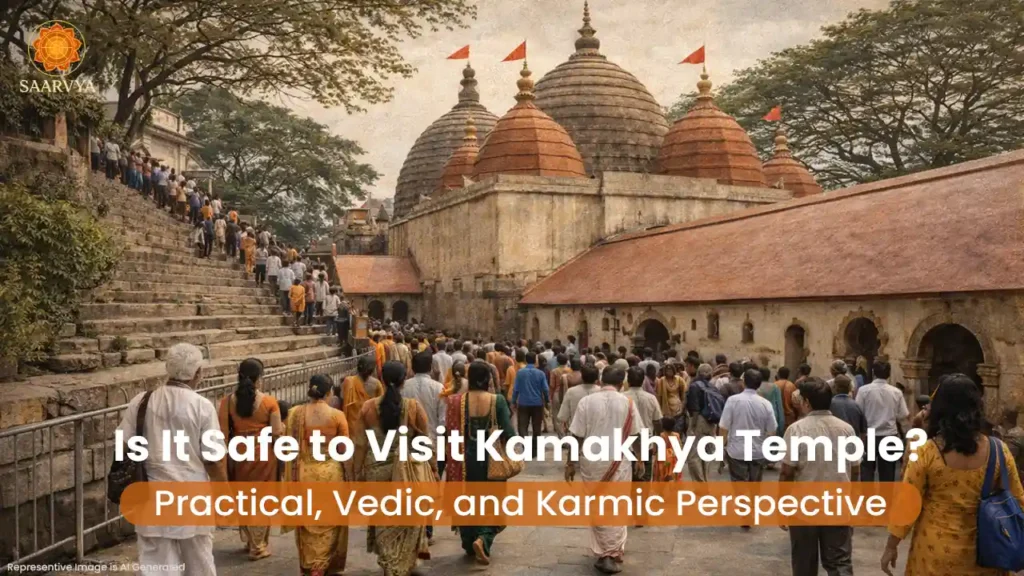

Understanding “is it safe to visit Kamakhya Temple” requires looking at safety on three interconnected levels: physical wellbeing, emotional readiness, and spiritual alignment. A Kamakhya Temple visit involves navigating crowds, steep steps, and intense devotional spaces, but also inner fears shaped by myths around Tantra. Importantly, Kamakhya Devalaya officially rejects sensational claims of black magic, affirming that only authorised, orthodox Tantric worship occurs inside Kamakhya Temple.
Physical Safety – Crowd, Terrain, and Logistics
Pilgrims often ask whether is it safe to visit Kamakhya Temple from a purely physical standpoint. The temple is a Shakti Peeth with lakhs of annual visitors, and while it is generally safe, the hill terrain, crowds, and cave-like sanctum introduce certain challenges.
Understanding these helps devotees plan a smoother, calmer, and more meaningful Kamakhya Temple visit.
Crowds, Queues, and Basic Precautions
Crowd behaviour plays a major role in temple safety. The queue system at Kamakhya changes dynamically depending on season, festival, and time of day. During peak periods like:
- Weekends and public holidays
- Navaratri
- Ambubachi Mela (the busiest period of the year)
- Special puja days, full-moon days, and sankranti
The line for Kamakhya Devi darshan can stretch for hours, moving through narrow corridors and tight curves. In such situations:
- Pushing and compression may occur, especially at bottleneck points near the main entrance.
- Elderly visitors or children may feel overwhelmed.
- Heat, dehydration, and fatigue can silently build up.
To stay physically comfortable and safe:
- Arrive early, ideally before 7 AM, to avoid large crowds.
- Wear non-slip footwear, as the stone floors can become slippery with water, oil, and offerings.
- Keep your hands free while descending into the inner cave; avoid carrying large bags or loose items.
- Stay hydrated, especially in summer and during Ambubachi.
- Politely refuse any touts offering “shortcuts,” “VIP access,” or unofficial rituals. These can lead to unsafe crowd situations and are discouraged by temple authorities.
Crowds at Kamakhya are rarely disorderly, but they can be physically intense. Understanding this prepares you to navigate them calmly without stress.
Hill, Steps, and Health Considerations
The temple is situated atop Nilachal Hill, and the final approach, whether by walking or by vehicle, still involves:
- Steep climbs
- Uneven stone steps
- Sudden turns
- High humidity during the monsoon
- Sun exposure during summer
Entering the garbhagriha (inner sanctum) requires descending a dark, narrow passage with:
- Low ceilings
- Wet floors
- Minimal lighting
- A small worship area where devotees must bend or crouch
For most people, this is perfectly manageable, but certain visitors may need to take precautions:
- Elderly devotees should move slowly, take breaks, and consider using vehicle access as far uphill as possible.
- Pregnant women may find the heat and tight spaces uncomfortable.
- People with knee, hip, or joint issues should avoid rushing, as the steps can be steep and slippery.
- Heart or respiratory patients should consult a doctor before attempting the descent inside the cave, especially during peak crowd seasons.
If needed, you can have a peaceful darshan from the outer areas instead of entering deep inside the Kamakhya Temple. The goddess does not measure devotion by physical proximity alone.
Moreover, temple volunteers and security personnel are generally helpful and quick to assist anyone showing signs of distress.
Emotional and Psychological Safety – Myths vs. Reality
For many people, the real anxiety around is it safe to visit Kamakhya Temple is not about the stairs or the crowds, but about the stories they’ve heard whispers of black magic, aghoris, “dangerous energies,” or human sacrifice. If someone arrives with these fears, even a normal Kamakhya Temple visit can feel overwhelming.
Grounding yourself in facts (and your own intention) makes a huge difference.
Official Clarification on “Black Magic” and Aghoris
The first thing to know is this: Kamakhya Devalaya itself has formally addressed these fears.
From the temple’s own visitor guidelines:
- No Tantrik or Aghori lives at Kamakhya or belongs to the official shebait (priest) families.
- The initiated members of the shebait families are called “Sadhaka”, not “Tantrik” in the sensational sense.
- Black magic, harmful kriya, or negative prayoga are not practiced by the domiciled priests in any form.
In other words:
The official line of the temple is very clear – it is a centre of orthodox Shakta–Tantric worship, not a playground for “black magic tourism.”
Even in recent high-profile criminal cases where the media loosely used the term “human sacrifice,” the temple authorities have publicly refuted those claims and emphasised that no such rituals exist in Kamakhya’s sanctioned worship.
There are many private websites and self-styled “tantriks” online who market black-magic-related pujas “at Kamakhya” or “through Kamakhya.” The Devalaya has issued public notices warning that such online platforms are not authorised by them and that devotees should only rely on official websites and channels.
So, at an institutional level:
- The temple disowns black magic claims.
- It defines its priests as sadhakas bound to traditional Tantra Marga, focused on devout puja, not harm.
- It actively warns against unauthorised middlemen and exploiters.
Spiritually speaking, that’s a strong indicator that it is safe to visit Kamakhya Temple when you stay within the official ecosystem of the Devalaya.
Handling Fear, Overwhelm, and “Heavy Energy”
Still, some sensitive visitors do report feeling:
- “Heavy” or emotional
- Drained or overwhelmed
- Uneasy around intense crowds or certain rituals
Most of the time, this is less about anything “dangerous” and more about:
- Heat, humidity, and exhaustion on the hill
- Crowd stress from long queues and pushing
- Subconscious fear built up from sensational videos, articles, or stories watched before the trip
- The natural emotional intensity of a powerful Shakti Peeth
A few simple practices can help you stay emotionally safe and grounded:
- Breathe and centre yourself
- Before entering the Kamakhya Temple, take a minute to slow your breath.
- Inhale gently, exhale slowly, and mentally offer your anxiety to the goddess.
- Use your own mantra or prayer
- Silently repeat a simple mantra—“Om Aim Hreem Kleem Chamundayai Vicche,” “Om Namah Shivaya,” or any personal prayer you trust.
- This anchors your mind and keeps you connected to your own spiritual path.
- Stay in sattvic company
- Avoid joining groups who are there for “tantric thrill,” ghost stories, or dark tourism content.
- Instead, stay close to families, regular devotees, and temple volunteers.
- Know when to step back
- If at any point the crowd, heat, or closeness inside Kamakhya Temple feels too much, step aside, sit quietly in the courtyard, drink some water, and compose yourself.
- The goddess is not only in the cave; she is present on the entire hill.
- Avoid “tantric tourism” mindset
- Going just to “test” the energy, hunt for “aghori visuals,” or chase YouTube content can amplify fear and ego.
- Go instead with a simple, honest sankalpa: “I am here for blessings, clarity, and inner peace.”
When you combine factual understanding (what the temple itself says) with a calm, respectful inner attitude, emotional safety naturally increases. The Kamakhya temple’s specialty is intense Shakti, not hidden malice. How you receive that Shakti depends a lot on your inner state.
Vedic and Astrological Considerations
For many devotees, safety is not limited to the physical or emotional realm. They also wonder whether is it safe to visit Kamakhya Temple from a spiritual timing perspective—whether their karma, graha-dasha, or inner state supports the journey. Kamakhya is one of the most powerful Shakti Peethas, and many traditional practitioners believe that visiting during a balanced mental and energetic period brings deeper blessings and smoother experiences.
This section provides guidance without fear only clarity, tradition, and spiritual practicality.
When Is It Auspicious to Visit?
Unlike certain temples that mandate strict muhurta-based entry, Kamakhya Temple does not require horoscopic permissions for darshan. Lakhs visit every year without consulting a jyotishi. That said, for those who follow Vedic timing, the following periods are traditionally considered auspicious:
1. Shukla Paksha (Waxing Moon)
The waxing fortnight is associated with:
- Growth
- Blessings
- Expansive energy
- Harmonious Shakti
Visiting during the Shukla Paksha is believed to enhance receptivity to Kamakhya Devi’s grace.
2. Fridays, Mondays, and Navaratri
- Fridays align with Devi’s energy (Shukra).
- Mondays harmonise Shiva–Shakti energy.
- Navaratri, especially the Ashwin Navaratri, is spiritually charged for Shakta worship.
These days often intensify the feeling of connection, though crowds may be heavier.
3. Supportive Personal Dashas
For those who follow astrology deeply, certain periods may feel more supportive:
- Moon dasha/antardasha → emotional clarity, devotion
- Venus (Shukra) periods → harmony, bhakti, pilgrimage
- Lagna lord periods → stability and self-alignment
These are not mandatory, but can make the inner experience calmer and more receptive.
4. Personal Shakti-related tithis
Chaturthi, Panchami, Ashtami, Navami, and Purnima are commonly chosen by devotees seeking blessings for:
- Marriage
- Fertility
- Mental peace
- Spiritual upliftment
If your sankalpa is devotional and dharmic, every day becomes a suitable day—but choosing auspicious timings can add an extra layer of spiritual alignment.
When to Postpone a Visit
This is an important but often misunderstood part of the question “is it safe to visit Kamakhya Temple” from a spiritual perspective. Postponement is never about fear; it’s about readiness. The goddess is compassion itself.
But certain states of mind or life circumstances may make the experience overwhelming rather than uplifting.
1. Severe Mental Disturbance or Emotional Instability
Many Vedic teachers advise postponing pilgrimage during periods of:
- Intense depression
- Sudden anxiety spikes
- Emotional breakdowns
- Confusion or despair
A Shakti Peeth amplifies the inner state. If your mind is unsettled, the emotional intensity may feel heavier.
2. Major Sade-Sati or Challenging Transits
Again not a rule, just advice used by traditional practitioners. During phases where:
- Saturn heavily afflicts the Moon
- Rahu–Moon periods intensify illusions or fears
- Debilitated Moon transits drain emotional clarity
it may be wiser to stabilise the mind first, then approach a powerful Devi shrine.
3. After Major Bereavement
Most lineages advise a temporary pause in temple visits during the initial period of mourning. This is not about impurity it’s about giving the mind space to grieve and heal before entering a spiritually charged environment.
4. When Physical Health is Too Weak
If your body is fragile due to:
- Recent surgery
- Severe illness
- Mobility challenges
- Chronic exhaustion
The physical strain of crowds and steps may overshadow the spiritual experience.
5. When Travelling Itself Is Risky
In classical Jyotish, certain transit combinations signify:
- Accident-prone periods
- Extreme fatigue
- Travel anxiety
If you are already aware of such a period from your astrologer, postponing by a few weeks can bring more peace.
Kamakhya Devi does not deny blessings to anyone based on their horoscope. These guidelines simply help devotees approach the temple when they are in a stable, open-hearted state so they can receive the goddess’s energy with calmness.
Karmic and Dharmic Safety – Intention Matters
Beyond crowds, steps, and dates, a deeper layer of “is it safe to visit Kamakhya Temple” lies in why you are going. At a Shakti Peeth like Kamakhya Devalaya, your inner intention (sankalpa) colours your experience more than any external factor. A sincere heart aligns naturally with the Devi; a restless or ego-driven mind can create its own turbulence.
Right Sankalpa vs. Curiosity and Power-Seeking – Is It Safe to Visit Kamakhya Temple with Any Intention?
Karmically, visiting any powerful Shakti Peeth is not the same as visiting a tourist spot. When people come to Kamakhya with certain motivations, they subtly shape the kind of energy they absorb.
Less harmonious intentions might include:
- Coming only out of morbid curiosity about “Tantra, aghoris, and black magic.”
- Wanting “powers” to control others, win manipulative relationships, or dominate situations.
- Trying to “test” the goddess “Let’s see if anything happens if I do this.”
- Treating the temple as a backdrop for edgy content rather than as a living deity’s home.
From a dharmic perspective, such intentions don’t make the place “unsafe”—they make the inner experience unstable. When you approach a Shakti Peeth with a mindset of control, thrill-seeking, or disrespect, you are more likely to:
- Feel unsettled or disturbed by the intensity of the atmosphere.
- Misinterpret natural emotional reactions as “something negative happened.”
- Strengthen your own karmic patterns of fear, ego, or obsession.
In contrast, a dharmic sankalpa aligns beautifully with Kamakhya’s nature as Mahamaya and Kameshvari:
- Seeking clarity, spiritual growth, and inner purity.
- Praying for healing, balanced relationships, and guidance, not control.
- Offering your fears, addictions, or confusions at the feet of the Devi.
- Simply coming to say, “Thank you,” for life, health, or protection.
When you visit in this spirit, the question “is it safe to visit Kamakhya Temple?” becomes almost irrelevant. Spiritually, you are stepping into alignment with Shakti’s grace rather than wrestling with it. The temple is not a threat; it becomes a mirror, a refuge, and a teacher.
Aligning Conduct with Dharma – How to Visit Kamakhya Temple the Right Way
Even the best intention needs to be supported by dharmic behaviour. How you conduct yourself during your Kamakhya Temple visit has its own karmic impact. A few simple principles keep your visit clean, dignified, and spiritually “safe”:
1. Ahimsa and Respect
- Avoid any form of cruelty or anger toward animals, fellow devotees, priests, or staff.
- Speak softly; queues are long, but shouting and quarrelling disturb everyone’s bhava.
- Remember that this is a living home of Kamakhya Devi, not a sightseeing monument.
2. Modest Clothing and Sobriety
- Dress in a way that is clean, modest, and respectful—you are entering a powerful Devi’s presence.
- Avoid intoxication (alcohol, drugs) before or during darshan. A foggy mind and Shakti Peeth energy don’t mix well.
3. Photography with Sensitivity
- Do not photograph inside the Kamakhya Temple, where it is prohibited or intrusive.
- Avoid taking close-ups of strangers during puja without consent.
- Focus less on capturing proof for social media and more on absorbing the moment.
4. Stay Away from Unauthorised Ritualists
- Some individuals around any famous temple may claim special “secret pujas,” shortcuts, or “powerful black magic rituals.”
- The Devalaya clearly states that only authorised shebait priests should perform puja on behalf of devotees.
- Engaging with random “tantriks” for harm-doing or manipulation is not only karmically heavy it is spiritually misaligned with the true Kamakhya temple speciality, which is transformation, not exploitation.
5. Honour Sacred Symbols
- Items like Kamakhya Devi’s red cloth (received during Ambubachi or special puja) should be treated as sacred: kept clean, placed respectfully, and not misused for superstition or manipulation.
- Use them as reminders of the Devi’s presence and protection, not as tools of fear.
When you combine:
- A sincere sankalpa
- Respectful conduct
- Awareness of physical limits
- And a humble heart
Your journey to Kamakhya Temple becomes karmically uplifting. You are not merely “safe,” you are supported.
Frequently Asked Questions
1. Is Kamakhya Temple physically safe to visit?
Yes. Lakhs of pilgrims visit the Kamakhya Temple every year without issues. With normal hill-temple precautions watching your footing, wearing non-slip footwear, avoiding peak crowds, and following security instructions the physical environment is safe. The temple is well-managed, and volunteers are present to guide devotees during rush hours. Those who need assistance (elderly, pregnant women, people with mobility concerns) can take slower routes or avoid entering deep inside the Kamakhya Temple.
2. Is there any spiritual or “tantric” risk in going to Kamakhya?
No. The temple authority has officially clarified that black magic, harmful rituals, or aghori practices are not permitted within the Devalaya. Worship is performed only by authorised, traditional sadhaka priests. Experiences of fear often arise from crowds, exhaustion, or external myths not from the goddess herself. When you follow dharmic conduct and maintain a sincere intention, a Kamakhya Temple visit is spiritually safe.
3. Should I check my horoscope before visiting?
It is not compulsory. Many devotees visit without consulting astrology. However, those who follow Vedic timing may choose supportive periods Shukla Paksha, Fridays, Navaratri, or stable personal dashas, such asa benefic Moon or Venus, to enhance emotional ease. If someone is going through severe emotional instability, grief, or a medically sensitive period, postponing may offer a more centred experience.
4. What are the Kamakhya Mandir timings?
Typical daily timings (subject to festival variations) are:
Morning: Around 5:30 – 6:00 AM (Mangala Aarti and opening)
Daytime: Continuous darshan with puja breaks
Afternoon break: Usually a short period where doors close
Evening closing: Around 10 PM
Timings can shift during Navaratri, Ambubachi Mela, lunar tithis, or major pujas. Checking updated Kamakhya Mandir timings from official sources before travel is recommended.
5. How to visit Kamakhya Temple without problems?
Plan your visit during early morning hours, avoid peak festival crowds unless you’re mentally prepared, carry water, and travel light. Respect local customs, follow queue discipline, and ignore unauthorised touts. For darshan-related rituals, approach only the recognised shebait priests. If visiting during summer, be mindful of heat and rest when needed.
6. Are children and elderly people safe at the temple?
Yes, but they require extra care. The steps and inner cave space can be slippery, dimly lit, and crowded. Elderly devotees should take vehicle access as far uphill as possible, and avoid long queues. Children must remain supervised at all times, especially near steep sections and the descent into the sanctum.
7. Is it safe for solo women travellers to visit Kamakhya?
Absolutely. Kamakhya sees many solo women pilgrims, especially in the mornings. Basic precautions avoiding secluded paths late at night, declining unsolicited ritual offers, and staying near families or groups, are enough. The temple area is generally busy and well-monitored.
8. Is Kamakhya associated with fertility blessings?
Yes. Kamakhya is revered as a fertility temple in India, symbolising creative Shakti. Many devotees come seeking blessings for marriage, conception, or emotional renewal. Items like Kamakhya Devi’s red cloth, especially during the Ambubachi Mela, are treated as auspicious tokens representing the goddess’s nurturing power.
9. Is photography allowed inside the temple?
Photography is strictly prohibited inside Kamakhya Temple, especially near the yoni-pitha. Visitors may take pictures in outer courtyards and scenic viewpoints, but never in the inner sanctum. Respecting this rule is a matter of spiritual etiquette and security.
10. How can I make my visit karmically positive?
Enter with humility. Follow dharmic behaviour no harm, no intoxication, no disrespectful photos, and no engagement with unauthorised “tantriks.” Offer simple prayers, help other devotees when possible, avoid littering, and keep your mind steady. Sincerely offering your fears, desires, or confusion to the goddess creates a spiritually uplifting experience.