
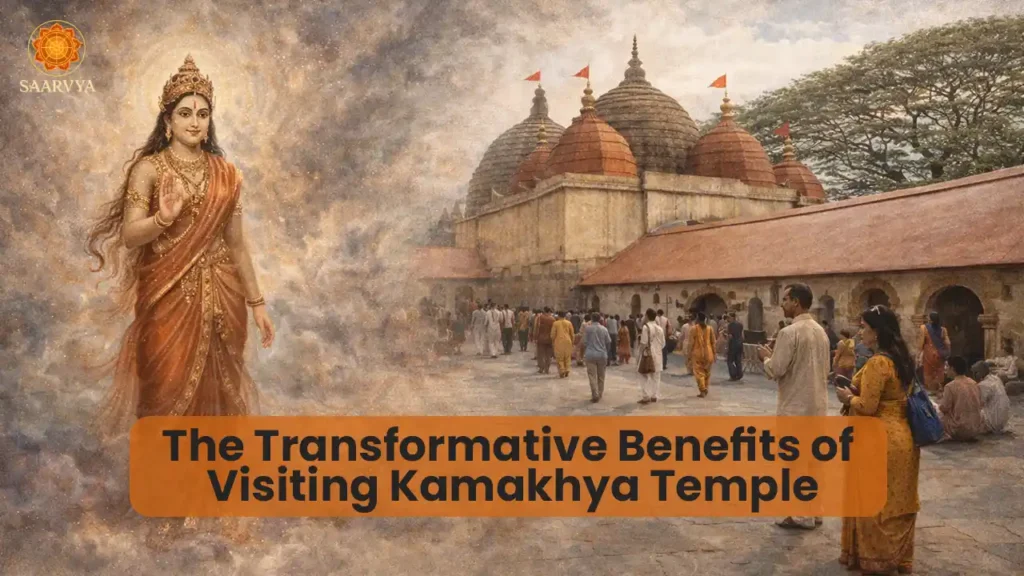

Understanding the deeper benefits of visiting Kamakhya Temple begins with recognising its identity as a sacred Guwahati Shakti Peeth, where Sati’s yoni is eternally worshipped as the source of creation. Pilgrims come here seeking not just darshan, but punya (merit), Shakti-siddhi (empowerment), and sukha–samriddhi (wellbeing and prosperity). The significance of Kamakhya Temple lies in blending profound spiritual energy with the living traditions of Tantra and Shaktism.
Spiritual Benefits of Visiting Kamakhya
The spiritual benefits of visiting Kamakhya Temple are often described by devotees not only in terms of blessings received but in how the pilgrimage changes their inner state. Kamakhya is not merely a temple it is a yoni-pitha, the living seat of creation, where the divine feminine is experienced in her most primordial and formless expression. This alone sets the shrine apart from typical pilgrimage destinations and explains why Kamakhya Temple is famous across India and beyond.
Deepening Connection with Shakti
Stepping into the garbhagriha of Kamakhya Mata Temple, one immediately senses why the site is considered a unique yoni puja temple. Here, the goddess is not represented through an idol but through a natural rock fissure constantly bathed by an underground spring—symbolising Sati’s yoni, the cosmic womb.
Devotees often describe the moment of darshan as:
- A surge of presence the kind that quiets the mind instantly
- A grounding calmness felt in the chest and spine
- An inward pull, as if being drawn closer to the source of one’s own consciousness
This atmosphere amplifies spiritual practices like:
- Mantra-japa, especially Devi mantras and Kamakhya beej mantra, benefits
- Meditation, where thoughts slow down naturally
- Surrender, as the ego relaxes before the womb of creation
Many pilgrims say that during the aarti, the vibrations inside the cave feel ancient—almost as though one is standing in a place where the boundary between material and subtle realms becomes thin.
This is the first and most profound Kamakhya Temple significance: an unfiltered experience of Shakti.
Inner Transformation and Removal of Obstacles
Another major spiritual benefit attributed to Kamakhya is antarik parivartan, inner transformation. Traditional Shakta texts describe the goddess as Mahamaya, the power who dissolves illusions and cleanses deep-seated karmic impressions.
Devotees often seek Kamakhya’s grace for:
- Removing negativity or stagnation in thought and emotion
- Overcoming internal fear, anxiety, or self-doubt
- Breaking long-standing obstacles in spiritual or life pursuits
- Awakening dormant spiritual potential
Authorised priests at Kamakhya perform certain Tantric upasanas—not the sensationalised versions, but orthodox rituals rooted in scripture. These rituals are believed to:
- Purify the subtle body
- Strengthen willpower
- Enhance clarity and direction
- Support the awakening of inner Shakti in a safe, guided way
In this sense, a genuine Kamakhya Temple visit acts as a catalyst—helping a devotee shed old patterns and move toward spiritual growth. Many yogis, tantrikas, and seekers visit repeatedly to deepen this inner refinement.
This makes up the second key spiritual benefit: Kamakhya clears the path for the devotee who arrives with sincerity.
Emotional and Relationship Benefits
The emotional benefits of visiting Kamakhya Temple are often just as significant as the spiritual ones. Kamakhya is not only a Guwahati Shakti Peeth, but she is also Hridaya-Roopini, the One who resides in the human heart. Many devotees say that the moment they step onto Nilachal Hill, they feel as if an unseen weight begins to loosen within them. This is because Kamakhya’s energy is not merely cosmic; it is deeply personal.
Healing of Heart, Mind, and Relationships
Kamakhya’s identity as Kameshvari, the goddess of love, desire, and emotional truth, makes her especially powerful in matters of the heart. Devotees often approach her seeking healing for:
- unresolved emotional pain
- long-standing family tensions
- marital disharmony
- confusion in love
- heartbreak and grief
Inside the cave, before the living yoni-pitha, many pilgrims report:
- A sudden release of suppressed emotions
- Tearfulness that feels purifying, not painful
- A quiet inner realisation about what truly matters
- A sense of forgiveness for oneself or others
This is because standing before the yoni, the primordial symbol of birth, renewal, and surrender, naturally softens the heart. It becomes easier to let go of ego, anger, and resentment.
Couples often visit together, seeking:
- Greater harmony
- Rekindling of affection
- Strengthening of trust
- Healing of misunderstandings
In cultural memory, Kamakhya has long been a goddess who blesses loving bonds not in the superficial sense of romance, but in the deeper sense of soulful partnership.
This emotional transformation is one of the profound Kamakhya Temple’s special aspects: healing occurs not only through rituals, but through the inner shifts that Devi initiates within the devotee.
Support in Fertility and Woman-Centred Intentions
Kamakhya is unique among all Shakti Peethas because she is explicitly associated with fertility, menstruation, and womanhood. Her annual festival, Ambubachi Mela, marks the goddess’s menstruation, symbolising renewal, fertility, and the sacredness of the female cycle.
For this reason, many women and couples visit seeking blessings for:
- conception
- healthy pregnancy
- balanced menstrual cycles
- healing of reproductive issues
- inner confidence and acceptance of womanhood
The temple’s sacred prasads, especially the Ambubachi cloth, flowers, and sindoor, are carried home with deep reverence. Many families believe that these items bring positivity to the womb and emotional security to the mother.
Among these, Kamakhya sindoor benefits are particularly cherished. Devotees view the sindoor as a manifestation of Devi’s generative energy, symbolising protection, abundance, and marital wellbeing. It is often kept on home altars or worn sparingly during important rituals.
The emotional reassurance and sense of hope that couples experience after darshan is itself a powerful benefit. For many, Kamakhya becomes a companion in their journey toward parenthood, a divine witness to their longing, courage, and devotion.
This makes Kamakhya not just a yoni puja temple, but a shrine where women feel seen, validated, and spiritually supported.
Material and Life-Path Benefits
While Kamakhya is revered primarily for her spiritual power, the benefits of visiting Kamakhya Temple often extend into the material and worldly dimensions of life. In Shakta philosophy, there is no conflict between seeking moksha (liberation) and artha/kama (worldly wellbeing), as long as the desire is aligned with dharma. Kamakhya, as Kameshvari, blesses both realms’ inner evolution and outer prosperity.
These benefits are not transactional; they arise when devotion, right conduct, and divine timing align.
Prosperity, Career, and Protection
Devotees frequently visit Kamakhya Mata Temple seeking blessings for stability in professional, financial, and social spheres. Traditionally, a sincere puja at Kamakhya is believed to support:
- Career growth, clarity in professional direction
- Success in business or entrepreneurship
- Relief from financial strain or debt cycles
- Victory in legal or bureaucratic disputes
- Overcoming adversaries, jealousy, or drishti
- Protection from unseen negativities
This is because Kamakhya’s energy is both nurturing and protective. As the presiding goddess of the Guwahati Shakti Peeth, she is invoked to remove:
- obstacles in a career
- family-level blockages affecting livelihood
- unseen karmic burdens that slow progress
Many devotees report that after their Kamakhya Temple visit, decisions become clearer, opportunities open unexpectedly, and past stagnation begins to dissolve. Again, this is not magic it is the psychological, karmic, and spiritual convergence that happens when one sincerely surrenders at a powerful Shakti Peeth.
The temple’s sacred objects, particularly Kamakhya sindoor, are revered for protective and abundance-related blessings. When kept respectfully on a home altar, it is believed to bring:
- stability in income
- harmony within the household
- shielding from the harmful intentions of others
- improved aura and confidence
These stories reflect not superstition, but lived experience rooted in centuries of tradition.
Guidance, Fortune-Telling, and Astrology Inputs
Another practical benefit is the sense of direction devotees often find after visiting Kamakhya. Pilgrims frequently combine their darshan with consultations from:
- jyotishis (Vedic astrologers)
- palmists
- intuitive readers
- spiritual counsellors
This is not because the temple mandates it, but because the Kamakhya Temple’s significance naturally attracts seekers undergoing life transitions, those seeking clarity about:
- career paths
- marriage
- fertility
- finances
- relocation
- spiritual progress
However, discernment is crucial.
Visitors should choose ethical, recommended, and grounded practitioners, avoiding:
- fear-based predictions
- exploitative “black magic” touts
- individuals promising impossible or manipulative outcomes
The true purpose of such guidance, when taken from trustworthy sources, is to help devotees interpret their life’s path, align their actions with dharma, and understand how their karmic cycles may unfold.
Many seasoned devotees say that combining:
- darshan of the Devi
- mantra practice
- and ethically grounded Jyotish guidance
creates a harmonious map for navigating the next chapter of life. This integration of spiritual vision with practical decision-making reflects the holistic Kamakhya temple specialty, a temple that empowers every dimension of a devotee’s life, not just the mystical or ritualistic.
Experiential and Cultural Benefits
Kamakhya is not only a shrine where devotees receive blessings, but it is also a living cultural universe. The benefits of visiting Kamakhya Temple unfold not only in prayer or ritual but also through immersion in an ancient landscape shaped by Tantra, folklore, architecture, nature, and centuries of devotional memory. When you approach Kamakhya not as a tourist spot but as a sacred ecosystem, the experience becomes deeper, smoother, and more transformative.
The moment one begins the ascent to Nilachal Hill, there is a shift in atmosphere: the air grows quieter despite the crowds, the road curves inward toward the heart of the hill, and the mind instinctively begins to soften into contemplation. This physical approach is itself part of the pilgrimage the hill prepares the devotee. And at the top, the temple’s distinctive architecture carries its own teachings. The dome, neither purely North Indian nor South Indian, expresses the perfectly blended Kamakhya Temple significance: an ancient Devi tradition reshaped through multiple dynasties, yet preserving its Tantric core.
Visitors often notice that Kamakhya does not rely on grandeur. Instead, it radiates something subtler and more intense born from centuries of uninterrupted worship. The scent of incense, the red hibiscus flowers, the rhythmic chanting, the small stone shrines scattered across the hill, the sound of bells echoing through the chambers all of this creates a layered sensory experience. It gently guides the mind inward, helping the devotee settle into a devotional rhythm long before reaching the garbhagriha.
One of the most profound cultural benefits of a Kamakhya Temple visit is exposure to authentic Tantric tradition not the commercialised or misunderstood version that circulates in media, but the disciplined, scripturally rooted practice maintained by the temple’s shebait families. Many visitors arrive with misconceptions about Tantra being synonymous with black magic. Yet, Kamakhya quietly dissolves these ideas. Here, Tantra is revealed as a spiritual science of discipline, surrender, mantra, and internal purification. The priests, the rituals, the fire offerings, and the rhythms of worship all demonstrate how Tantra in its orthodox form is aligned with dharma, not fear. This alone elevates the cultural understanding of thousands who visit the shrine.
During Ambubachi Mela, the temple’s practices expand into a vibrant tapestry of devotion, storytelling, folk tradition, ascetic gatherings, and community rituals. For many travellers, witnessing this festival serves as a profound cultural education. It becomes clear why Kamakhya Temple is famous not merely as a Shakti Peeth but as the heart of Eastern India’s living Tantric heritage. The experience challenges modern discomfort around menstruation and replaces it with reverence, symbolism, and a deep appreciation of womanhood’s sacred cycles.
The natural environment around the temple plays a significant role as well. The views of the Brahmaputra, glimpses of cloud-covered hills, and the lush vegetation create a quiet contemplative mood. Many devotees choose to sit for a few moments on the outer platforms simply to breathe and absorb the place. The climb, though physically demanding for some, often leaves the mind refreshed. The hill, the river, and the sprawling sky show why many consider Kamakhya not just a pilgrimage but an inward journey that uses nature as its guide.
Exploring the smaller shrines surrounding the main temple also enriches the experience. Places like Bhubaneswari, Bagala, Tara, and the sacred ponds each carry their own stories and energies. The walk between them naturally slows down the mind and creates a sense of pilgrimage that is not rushed or compelled. Instead, it feels like participating in a much older rhythm, one followed by countless devotees before you.
Culturally, Kamakhya has a stabilising effect on the mind. Visitors often say that simply being in this landscape changes the way they perceive Tantra, femininity, devotion, and the body. It gently replaces fear with understanding, myths with lived experience, and confusion with a clearer spiritual orientation. These are subtle benefits, but they shape the devotee long after they have returned home.
When all of these layers, architectural, natural, ritualistic, emotional, and philosophical, come together, they create a uniquely wholesome experience. You do not just “visit” Kamakhya; you absorb it. And in that absorption lies one of the greatest, but least discussed, Kamakhya temple specialities: the ability to transform the devotee without forcing anything, simply through presence.
Special Boons and Sacred Objects
One of the subtle yet deeply cherished benefits of visiting Kamakhya Temple lies in the sacred objects and blessings associated with the shrine. These items are not meant to function as shortcuts or magical solutions; rather, they operate as carriers of faith, memory, and energetic imprint. In Shakta tradition, objects touched by the Devi or by the flow of ritual become reminders of her presence long after the pilgrimage has ended. They continue the devotee’s connection with the Kamakhya Mata Temple even from afar.
Among these, Kamakhya sindoor is considered especially potent. Unlike ordinary ritual vermilion, it carries the symbolic resonance of the yoni-pitha the primordial creative force. Many devotees describe that keeping a small amount of this sindoor on their home altar creates a sense of protection and grounding. It is treated with reverence, not used casually. The traditional belief, passed down through families and sadhakas, is that Kamakhya sindoor benefits include:
- Creating a shield against negativity and jealousy
- Supporting harmony in marriage or family relationships
- Strengthening the aura and confidence
- Attracting auspiciousness in the household
These benefits are not meant to be interpreted as superstition, but as reflections of how faith shapes one’s emotional and spiritual environment. When you place something sacred in your home with devotion, it influences how you think, behave, and relate to others.
Another powerful sacred item is the Ambubachi cloth or special prasad distributed after the Ambubachi Mela. Since the temple remains closed during the goddess’s annual menstruation, the reopening period is considered highly charged with Shakti. Receiving the red cloth (or even a small thread from it) is believed to offer protection, emotional strength, and fertility blessings. Some families keep it in their puja room, while others carry a small folded piece in their wallet or tie it discreetly near their main entrance.
The profound significance of these objects lies not in their physical form, but in the stories and intentions attached to them. They become vessels of continuity, reminders of the moment when you bowed your head inside the cave, when your hands touched the cool stone, when the aarti flame illuminated the ancient walls of the yoni puja temple. Through these reminders, the pilgrimage does not end on the hill; it continues in the heart.
This continuity is why many devotees visit Kamakhya again and again. For them, the temple is not a one-time destination but an anchor point in their spiritual life. They treat Kamakhya as their personal kshetra the space where they feel most aligned with their ishta-devata. Repeated visits deepen this relationship, enriching every aspect of their life-path.
Over time, many devotees describe subtle long-term improvements: clearer intuition, better emotional stability, more harmonious relationships, and an increased ability to navigate challenges with courage. They attribute these gradual shifts not merely to external rituals but to the inner transformation sparked by consistent connection with the Devi. The Kamakhya beej mantra benefits, when practiced regularly at home after receiving darshan, amplify these effects. Chanting the mantra aligns the devotee’s mind with Kamakhya’s energy, helping them maintain clarity, devotion, and strength.
Ultimately, the sacred objects offered at Kamakhya are not charms they are reminders of a relationship. They help devotees remember who they are when they stand before the goddess: open, humbled, courageous, and truthful. And that remembering becomes its own lifelong blessing.
Conclusion
When devotees speak about the benefits of visiting Kamakhya Temple, they rarely limit their words to any single blessing. Instead, they describe a journey that touches every layer of life spiritual, emotional, relational, material, and karmic. Kamakhya is not a goddess who grants only external boons; she reshapes the devotee from within. Her shrine on Nilachal Hill is not just a destination, but a mirror that shows the seeker who they truly are and who they can become.
People come seeking clarity, healing, conception, prosperity, direction, protection, or inner peace and what they often receive is far deeper: a renewed sense of themselves. The cave-like garbhagriha, the living yoni-pitha, the chants, the hibiscus flowers, the flame of the aarti, the scent of camphor, the breathtaking view of the Brahmaputra all these elements work together like steps in an unseen ritual. Even those who enter with hesitation or misconceptions about Tantra leave with a softer heart and a clearer mind.
Kamakhya’s energy is ancient yet intimate. She does not overwhelm; she invites. She does not demand perfection; she calls for sincerity. Whether one comes with emotional wounds, unfulfilled desires, spiritual longing, or simply gratitude, the Devi accepts it all. And in that acceptance lies one of the greatest gifts of this Guwahati Shakti Peeth: the quiet realisation that the goddess is not distant but deeply present within you.
The pilgrimage does not end when you leave the hill. Sacred objects like sindoor or Ambubachi cloth become reminders of the Devi’s presence, and daily chanting of her mantras keeps the connection alive. Over time, these small acts of remembrance turn into a long-term relationship a thread of devotion woven through life’s ups and downs.
In this way, the true significance of Kamakhya Temple reveals itself slowly, over months or years: life begins to move with greater harmony, intuition strengthens, relationships soften, burdens lighten, and courage grows. Nothing dramatic may happen externally, yet internally everything shifts. The Devi blesses not through spectacle but through subtle transformation.
Ultimately, the greatest benefit of visiting Kamakhya is not what she gives, but what she awakens the awareness that Shakti is not outside you, but the essence of your being. And once a devotee realises this, they understand why Kamakhya calls people back again and again: not because she withholds anything, but because she keeps revealing more.
Frequently Asked Questions
1. What are the main benefits of visiting Kamakhya Temple?
Devotees experience spiritual grounding, emotional healing, clarity of mind, and removal of inner obstacles. Many also report improvements in relationships, fertility-related intentions, and life-path decisions. The temple’s energy helps align the devotee with Shakti, leading to inner strength and external harmony.
2. Why is Kamakhya Temple famous among Shakta devotees?
Kamakhya is revered as a Guwahati Shakti Peeth, where Sati’s yoni is worshipped as the cosmic source of creation. This unique identity, combined with its ancient Tantric traditions and powerful ambience inside the garbhagriha, makes it spiritually significant across India.
3. What is the spiritual significance of Kamakhya Temple?
The significance of Kamakhya Temple comes from its role as a yoni-pitha a rare place where Shakti is worshipped in her formless, generative state. Devotees often feel profound presence, stillness, and inner transformation after visiting.
4. Does Kamakhya help in removing obstacles or negativity?
Yes, traditional belief holds that sincere worship and proper puja performed by authorised priests help dissolve inner blocks, reduce subtle negativity, and strengthen the devotee’s mind. Kamakhya is considered Mahamaya the remover of illusion.
5. Are there emotional or relationship benefits of a Kamakhya Temple visit?
Many pilgrims seek healing of the heart, improvement in marital or family harmony, and rekindling of emotional balance. As Kameshvari, Kamakhya supports love, mutual understanding, and deeper connection between partners.
6. Is Kamakhya associated with fertility blessings?
Yes, the temple is strongly linked with fertility, womanhood, and menstrual wellbeing. Women and couples visit seeking blessings for conception, a healthy reproductive cycle, or emotional readiness for parenthood. Ambubachi prasad and sacred cloth are often kept at home with reverence.
7. What are the Kamakhya sindoor benefits?
Kamakhya sindoor is believed to protect the household from negativity, strengthen relationships, attract abundance, and support emotional stability. Its power comes from faith and the sanctity of the yoni-pitha, not from superstition.
8. Are there benefits of chanting Kamakhya mantras at home?
Yes. Regular japa, especially of the beej mantra, enhances inner clarity, reduces anxiety, deepens intuition, and strengthens devotion. Many devotees continue mantra practice after returning from the pilgrimage for long-term transformation.
9. Does Kamakhya offer guidance on life-path decisions?
Many visitors feel a renewed sense of direction after darshan. Some also consult ethical and reputed jyotishis near the temple. When combined with inner clarity received during the pilgrimage, this guidance helps in career, relationships, and major life choices.
10. Are there any cultural or experiential benefits of visiting Kamakhya?
Absolutely. Kamakhya exposes devotees to living Tantra not the sensationalised version, but its disciplined, dharmic form. The architecture, festivals, sacred ponds, and views of the Brahmaputra create a contemplative atmosphere that enriches both mind and spirit.