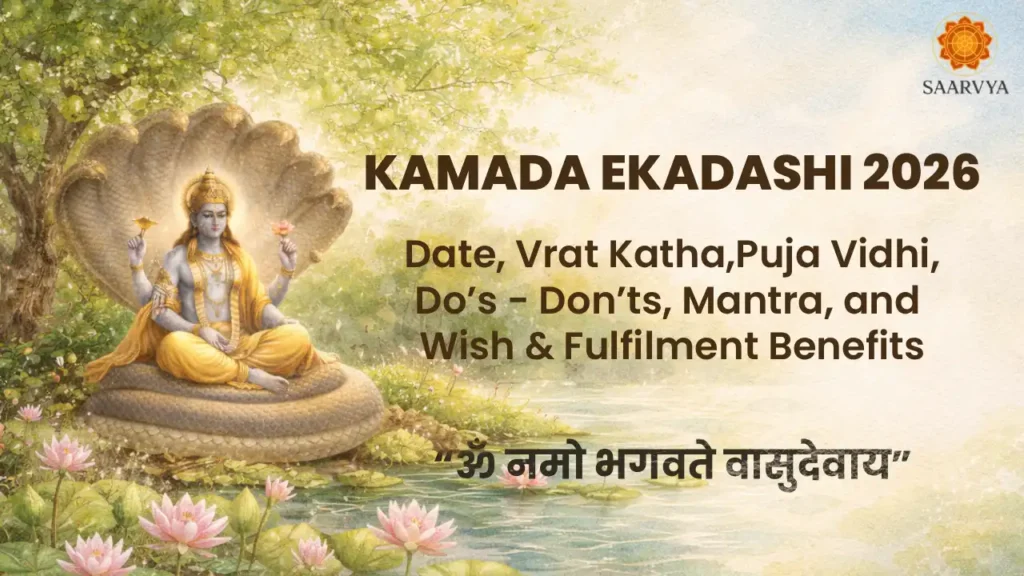

Kamada Ekadashi is observed on Chaitra Shukla Ekadashi, making it the first Ekadashi of the Hindu lunar year. Spiritually, this placement is not incidental. Chaitra marks renewal—new beginnings after the karmic closure of Papmochani Ekadashi and the cleansing intensity of Navratri. Kamada Ekadashi, therefore, functions as a constructive Ekadashi, not merely one of purification but of rebuilding destiny.
The word “Kamada” literally means “that which fulfills desires.” However, scriptures are careful to qualify this: Kamada Ekadashi fulfills righteous, dharmic desires, not impulsive or harmful cravings. This distinction is central to its theology. The Ekadashi does not bypass karma; instead, it untangles karmic knots sins, curses, past negligence that block rightful outcomes such as marriage, progeny, stability, reputation, health, and spiritual clarity.
Texts such as the Varaha Purana and narrations shared by Sri Krishna to Yudhishthira describe Kamada Ekadashi as uniquely capable of:
- destroying sins accumulated over multiple births
- removing pishacha or cursed states caused by negligence, distraction, or moral lapses
- restoring lost dignity, relationships, and direction in life
Because this Ekadashi inaugurates the yearly cycle, devotees traditionally use it to set sankalpas for the entire year, making it especially relevant for people standing at crossroads emotionally, professionally, or spiritually.
Kamada Ekadashi 2026 will be observed on Sunday, 29 March 2026 (Chaitra Shukla Ekadashi). On this day, devotees observe a grain-free fast, worship Lord Vishnu with ritual purity, listen to the Kamada Ekadashi Vrat Katha, and break the fast during Dwadashi Parana on 30 March 2026. This Ekadashi is traditionally believed to remove sins, curses and pishacha dosha, while fulfilling righteous wishes related to marriage, family, career, health and spiritual progress.
Kamada Ekadashi 2026 Date, Tithi & Parana Timing
Kamada Ekadashi in 2026 falls during Chaitra Shukla Paksha, the waxing phase of the Moon that symbolizes growth, restoration, and forward movement.
- Ekadashi Tithi begins: Saturday, 28 March 2026 at 08:45 AM (IST)
- Ekadashi Tithi ends: Sunday, 29 March 2026 at 07:46 AM (IST)
- Vrat (fast) observed on: Sunday, 29 March 2026
Since the Ekadashi tithi spans sunrise on 29 March, the fast is correctly observed on Sunday, following standard Udaya Tithi principles.
Dwadashi Parana (Fast-Breaking)
- Parana date: Monday, 30 March 2026
- Example Parana window (New Delhi): 06:14 AM – 07:09 AM (as per Pawan Kaushik Panchang)
Some panchangs mention slightly broader windows extending beyond this. The safest and scripturally consistent rule is:
- break the fast after sunrise
- after Hari Vasara ends
- within Dwadashi tithi
Because Parana timings vary by city due to sunrise differences, devotees are advised to check their local panchang for precise windows.
Quick View – Kamada Ekadashi 2026
| Detail | Information |
|---|---|
| Ekadashi Name | Kamada Ekadashi |
| Month & Paksha | Chaitra Month, Shukla Paksha |
| Vrat Date (Fast) | Sunday, 29 March 2026 |
| Ekadashi Tithi Begins | 28 March 2026 at 08:45 AM (IST) |
| Ekadashi Tithi Ends | 29 March 2026 at 07:46 AM (IST) |
| Parana Date | Monday, 30 March 2026 |
| Parana Time (Delhi Example) | 06:14 AM – 07:09 AM |
| Presiding Deity | Lord Vishnu (Krishna / Narayan form) |
| Core Focus | Wish-fulfillment, removal of sins & curses, liberation from pishacha dosha, new karmic beginnings |
Note: Parana timings vary by location. Always confirm sunrise-based Parana window using your local panchang and ensure Hari Vasara has ended before breaking the fast.
What is Kamada Ekadashi?
Kamada Ekadashi derives its name from the Sanskrit word “Kāma”, meaning desire or wish, and “Da”, meaning the one that grants. Together, Kamada Ekadashi is described in the scriptures as the Ekadashi that fulfills righteous desires while simultaneously destroying deep-rooted sins and curses.
What makes Kamada Ekadashi especially significant is its timing. It falls on Chaitra Shukla Ekadashi, which is the first Ekadashi after Chaitra Navratri and the beginning of the Hindu lunar new year cycle. Spiritually, this positions Kamada Ekadashi as a karmic reset point—a moment where old impressions are meant to be consciously released before new intentions are planted.
Unlike Ekadashis that focus mainly on austerity or renunciation, Kamada Ekadashi uniquely balances purification with fulfillment. It does not reject worldly life; instead, it purifies desires so they align with dharma. Scriptures repeatedly emphasize that wishes asked on Kamada Ekadashi bear fruit only when they are righteous, non-harmful, and rooted in responsibility.
Why Kamada Ekadashi Is Considered Exceptionally Powerful
Traditional texts describe Kamada Ekadashi as capable of destroying sins accumulated across multiple births, including those severe enough to result in pishacha or cursed states of existence. This is why Kamada Ekadashi is often recommended not only for personal wish-fulfillment, but also for:
- Family members suffering repeated failures without clear cause
- Obstacles in marriage, childbirth, or stability
- Lingering guilt, fear, or karmic heaviness
- Situations believed to be influenced by curses (shraap) or inauspicious karmas
The emphasis is not on fear, but on release. Kamada Ekadashi functions as a spiritual corrective an opportunity to realign intention, conduct, and devotion.
Kamada Ekadashi and the Concept of “New Karmic Beginnings”
Because this Ekadashi appears at the start of the Chaitra cycle, many traditions regard it as the ideal day for new sankalpas related to:
- Marriage and family harmony
- Career transitions or examinations
- Health recovery and longevity
- Breaking destructive habits or addictions
- Long-pending life decisions
The vrata teaches that desire itself is not the problem unconscious desire is. Through fasting, restraint, worship, and reflection, Kamada Ekadashi trains the devotee to purify desire before asking for its fulfillment.
This is why the scriptures consistently link Kamada Ekadashi with both liberation (moksha) and success (siddhi), a rare combination among religious observances.
Kamada Ekadashi Vrat Katha
The Story of Gandharva Lalit and His Devoted Wife Lalita
The Kamada Ekadashi Vrat Katha is narrated by Bhagwan Krishna to Yudhishthira in the Padma Purana. Among all Ekadashi stories, this katha is considered one of the most emotionally layered and karmically instructive, because it deals not only with sin, but with love, neglect, curse, loyalty, repentance, and ultimate liberation.
The Setting: Ratnapura and King Pundarika
In ancient times, there existed a magnificent celestial city named Ratnapura, ruled by the righteous and disciplined King Pundarika. The city was inhabited by Gandharvas, Kinnaras, and Apsaras, beings gifted in music, art, and refined culture. Daily worship of Vishnu, adherence to dharma, and strict moral conduct were expected in the king’s court.
Among the Gandharvas, one singer stood above all others Lalit. His voice was melodious, technically flawless, and spiritually uplifting. Lalit was not only admired for his talent, but also for his good conduct and devotion. His wife Lalita was equally virtuous chaste, loving, and completely devoted to her husband.
The Moment of Negligence and the Curse
One day, during a grand assembly in King Pundarika’s court, Lalit was invited to sing before the king and the gathered celestials. Music in such a court was not mere entertainment—it was a sacred duty, performed with full awareness and reverence.
As Lalit began singing, his mind wandered. Instead of remaining fully present in his service, his thoughts drifted toward his wife Lalita her beauty, her affection, and domestic pleasures. This momentary lapse of attention, born not of malice but attachment, caused Lalit to miss a beat and falter in rhythm.
In ordinary circumstances, such a mistake might be forgiven. But in a dharmic royal court where duty performed without mindfulness is considered adharma, the error carried weight. Enraged by what he perceived as disrespect and negligence, King Pundarika pronounced a terrible curse:
“Because you allowed attachment to overpower duty, you shall fall from your Gandharva form and become a rakshasa, wandering the forests in hunger, fear, and suffering.”
Instantly, Lalit lost his celestial body and transformed into a terrifying rakshasa, cast out into dense forests far from Ratnapura.
Lalita’s Loyalty and Shared Suffering
When Lalita learned of her husband’s fate, she did not abandon him. Though frightened by his monstrous form, she recognized his soul and followed him into exile. In the forest, Lalit suffered immensely driven by hunger, fear, and shame while Lalita endured hardship silently, serving him with unwavering devotion.
This period is crucial in the katha. Lalita never once blamed Lalit, nor cursed fate. Her suffering was not passive it was purposeful, rooted in loyalty and hope. The scriptures emphasize that her tapasya began not in a forest or temple, but in steadfast love during suffering.
Seeking a Remedy: The Sage’s Guidance
After years of wandering, Lalita encountered the great sage Shringi (in some versions, Vashishta). Overcome with grief, she narrated her husband’s story and begged for a path to his liberation.
The sage, moved by her sincerity, replied:
“There exists one vrata powerful enough to destroy even rakshasa-yoni karma and the sins that cause it. That vrata is Kamada Ekadashi, observed on Chaitra Shukla Ekadashi.”
He instructed Lalita to:
- Observe a strict Ekadashi fast, avoiding grains
- Worship Lord Vishnu with full purity
- Remain truthful, celibate, and disciplined
- And most importantly, offer the entire punya of the vrata for her husband’s liberation, not for herself
The Vrata and the Miracle of Liberation
Lalita observed Kamada Ekadashi with absolute sincerity. She fasted, worshipped Vishnu, stayed awake in remembrance, and broke the fast properly on Dwadashi. At the time of Parana, she consciously dedicated the fruit of the vrata to Lalit.
Immediately, a divine transformation occurred.
Lalit’s rakshasa body dissolved. His original Gandharva form radiant, graceful, and luminous reappeared. Freed from the curse, both husband and wife were lifted into higher realms, blessed by Vishnu’s grace.
Bhagwan Krishna concludes the katha by telling Yudhishthira:
“O King, Kamada Ekadashi destroys even the gravest sins, removes curses, frees beings from ghostly and demonic yonis, and fulfills all righteous desires of those who observe it with devotion.”
Spiritual Interpretation of the Katha (Why This Story Matters)
This katha is not merely mythological it is deeply psychological and karmic:
- Lalit’s fall shows how even minor negligence in one’s duty, when driven by attachment, can create disproportionate karmic consequences.
- Lalita’s role reveals that sincere devotion and selfless intention can redeem not only oneself, but others tied to us karmically.
- Kamada Ekadashi emerges as a vrata where one person’s disciplined bhakti can neutralize another’s accumulated karma.
At its core, the story teaches that:
When desire is purified through discipline and devotion, it no longer binds it liberates.
Puja Vidhi for Kamada Ekadashi 2026
The Puja Vidhi of Kamada Ekadashi is not merely a sequence of ritual acts; it is a structured inner process designed to purify intention (kāma), align action with dharma, and consciously redirect karmic momentum at the very beginning of the Hindu lunar year. Each step before, during, and after Ekadashi has a specific purpose and logic.
Dashami Preparation (Saturday, 28 March 2026) – Setting the Inner Ground
The vrata of Kamada Ekadashi begins one day earlier, on Dashami. This is often ignored, but scriptures emphasize that Ekadashi fruit depends heavily on Dashami conduct.
On Dashami evening:
- Consume one simple, sattvic meal before sunset. The purpose is not austerity, but lightness digestive, mental, and emotional.
- Strictly avoid meat, alcohol, onion, garlic, intoxicants, and excessive spices from this point onward. These are considered tamasic and disturb mental clarity.
- Reduce unnecessary social interactions, arguments, and digital overstimulation. Kamada Ekadashi is about intentional desire, not scattered wanting.
- Mentally clarify one to three righteous wishes (marriage resolution, health recovery, career stability, release from family obstacles, spiritual progress). Vague intentions weaken the vrata.
Dashami is about decluttering the mind, so Ekadashi can work as a focused karmic instrument.
Ekadashi Morning (Sunday, 29 March 2026) – Snan, Shuddhi & Sankalpa
Morning Snan (Purification Bath)
Wake before sunrise. Bathe with clean water; if available, add a few drops of Ganga jal. The bath symbolises shedding past impressions before entering a new karmic cycle.
Wear clean yellow or white clothes, colours associated with Vishnu, sattva, and renewal.
Clean the puja space thoroughly. Place the image or idol of Lord Vishnu / Krishna / Narayana facing East or North. Light itself should fall gently on the altar—harsh lighting is avoided in traditional homes.
Sankalpa (The Heart of Kamada Ekadashi)
The sankalpa is the most critical step of Kamada Ekadashi. This vrata is specifically wish-oriented, but wishes must be aligned with dharma.
Sit calmly, hold water in the right palm, and internally state:
- Your name, gotra (if known), place
- Date: Chaitra Shukla Kamada Ekadashi, 29 March 2026
- Intention:
- Removal of sins and karmic obstacles
- Release from curses, pishacha-type disturbances, repeated failures
- Fulfilment of specific righteous desires
- Growth in devotion, clarity, and restraint
The sankalpa should be quiet, sincere, and emotionally grounded, not dramatic or desperate. Kamada Ekadashi responds to steadiness, not agitation.
Main Puja to Lord Vishnu – Anchoring Desire in Devotion
After sankalpa:
- Light a ghee diya (preferred) or oil lamp.
- Offer incense and perform brief achamana.
- Begin with Vishnu dhyana visualising Vishnu as calm, sustaining, and protective.
Offerings
Offer panchopachara or shodashopachara, depending on capacity:
- Flowers (preferably yellow or white)
- Akshata (uncooked rice offered symbolically, not consumed)
- Tulsi leaves (collected earlier; never plucked on Ekadashi)
- Fruits and vrat-friendly naivedya (no grains)
The act of offering symbolises surrendering personal desire to divine order—the core philosophy of Kamada Ekadashi.
Path, Japa & Katha
- Chant “Om Namo Bhagavate Vasudevaya” at least 108 times.
- If inclined, recite Vishnu Sahasranama or selected Bhagavad Gita verses.
- Read or listen to the full Kamada Ekadashi Vrat Katha (Lalit–Lalita story).
This is essential scriptures repeatedly state that hearing the katha activates the vrata’s fruit.
End with aarti and silent prayer, mentally offering the vrata’s merit toward wish-fulfilment and karmic release.
Day-Long Upavas & Inner Discipline
Fasting on Kamada Ekadashi is not about physical denial alone; it is about reducing karmic noise.
Acceptable fasting styles:
- Nirjala – only for healthy, experienced devotees
- Phalahar – fruits, water, milk, nuts
- Vrat-compliant meal without grains, pulses, onion or garlic (for medical reasons)
Throughout the day:
- Avoid anger, gossip, arguments, sexual activity, and indulgent entertainment.
- Spend time in japa, bhajan, scripture reading, or quiet reflection.
- Many traditions discourage daytime sleep—not as punishment, but to keep awareness active.
The inner instruction of Kamada Ekadashi is simple: Do not let desire become restlessness. Let it become prayer.
Dwadashi Parana (Monday, 30 March 2026) – Sealing the Vrata
Parana is not merely “breaking the fast”; it is closing the karmic ritual correctly.
- Wake early and perform a short Vishnu puja.
- Parana window (Delhi example): 06:14 – 07:09 AM Always break the fast after sunrise, after Hari Vasara ends, and within Dwadashi.
- Perform daan first food, clothes, or money before eating.
- Break the fast with simple, sattvic food, at home, without overeating.
Improper Parana is said to weaken the fruit of the vrata, regardless of how strict the fast was.
Why This Vidhi Works (Underlying Logic)
The Kamada Ekadashi Puja Vidhi works on three levels simultaneously:
- Physical – fasting resets consumption patterns
- Psychological – sankalpa + restraint restructure desire
- Karmic – Vishnu-bhakti dissolves past impressions blocking outcomes
This is why Kamada Ekadashi is repeatedly described as:
“Sarva-kāma-pradāyikā” — the Ekadashi that fulfills all righteous desires.
Food Rules on Kamada Ekadashi
What to Eat, What to Avoid and Why It Matters
On Kamada Ekadashi, food is not treated merely as nutrition; it is understood as a carrier of guna (quality) and karma (impression). The dietary discipline of this day exists to support the deeper purpose of the vrata: purifying desire, removing karmic blocks, and aligning personal will with Vishnu-tattva.
This is why the food rules are strict, but also deeply symbolic and psychologically intelligent, not arbitrary.
Why Grains Are Avoided on Kamada Ekadashi
All Ekadashis, including Kamada Ekadashi, strictly prohibit grains (rice, wheat, barley, pulses). Scripturally, grains are believed to absorb subtle impurities on Ekadashi tithi; symbolically and practically, they represent heaviness, inertia, and worldly anchoring.
From a spiritual standpoint:
- Grains strengthen tamas and rajas when digestion is slowed by fasting.
- Kamada Ekadashi is about wish-clarification, not indulgence; heavy foods intensify restlessness.
From a physiological lens:
- Avoiding grains gives the digestive system a full break.
- Light intake stabilizes blood sugar and reduces craving-driven decisions.
Thus, grain-avoidance is not punishment it is strategic restraint.
What Is Allowed on Kamada Ekadashi (and Why)
Fruits, Nuts & Natural Foods
Fresh fruits, coconut, dry fruits, and makhana are allowed because they are:
- Easily digestible
- Non-stimulating
- Associated with sattva (clarity and calm)
They support fasting without triggering lethargy or agitation.
Vrat Flours (When Needed)
Flours like kuttu, singhara, rajgira, sabudana, samak rice are permitted because they are:
- Not classified as true grains in dharmic texts
- Traditionally used to sustain health during vrata without breaking its spirit
These should still be eaten in moderation, not as indulgent feasts.
Dairy (In Balance)
Milk, curd, ghee, and paneer are allowed, but excess is discouraged. Dairy nourishes and grounds, but overuse can dull alertness counterproductive for Ekadashi focus.
What Must Be Avoided (Beyond Grains)
Onion & Garlic
On Kamada Ekadashi, onion and garlic are avoided because they:
- Intensify passion, agitation, and sensory craving
- Pull the mind outward when the vrata aims inward
Even people not fasting are advised to avoid them on this day.
Non-Vegetarian Food & Intoxicants
Meat, eggs, alcohol, tobacco, and stimulants are completely forbidden. Kamada Ekadashi is about reversing karmic weight, not adding new impressions of violence or loss of awareness.
Processed & Packaged “Vrat” Foods
Modern packaged vrat foods often contain additives, grain contamination, or excessive sugar. Traditional practice values simplicity over substitution.
The Deeper Rule: Intention Over Quantity
Scriptures repeatedly state that Kamada Ekadashi loses potency if fasting becomes indulgent.
Eating:
- Multiple “fasting meals”
- Fried vrat snacks in excess
- Constant grazing throughout the day
…defeats the vrata’s purpose, even if technically grain-free.
The guiding principle is:
Eat only to sustain the body, not to entertain the senses.
Food on Dwadashi (Parana Day)
On Dwadashi, food discipline continues briefly:
- Break the fast only within the Parana window
- Eat one simple sattvic meal
- Traditionally avoid honey and urad dal
- Avoid eating in others’ homes and avoid luxury foods
This gradual return prevents digestive shock and symbolically seals the vrata.
Health Disclaimer (Important but Often Ignored)
Kamada Ekadashi does not demand physical harm:
- Pregnant women, elderly people, diabetics, and the ill may keep mild fasts
- Puja, japa, and sankalpa alone still carry merit when fasting is unsafe
Dharma never glorifies self-damage; intentional devotion outweighs physical austerity.
Why These Food Rules Fulfill Wishes
Kamada Ekadashi is about desire purified by restraint. Food restraint trains the mind to:
- Delay gratification
- Clarify intention
- Release compulsive wanting
When desire stops being desperate, it becomes directed—and that is when this Ekadashi is said to “grant wishes.”
Do’s and Don’ts on Kamada Ekadashi
How This Vrata Actually Works at the Karmic Level
On Kamada Ekadashi, the outcome of the vrata is determined less by how much you do and more by how aligned your actions are with its inner purpose. Scriptures describe this Ekadashi as wish-fulfilling not because it bends reality magically, but because it reorders desire, intention, and karma.
This is why the do’s and don’ts are framed as behavioral disciplines, not ritual checklists.
Do’s on Kamada Ekadashi
1. Observe the Fast With Inner Clarity
Fasting on Kamada Ekadashi should be accompanied by a clear sankalpa. This is not a day for vague wishing. Traditionally, devotees are advised to hold one or two righteous desires clearly in mind marriage harmony, removal of obstacles in career, healing of family issues, or progress in spiritual life.
The fast trains the mind to pause impulsive wanting and convert it into focused intention, which is why Kamada Ekadashi is associated with results.
2. Perform Vishnu Puja With Consistency, Not Hurry
Worship of Lord Vishnu on this day should be calm and deliberate. Lighting a diya, offering tulsi, flowers, fruits, and chanting Vishnu mantras are not symbolic gestures alone—they create repetition and steadiness, which stabilizes the mind.
Consistency in worship matters more than length. A simple but attentive puja has greater karmic impact than a rushed elaborate ritual.
3. Read or Listen to the Vrat Katha Fully
The Kamada Ekadashi Vrat Katha is not optional. Scripturally, the Katha is the core transformer of the vrata.
The story of Lalit and Lalita teaches that:
- Even unintended negligence can cause severe karmic consequences
- Selfless devotion and discipline can reverse even cursed states
Listening to the Katha is meant to reframe how the devotee understands failure, guilt, and hope this psychological shift is central to wish-fulfilment.
4. Practice Charity With Intention
Daan on Kamada Ekadashi should be purposeful. Feeding the hungry, helping someone facing obstacles, donating to temples or cow shelters all these acts counteract the very selfish desire patterns that block fulfillment.
In dharmic logic, wishes fulfilled through hoarding collapse, while wishes aligned with generosity sustain.
5. Maintain Mental Restraint
The vrata explicitly emphasizes:
- Truthful speech
- Emotional restraint
- Avoidance of anger, gossip, and unnecessary debate
Why? Because Kamada Ekadashi is about purifying desire, and uncontrolled speech is one of desire’s fastest outlets.
Don’ts on Kamada Ekadashi
1. Do Not Treat the Fast as a Food Hack
Eating excessive vrat snacks, fried foods, or constantly “replacing” meals defeats the vrata’s purpose. Kamada Ekadashi loses potency when fasting becomes indulgence in disguise.
The discipline is about voluntary reduction, not culinary creativity.
2. Avoid Sexual Activity and Sensory Excess
Texts clearly advise brahmacharya on Ekadashi and Dwadashi. This is not moral policing—it is energetic conservation.
Kamada Ekadashi works on redirecting life force away from immediate pleasure toward long-term alignment. Sensory excess fragments this focus.
3. Avoid Dishonest or Adharmic Interaction
Meeting, assisting, or conspiring with people engaged in deception, exploitation, or unethical acts is discouraged on this day.
Some traditional manuals go as far as stating that association itself leaves impressions, which is why conscious social restraint is advised.
4. Do Not Break the Fast Incorrectly
Breaking the fast:
- Before sunrise
- During Hari Vasara
- Or outside Dwadashi tithi
…is considered a serious error. The Parana is not just a meal it is the closure of the sankalpa. Incorrect Parana is said to scatter the vrata’s accumulated merit.
5. Avoid Pride About the Vrata
Publicly boasting about fasting, advertising one’s discipline, or mentally comparing oneself to others weakens the vrata. Kamada Ekadashi responds to humility, not performance.
Why These Rules Exist
Kamada Ekadashi functions like a behavioral reset:
- Fasting regulates impulse
- Silence regulates reaction
- Charity regulates attachment
- Worship regulates direction
Together, they create a state where desire is no longer chaotic, but ordered and in dharmic thought, ordered desire is fulfillable desire.
Benefits of Kamada Ekadashi
How This Vrata Works Spiritually, Karmically, and in Real Life
The benefits of Kamada Ekadashi are traditionally described in strong language wish-fulfillment, curse removal, liberation from ghostly states, and destruction of grave sins. When read superficially, this can sound exaggerated. When read carefully, however, these benefits follow a coherent inner logic rooted in how desire, discipline, and karma interact.
Kamada Ekadashi is not about getting everything you want; it is about wanting rightly, acting cleanly, and releasing what blocks fulfillment.
Spiritual & Karmic Benefits
At its core, Kamada Ekadashi works on desire itself. In Vedic psychology, desire (kāma) is neither good nor bad it becomes destructive only when it is impulsive, obsessive, or divorced from dharma.
This Ekadashi purifies desire by temporarily withdrawing sensory fuel (food, pleasure, distraction) and redirecting attention toward Vishnu, the principle of order and preservation.
Because of this, scriptures say Kamada Ekadashi:
- Destroys sins accumulated through uncontrolled desire, negligence, or repeated ethical compromise
- Neutralizes curses (śrāpa) that arise from disrespect, broken duties, or misuse of power
- Frees the soul from lower or disturbed states of existence (symbolically called pishacha or rakshasa yonis)
These are not random punishments; they represent states of consciousness dominated by craving, fear, or guilt. Kamada Ekadashi interrupts that loop.
Liberation From Curses & Pishacha Dosha
In the Kamada Ekadashi Vrat Katha, Lalit’s fall into rakshasa form happens not because he was evil, but because of loss of awareness during duty. This is crucial.
Kamada Ekadashi addresses:
- Situations where life feels “stuck” despite effort
- Repeated failures with no clear cause
- Family patterns of delay, obstruction, or unexplained fear
Calling these “curses” is symbolic language for entrenched karmic patterns. The vrata works by combining:
- Repentance (acknowledging error)
- Discipline (fasting and restraint)
- Redirection (bhakti and sankalpa)
This triad dissolves the inertia that keeps such patterns alive.
Wish-Fulfilment: What Kind of Wishes Actually Work
Kamada Ekadashi is famous for fulfilling wishes, but texts are precise about which wishes succeed.
Wishes aligned with:
- Marriage harmony and removal of marriage delays
- Child-related blessings and family stability
- Career clarity, exam success, and ethical professional growth
- Health recovery and mental peace
- Spiritual progress and freedom from fear
…are repeatedly praised.
Wishes driven purely by ego, revenge, greed, or harm to others are not supported. The vrata refines desire; it does not empower obsession.
This is why many traditions advise stating the wish once, clearly, during sankalpa, and then letting it go rather than mentally repeating it all day.
Benefits for Family & Lineage
One of the most powerful but less discussed aspects of Kamada Ekadashi is intergenerational impact.
The Lalita–Lalit story shows that:
- One person’s disciplined vrata can liberate another
- Devotion done without selfish motive travels beyond the individual
Because of this, Kamada Ekadashi is often observed:
- For spouses facing difficulties
- For children going through obstacles
- For ancestors believed to be unsettled
The benefit here is not mystical transfer, but restoration of order within the family’s karmic flow.
Practical & Psychological Benefits
On a lived level, Kamada Ekadashi produces noticeable effects because it interrupts modern overload:
- Fasting calms digestion and reduces physiological stress
- Abstaining from stimulants and heavy food stabilizes mood
- Reduced sensory input lowers anxiety and compulsive thinking
More importantly, structured rituals provide closure. Many people carry guilt, unresolved regret, or fear of failure. Kamada Ekadashi creates a sanctioned space for:
- Acknowledging mistakes without self-hatred
- Making a clean internal commitment to change
- Letting go without denial
This is why people often report clarity, relief, or emotional release after observing this vrata sincerely.
Long-Term Benefit: Resetting the Karmic Year
Because Kamada Ekadashi occurs early in Chaitra, it is traditionally seen as a karmic reset point. Observing it properly sets the tone for the coming year.
It encourages:
- Fewer impulsive decisions
- More conscious desires
- Stronger alignment between intention and action
Over time, this reduces self-sabotage the real enemy behind most unfulfilled wishes.
Mantras & Sankalpa for Kamada Ekadashi
How to Use Sound and Intention Without Diluting the Vrata
On Kamada Ekadashi, mantra is not treated as a magical incantation but as a tool to discipline desire and focus consciousness. The scriptures repeatedly emphasize that mantra without bhāva (inner alignment) becomes mechanical, while a simple mantra used with clarity becomes transformative.
This is why fewer mantras are recommended on Ekadashi—depth over quantity.
The Core Mantra of Kamada Ekadashi
Why This Mantra Is Central
“ॐ नमो भगवते वासुदेवाय”
Om Namo Bhagavate Vasudevaya
This is the primary mantra prescribed for Kamada Ekadashi across Vaishnava traditions.
Its inner meaning is crucial:
- Om – alignment with cosmic order
- Namo – surrender of ego-driven desire
- Bhagavate – recognition of divine intelligence
- Vasudevaya – the one who pervades and sustains all beings
This mantra does not ask for a wish. It removes the internal resistance that blocks fulfillment.
How to Chant It Correctly
- Minimum: 108 repetitions
- Ideal: 108 or 1008, depending on capacity
- Time: After morning puja, or spread calmly through the day
- Posture: Seated, spine upright, eyes gently closed or focused on Vishnu’s image
Avoid rushing or multitasking. Even 108 slow, attentive repetitions are superior to thousands done mechanically.
Hare Krishna Mahamantra
“हरे कृष्ण हरे कृष्ण, कृष्ण कृष्ण हरे हरे
हरे राम हरे राम, राम राम हरे हरे”
This mantra is widely encouraged on Ekadashi, especially in Gaudiya traditions.
Why it works on Kamada Ekadashi:
- It dissolves obsessive thought patterns
- It replaces craving with remembrance
- It softens emotional rigidity caused by repeated disappointment
This mantra is particularly helpful for those:
- Struggling with emotional attachment
- Facing repeated relational or career setbacks
- Experiencing fear, guilt, or mental agitation
It can be chanted mentally throughout the day, especially during moments of restlessness.
Sankalpa on Kamada Ekadashi
This Is Where Wishes Are Actually Set
The sankalpa is the most misunderstood and most important part of Kamada Ekadashi.
A correct sankalpa is:
- Clear, specific, and limited
- Rooted in dharma
- Free from desperation or bargaining
When to Take Sankalpa
- After bath, before or during morning puja
- Facing East or North
- Holding a little water in the right hand (or mentally, if unable)
Structure of a Proper Sankalpa
Internally or verbally state:
- Your name, place, and the tithi: “Chaitra Shukla Kamada Ekadashi”
- One or two righteous intentions only
- A concluding surrender to Vishnu’s wisdom
Example (Conceptual, Not Formulaic)
“On Kamada Ekadashi, I observe this vrata to remove obstacles born of past actions and to receive clarity, stability, and success in my rightful duties. May my desires align with dharma and bear fruit only if they lead to welfare and peace.”
Notice:
- No begging
- No excessive listing of wishes
- No fear-based language
This restraint is intentional. Kamada Ekadashi responds to clarity, not emotional overflow.
Offering the Merit (Phala-Samarpana)
One of the most powerful but often skipped practices is offering the merit of the vrata.
Traditionally, devotees are encouraged to:
- Offer the punya for a spouse, child, parent, or ancestor
- Offer it for removal of family obstacles
- Or offer it entirely to Vishnu without expectation
This act neutralizes subtle ego and often strengthens the result, paradoxically increasing the chance of wish-fulfillment.
What Not to Do With Mantras
Avoid:
- Chanting while scrolling, talking, or lying down casually
- Constantly repeating the wish during chanting
- Treating mantra as a transactional demand
Mantra on Kamada Ekadashi is about emptying desire of noise, not amplifying it.
Why This Section Matters
Many people “observe” Kamada Ekadashi but miss its core power because they:
- Overdo rituals
- Underdo intention
- Or turn mantra into negotiation
When mantra, fasting, and sankalpa align, Kamada Ekadashi becomes what scriptures describe a vrata that transforms wanting into fulfillment by first restoring inner order.
Frequently Asked Questions
When is Kamada Ekadashi in 2026 and what is the Parana time?
Kamada Ekadashi will be observed on Sunday, 29 March 2026, during Chaitra Shukla Ekadashi. The fast is broken on Monday, 30 March 2026, during Dwadashi Parana, after sunrise and after Hari Vasara ends.
For New Delhi, one commonly cited Parana window is 06:14 AM – 07:09 AM, but devotees should always verify timings using their local panchang, as sunrise and Dwadashi end times vary by location.
What is the main Kamada Ekadashi Vrat Katha and why is it important?
The central Kamada Ekadashi Vrat Katha narrates the story of Gandharva Lalit and his wife Lalita, where Lalit falls into a cursed rakshasa state due to negligence in duty, and Lalita liberates him by observing Kamada Ekadashi with devotion and offering its merit to him.
The importance of this Katha lies in its message even severe karmic consequences, curses, and pishacha-type states can be dissolved through disciplined fasting, devotion to Vishnu, and selfless intention. Scripturally, listening to or reading the Katha is considered essential to activate the full phala of the vrata.
Can Kamada Ekadashi be observed with fruits or milk instead of nirjala fasting?
Yes. Nirjala fasting is not mandatory. Kamada Ekadashi allows different levels of observance depending on health and capacity:
● Nirjala (no water): only for experienced, healthy devotees
● Phalahar: fruits, milk, water, nuts
● Light vrat food (no grains): for those with medical constraints
Scriptures consistently emphasize bhakti and sankalpa over physical hardship. A sincere, medically safe fast carries full merit.
Which wishes are suitable to ask for on Kamada Ekadashi?
Kamada Ekadashi is traditionally associated with righteous wish-fulfilment, especially related to:
● Marriage delays or marital harmony
● Child-related concerns
● Career obstacles, exams, promotions, and business clarity
● Legal issues and repeated failures
● Health recovery and mental peace
● Release from curses, pishacha dosha, or inherited obstacles
Wishes rooted in harm, greed, or revenge are discouraged. The vrata works best when desires are aligned with dharma and long-term wellbeing.
What should be strictly avoided on Kamada Ekadashi and Dwadashi?
On Kamada Ekadashi (and largely on Dwadashi as well), devotees should avoid:
● Grains, pulses, onion, garlic, meat, eggs, alcohol
● Sexual activity and excessive sensory indulgence
● Lying, gossip, anger, cruelty, or harming any being
● Breaking the fast before proper Parana time
On Dwadashi, many traditional texts further advise avoiding honey, urad dal, oil massage, hair/nail cutting, and eating in others’ homes.
These restraints are meant to preserve the vrata’s karmic continuity, not to impose fear.
Can the merit of Kamada Ekadashi be offered for someone else?
Yes. One of the most powerful aspects of Kamada Ekadashi is phala-samarpana, offering the merit of the fast for:
● A spouse or family member facing difficulties
● Someone suffering from illness, addiction, or repeated misfortune
● Ancestors believed to be unsettled
The Vrat Katha itself demonstrates that one person’s sincere Ekadashi can liberate another, making this practice scripturally validated.
Is Kamada Ekadashi only about wish-fulfilment, or does it also give moksha?
While Kamada Ekadashi is famous for wish-fulfilment, scriptures clearly state that it also:
● Destroys sins of many births
● Frees the soul from lower or disturbed states of existence
● Gradually leads the devotee toward Vaikuntha and liberation, when observed regularly with devotion
Wish-fulfilment is described as a by-product of inner purification, not the final goal.