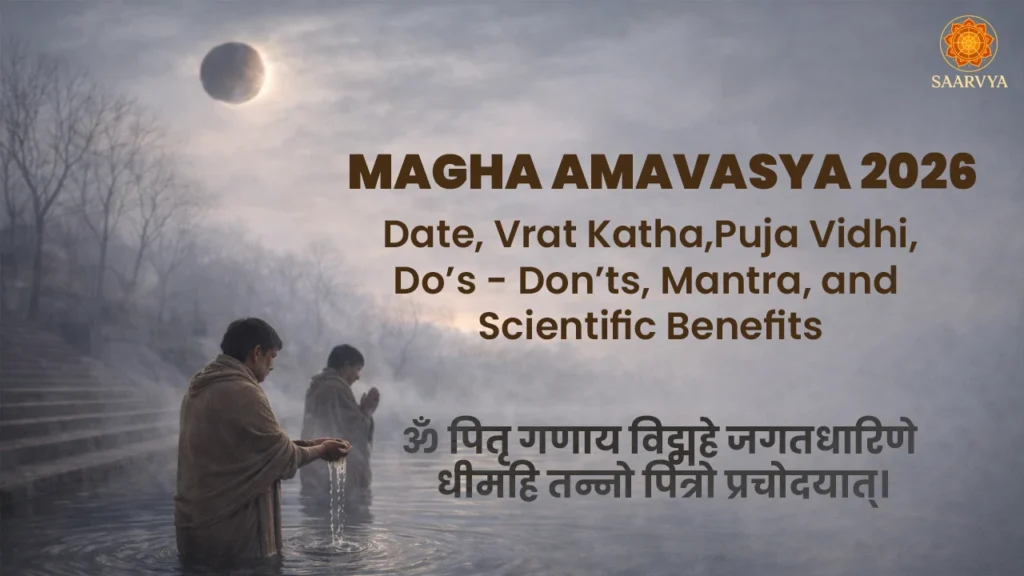

Magha Amavasya 2026 is one of the most spiritually intense Amavasya observances in the Sanatan calendar, marking the beginning of the sacred Magha Snan period and widely known as Mauni Amavasya. Falling in the Magha month, this New Moon is dedicated to silence (maun), self-discipline, ancestral remembrance, and deep inner purification. Scriptural tradition treats this day as a threshold—where restraint of speech and desire becomes a form of tapasya, and simple acts like fasting, silence, and holy bathing are believed to dissolve accumulated karmic weight while preparing the seeker for higher spiritual clarity.
Quick View Table
| Aspect | Details |
|---|---|
| Date (2026) | January 18, 2026 (Sunday) |
| Lunar Month & Paksha | Magha Krishna Paksha |
| Tithi Timing | Begins Jan 18, 12:06 AM · Ends Jan 19, 01:24 AM |
| Puja Muhurat | Brahma Muhurat (pre-sunrise) · Sunrise bath |
| Key Mantra | Om Namo Narayanaya (observed in silence) |
| Main Rituals | Ganga snan, Gupta Daan, Maun Vrat |
| Core Benefits | Paap kshaya, mind discipline, moksha-oriented punya |
This quick-view table reflects the Udaya-tithi principle, which is why Magha Amavasya is observed on January 18, even though the Amavasya tithi extends into the next day. Rituals such as the sunrise bath, maun vrat, and silent daan are considered most effective when performed during the early hours, especially before the day’s sensory activity begins.
Exact Date & Muhurat (New Delhi / Tripura)
For devotees observing Magha Amavasya 2026, accuracy of date and muhurat is especially important because this Amavasya is closely tied to maun vrat, holy bathing, and ancestral rites that depend on udaya tithi (tithi prevailing at sunrise).
According to standard Drik Panchang calculations, Magha Amavasya will be observed on Sunday, January 18, 2026. The Amavasya tithi begins at 12:06 AM on January 18 and ends at 01:24 AM on January 19. Since the tithi is present at sunrise on January 18, that day is considered valid for all primary observances, including Ganga snan, maun vrat, tarpan, and gupta daan. The fast and silence are traditionally concluded after sunrise on January 19, following proper parana.
The most auspicious period for Magha Amavasya practices is the Brahma Muhurat, the pre-dawn window when mental activity is naturally subdued and external distractions are minimal. Bathing in a sacred river at sunrise is regarded as the core act of the day, especially during the Magha month. For those unable to access the Ganga, ritual bathing in local rivers or water bodies—such as the Gomati in Tripura is considered acceptable when accompanied by sincere intent and remembrance.
For lineage-based rituals like tarpan, some traditions also permit performance during Nishita Kaal (midnight), which symbolically represents the threshold between darkness and light. This timing is particularly observed by households with strong Pitru traditions. Additionally, Abhijit Muhurat, around midday, is often chosen for gupta daan charity performed quietly and without disclosure aligning with the inward nature of Mauni Amavasya.
To place Magha Amavasya in its annual context:
| Nearby Amavasya | Date | Notes |
|---|---|---|
| Paush Amavasya | December 8, 2025 | Previous Amavasya |
| Magha Amavasya | January 18, 2026 | Mauni Amavasya |
| Phalguna Amavasya | February 17, 2026 | Next Amavasya |
This precise timing framework helps devotees plan their observance with clarity, ensuring that Magha Amavasya is approached not as a routine ritual day, but as a carefully aligned spiritual discipline.
Mythological Story (Vrat Katha)
The Vrat Katha of Magha Amavasya 2026, widely remembered as Mauni Amavasya, highlights the power of silence (maun) as a spiritual discipline rather than mere absence of speech. Puranic narratives repeatedly emphasize that restraint of the senses on this day is considered equal to years of external ritual practice.
One well-known account from the Vishnu Purana describes a king who, despite his righteous rule, was burdened by unseen karmic afflictions recurring losses, public unrest, and personal sorrow. Guided by sages, he observed complete maun vrat on Magha Amavasya, bathing in the Ganga at dawn and offering tarpan to his ancestors without uttering a single word. Scriptures note that this discipline refined his inner awareness, dissolving ego-driven action. In time, his kingdom regained stability, illustrating that mastery over speech leads to mastery over action.
Another tradition narrates the story of Sage Harishchandra, who maintained silence during intense trials to uphold Raja Dharma. On a Magha Amavasya, he immersed himself in the Ganga while observing maun, dedicating the act to truth rather than personal relief. This silent endurance is said to have freed him from accumulated sin (paap kshaya), reinforcing the belief that Mauni Amavasya amplifies the fruits of self-restraint.
A commonly told cautionary tale also appears in regional lore: a wealthy ruler who vowed silence on Magha Amavasya but broke it out of pride. Soon after, his fortunes declined, not as punishment, but as a consequence of disturbed mental discipline. Realizing his error, he resumed the vow in subsequent years, combining maun, tarpan, and gupta daan. Gradually, balance returned to his life, underscoring that the vow’s strength lies in humility rather than austerity.
The Peepal worship narrative further complements these stories. It is believed that devas reside within the Peepal tree during Mauni Amavasya. Performing 108 silent circumambulations is described in Smriti literature as yielding merit comparable to major pilgrimages such as the Amarnath Yatra not as a literal equivalence, but as a metaphor for the transformative power of focused silence and sustained awareness.
Together, these stories frame Magha Amavasya as a day where inner conquest surpasses outward ritual. The Vrat Katha teaches that silence, when consciously practiced, becomes a tool for self-realization, ancestral reconciliation, and karmic clarity making Mauni Amavasya a cornerstone of introspective spirituality.
Puja Vidhi (Step-by-Step)
The Puja Vidhi of Magha Amavasya 2026 is centered on restraint, silence, and inward discipline. Unlike celebratory observances, Mauni Amavasya rituals are deliberately minimal, as the primary practice is maun vrat mastery over speech and impulse. Each step supports this inner orientation rather than external display.
Pre-Dawn Snan (Ritual Bath)
The observance begins during Brahma Muhurat, before sunrise. Devotees bathe in a sacred river traditionally the Ganga or in a local water body if pilgrimage is not possible. While bathing, Arghya is offered to the rising Sun with the mantra “Om Suryaya Namah”, either mentally or in a barely audible whisper. This act symbolizes surrender of ego and awakening of clarity at the threshold of the day.
Maun Vrat Sankalp and Altar Setup
After bathing, a simple altar is prepared facing east. A ghee lamp, black sesame (til), Peepal leaves, and clean water are placed without ornamentation. A sankalp is taken mentally, committing to silence for the duration of Magha Amavasya. Silence here is not just verbal; it includes restraint from unnecessary gestures, arguments, or digital engagement, allowing awareness to turn inward.
Tarpan for Ancestors
Tarpan is performed silently using water mixed with black sesame. Offerings are made for three generations of ancestors, acknowledging lineage continuity. The mantra “Om Pitribhyo Swadha Swaha” is repeated mentally, often 21 times, emphasizing remembrance rather than vocal recitation. This quiet offering aligns with the essence of Mauni Amavasya honoring ancestors without outward expression.
Gupta Daan (Hidden Charity)
One of the most distinctive practices of Magha Amavasya is Gupta Daan, charity performed without disclosure or recognition. Food grains, warm clothing, ghee, or blankets are donated discreetly to the needy or Brahmins. Scriptures consider this form of giving especially potent on Mauni Amavasya because it dissolves pride and expectation, reinforcing selflessness.
Peepal Parikrama and Conclusion
In the evening, devotees circumambulate the Peepal tree 108 times, maintaining silence throughout. Each round represents discipline over restlessness and gradual refinement of the mind. The observance concludes with a soft aarti after sunset. Silence is traditionally broken only after proper parana on the next day, following sunrise.
This step-by-step Vidhi shows why Magha Amavasya is regarded as a practice of inner tapasya rather than external ritual. Simple acts, when performed in silence and awareness, are believed to yield deeper transformation than elaborate ceremonies.
Do’s & Don’ts on Mauni (Magha) Amavasya
Observing Magha Amavasya 2026, especially in its Mauni Amavasya form, relies more on discipline and restraint than on ritual complexity. The traditional Do’s & Don’ts are meant to protect the vow of silence, mental clarity, and ancestral focus, not to impose fear or rigidity.
Do’s (What Is Encouraged)
| Do’s | Why It Matters |
|---|---|
| Observe maun (silence) as much as possible | Silence reduces mental noise and supports mastery over impulses, which is the core spiritual aim of Mauni Amavasya. |
| Take a sacred bath at sunrise | Sunrise snan during Magha month is believed to reset bodily rhythm and mark a conscious spiritual beginning. |
| Maintain a fruit/milk or very light fast | Light fasting conserves energy and prevents digestive strain, keeping awareness steady throughout the day. |
| Perform gupta daan discreetly | Hidden charity dissolves ego and expectation, reinforcing selflessness over recognition. |
| Light a diya near Peepal in the evening | The steady flame symbolizes continuity of awareness through silence and darkness. |
Don’ts (What Is Traditionally Avoided)
| Don’ts | Reason |
|---|---|
| Avoid speaking, arguing, or socializing unnecessarily | Speech disperses mental energy, directly opposing the intent of maun vrat. |
| No non-vegetarian food, garlic, onion, or alcohol | These are considered tamasik and may increase restlessness and sensory agitation. |
| Do not cut hair or nails | Such acts are traditionally avoided on Amavasya as they signify physical disposal during a day of remembrance. |
| Avoid daytime sleep | Sleeping during the day increases inertia and dullness, counteracting alert silence. |
| Do not begin new ventures or take loans | Magha Amavasya is meant for inward closure, not outward expansion. |
Tradition consistently emphasizes that breaking a rule unintentionally does not invalidate the observance. If silence is broken or food restrictions are missed, calm awareness and continuation of the vow are considered more important than guilt. Mauni Amavasya values discipline without harshness.
Scientific Temperament (Rational Perspective)
Although Magha Amavasya 2026 is grounded in spiritual discipline, many of its core practices align closely with principles recognized in modern psychology, neuroscience, and physiology. The traditions do not claim scientific “proof,” but they reflect an intuitive understanding of how silence, fasting, and seasonal rhythms affect the human system.
The central practice of Maun Vrat (silence) has a clear cognitive parallel. Contemporary mindfulness and meditation studies show that intentional silence reduces cortisol levels, the hormone associated with stress. By minimizing verbal output and social interaction, the brain’s prefrontal cortex responsible for attention and self-regulation, becomes more active, while impulsive response patterns gradually quieten. This explains why Mauni Amavasya is associated with improved mental control and clarity rather than emotional suppression.
Fasting on Amavasya, especially in the Magha month, also has physiological relevance. Short-duration fasting is known to trigger autophagy, a cellular repair mechanism where the body clears damaged cells and recycles energy. In winter, when metabolism naturally slows, light fasting reduces digestive load and redirects energy toward maintenance and immune balance rather than constant intake.
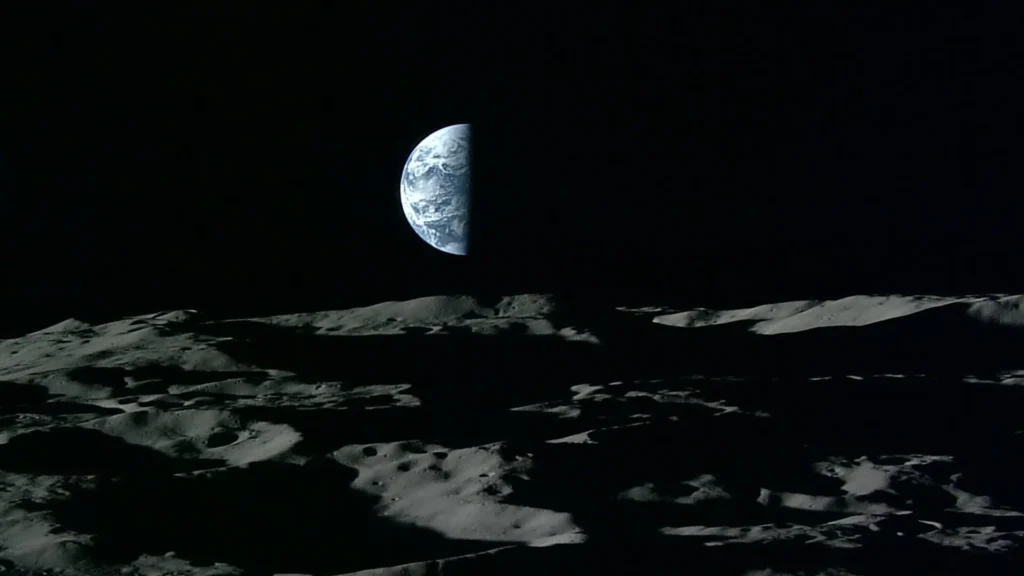
The new moon phase itself contributes to the introspective tone. Reduced nocturnal light exposure helps stabilize circadian rhythms, supporting deeper rest and hormonal balance. Lower sensory stimulation at night complements the silence and restraint prescribed on Magha Amavasya, making it easier to remain calm and attentive.
Practices like cold-water bathing during early morning hours, common during Magha snan have also been studied for their role in activating brown adipose tissue, which supports heat regulation and metabolic efficiency in cold climates. While scriptures describe this as purification, modern research views it as a mild stressor that strengthens adaptive responses.
Even ritual elements such as sesame (til) donation have nutritional logic. Sesame seeds are rich in omega fatty acids, antioxidants, and minerals, making them seasonally appropriate in winter. Their use in daan reflects practical dietary wisdom embedded within ritual symbolism.
Seen through this lens, Magha Amavasya does not oppose rational thought. Instead, it demonstrates how ancient spiritual disciplines often evolved in harmony with human biology and seasonal awareness, offering a structured pause for mental reset and physical balance.
Key Mantras for Magha Amavasya
Mantras associated with Magha Amavasya 2026 are designed to support silence, steadiness of mind, and ancestral remembrance rather than intense vocal ritual. On Mauni Amavasya, chanting is traditionally done mentally or in a very soft tone, ensuring that the essence of maun (silence) remains intact.
| Deity / Ritual Context | Mantra | Recommended Repetitions |
|---|---|---|
| Maun Vrat (Inner Discipline) | Om Namo Narayanaya | 108 times (silent japa) |
| Pitru Tarpan | Om Pitribhyo Swadha Swaha | 21 times |
| Ganga Snan Invocation | Om Gange Cha Yamune Chaiva… | 11 times |
| Peepal Parikrama | Om Tat Purushaya Vidmahe… | 108 times (mental recitation) |
How These Mantras Are Traditionally Understood
The Narayan mantra is central to Mauni Amavasya because Vishnu is regarded as the preserver of cosmic and familial order. Silent repetition cultivates steadiness and counters the mind’s tendency to wander during fasting and silence.
The Pitru tarpan mantra is used not as a plea but as acknowledgment recognizing lineage continuity and expressing gratitude. Repeating it 21 times reflects measured discipline rather than numerical obsession.
During Ganga snan, the river-invocation mantra reminds the devotee that sacredness lies not only in geography but in intent. Even when bathing in local rivers, the mantra helps mentally connect to the purifying principle represented by the Ganga.
For Peepal parikrama, mental chanting maintains inward focus while the body moves. Scriptures repeatedly note that on Magha Amavasya, correct bhava outweighs pronunciation, especially when silence itself is the primary vow.
Together, these mantras serve as anchors for awareness, ensuring that the observance of Magha Amavasya remains contemplative, disciplined, and inwardly aligned.
Frequently Asked Questions
Magha Amavasya 2026 kab hai
Magha Amavasya 2026 will be observed on Sunday, January 18, 2026. The Amavasya tithi begins at 12:06 AM on January 18 and ends at 01:24 AM on January 19, making January 18 the valid day as per udaya tithi.
Mauni Amavasya vrat kaise rakhein?
Mauni Amavasya vrat is observed by maintaining silence (maun) throughout the day, taking a fruit-and-milk or very light fast, performing sunrise snan, offering tarpan to ancestors, and doing gupta daan without disclosure. The vow is concluded after sunrise on the next day.
Mauni Amavasya ke kya labh hote hain?
Traditional texts associate Mauni Amavasya with paap kshaya, improved control over speech and thought, ancestral harmony (pitru preeti), and accumulation of moksha-oriented punya. Practitioners also experience mental calm and clarity through silence and restraint.
Pregnant women, Magha Amavasya vrat kar sakti hain?
Pregnant women are generally advised not to observe strict fasting or prolonged silence. A symbolic observance such as light silence for some hours and simple food is considered acceptable, but health guidance should always take priority.
Agar maun vrat toot jaye to kya karein?
If silence is broken unintentionally, traditions advise remaining calm and resuming the vow rather than feeling guilty. Performing an additional tarpan or daan on the next Amavasya is considered sufficient. Intention is regarded as more important than perfection.