
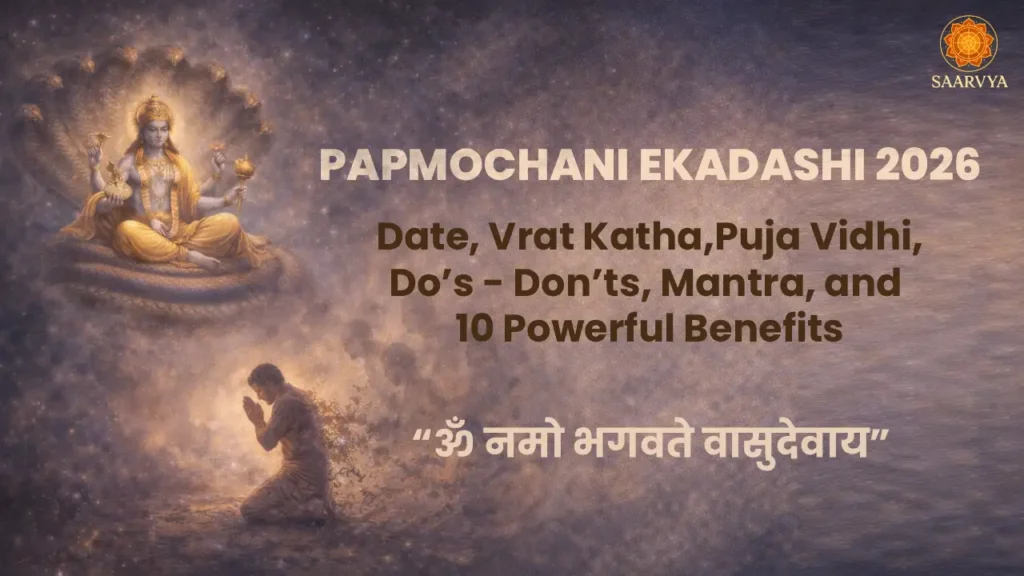

Papmochani Ekadashi is regarded as one of the most intense karmic-cleansing observances in the Ekadashi cycle. The word Papmochani itself is revealing “pap” means sin and “mochani” means liberation pointing to a vrata meant to free the seeker from accumulated moral, mental, and karmic burdens. Falling as the last Ekadashi of the Vedic lunar year, just before Chaitra Navratri, this day symbolically closes old accounts and prepares the mind for renewal. Scriptures describe it as capable of dissolving even very grave sins, restoring inner peace, prosperity, and steady movement toward moksha.
Papmochani Ekadashi 2026 will be observed on Sunday, 15 March 2026 (Chaitra Krishna Ekadashi). On this day, devotees fast by avoiding grains and tamasic food, worship Lord Vishnu with yellow flowers and fruits, listen to the Papmochani Ekadashi Vrat Katha, and break the fast during Dwadashi Parana on 16 March 2026 to be freed from sins, guilt, and obstacles while gaining peace, prosperity, and spiritual upliftment.
Papmochani Ekadashi 2026: Date, Tithi Duration & Muhurat (India)
Papmochani Ekadashi is observed according to the Ekadashi tithi, not the civil calendar date alone. As this tithi spans two days in 2026, the fast is kept on the day when Ekadashi predominates during sunrise.
- Ekadashi tithi begins: Saturday, 14 March 2026, at 08:10 – 08:11 AM
- Ekadashi tithi ends: Sunday, 15 March 2026, at 09:16 – 09:17 AM
- Vrat (fasting) day: Sunday, 15 March 2026
The Dwadashi Parana the ritual breaking of the fast is equally important and must be done correctly to complete the vrata:
- Parana date: Monday, 16 March 2026
- Parana window (New Delhi example): approximately 06:30 AM to 08:54–09:11 AM
- Dwadashi ends: around 09:40 AM
Devotees should always ensure that Parana is done after sunrise, within Dwadashi tithi, and after Hari Vasara, consulting a local panchang for city-specific accuracy.
Quick View – Papmochani Ekadashi 2026
| Detail | Information |
|---|---|
| Ekadashi name | Papmochani Ekadashi (Papamochani Ekadashi) |
| Lunar month & paksha | Chaitra month, Krishna Paksha |
| Vrat date | Sunday, 15 March 2026 |
| Ekadashi tithi | 14 Mar 08:10/08:11 AM – 15 Mar 09:16/09:17 AM |
| Parana date | Monday, 16 March 2026 |
| Parana time | ~06:30–08:54/09:11 AM |
| Presiding deity | Lord Vishnu (with Lakshmi) |
| Core focus | Total sin-cleansing, release from guilt, peace, prosperity, moksha |
What is Papmochani Ekadashi?
Meaning, Power & Place in the Ekadashi Cycle
Papmochani Ekadashi is not treated in the scriptures as an ordinary fast. Its very name defines its function and its intensity.
The word “Papmochani” is formed from two Sanskrit roots:
- Pap (पाप) – sin, wrongdoing, karmic transgression, moral error (both conscious and unconscious)
- Mochani (मोचनी) – that which releases, liberates, unties, or dissolves
Taken together, Papmochani Ekadashi literally means “the Ekadashi that liberates one from sins.” Not symbolically, not partially but completely, when observed with repentance, restraint, and devotion.
Its Unique Position in the Lunar Year
Papmochani Ekadashi occurs in Chaitra Krishna Paksha, making it the final Ekadashi of the Vedic lunar year. This timing is extremely important.
In the traditional Hindu spiritual calendar:
- Chaitra Navratri marks the beginning of a new spiritual cycle
- Papmochani Ekadashi, falling just before it, functions as a karmic closure point
In other words, this Ekadashi is meant to:
- Close unresolved karmic accounts
- Clean accumulated moral and psychological residue
- Prepare the seeker for a fresh dharmic cycle
Scripturally and symbolically, Papmochani Ekadashi acts like a year-end karmic purification, ensuring that the seeker does not carry heavy inner baggage into the new cycle of sadhana.
Why Papmochani Ekadashi Is Considered Extremely Powerful
Texts such as the Padma Purana and explanations given by sages like Lomasha Rishi describe Papmochani Ekadashi as capable of destroying even the gravest categories of sin, when other remedies may fail.
The sins traditionally mentioned include:
- Brahma-hatya level sins (grave moral transgressions, not limited to literal meanings)
- Theft of gold or sacred trust
- Chronic intoxication and loss of self-control
- Illicit relationships and betrayal of vows
- Repeated lying, slander, and moral hypocrisy
What makes Papmochani Ekadashi different is not severity alone, but sincerity. Scriptures repeatedly state that this Ekadashi responds especially to:
- Genuine remorse
- Recognition of one’s own fallibility
- Willingness to change patterns, not merely escape punishment
It is therefore often prescribed for people who feel:
- Trapped by past actions
- Overwhelmed by guilt or shame
- Spiritually “stuck” despite effort
- Caught in repeating destructive habits
Papmochani Ekadashi does not deny wrongdoing—it burns it through conscious repentance and disciplined restraint.
Types of Problems & Patterns Addressed
Beyond classical “sins,” Papmochani Ekadashi is understood to work on subtler levels as well.
Traditionally, it is said to help with:
- Persistent obstacles despite effort
- Sudden reversals of fortune
- Mental heaviness, fear, or moral confusion
- Financial instability rooted in poor choices
- Addictive or compulsive tendencies
- Broken self-respect or inner confidence
The logic given in the scriptures is clear when pap (negative karma) dissolves, its external effects fear, instability, repeated crisis also begin to loosen.
That is why regular observers of Papmochani Ekadashi are described as being:
- Less prone to catastrophic downfall
- More protected during crises
- Gradually aligned toward stable wealth and peace
Papmochani Ekadashi as a Spiritual Reset
At its deepest level, Papmochani Ekadashi functions like a spiritual reset mechanism.
- It acknowledges that human beings fall
- It accepts that desire, ignorance, and pressure can derail even disciplined lives
- But it insists that no fall is final if repentance is real
This is why Papmochani Ekadashi is not fear-based.
It is liberation-based.
It does not say “you are condemned.” It says, “you can be cleansed if you choose restraint, truth, and surrender.”
Papmochani Ekadashi Vrat Katha
The Story of Medhavi Rishi and Apsara Manjughosha (Detailed Narrative)
The Papmochani Ekadashi Vrat Katha is deliberately intense, because the Ekadashi itself deals with serious moral collapse, temptation, repentance, and restoration. Unlike lighter Ekadashi stories, this katha does not soften human weakness—it exposes it fully, and then shows the exact spiritual mechanism through which even deep corruption can be undone.
The story is traditionally narrated by Lomasha Rishi, and its authority is traced to the Padma Purana.
In ancient times, there lived a powerful sage named Medhavi, the son of the great rishi Chyavana. Medhavi was not an ordinary ascetic. From a very young age, he had immersed himself in severe tapasya, practicing celibacy, austerity, mantra-japa, and sensory restraint in a dense forest. His penance was so intense that it began to disturb the balance of the higher realms.
As Medhavi’s spiritual power increased, the devas grew uneasy. In the Puranic worldview, such fear does not arise from ego alone it arises from the understanding that unchecked ascetic power can reshape destiny itself. Concerned that Medhavi might gain powers capable of overriding cosmic order, Indra, the king of the devas, decided to intervene.
Rather than confronting Medhavi directly, Indra chose a familiar method: temptation through pleasure.
He summoned the apsara Manjughosha, renowned not only for her beauty but for her mastery over desire, emotion, and illusion. She was instructed to break Medhavi’s tapasya—not by force, but by attraction.
Manjughosha entered the forest where Medhavi was performing penance. She sang, danced, laughed, and gradually filled the environment with sensory richness that stood in stark contrast to Medhavi’s austere discipline. At first, Medhavi resisted. Years of tapasya had strengthened his will. But temptation in the Puranic sense is rarely sudden it is slow, persistent, and adaptive.
Over time, Medhavi’s vigilance weakened.
One day, his restraint broke completely.
Medhavi abandoned his vows and entered into a life of pleasure with Manjughosha. Days turned into months. Months into years. In some versions of the katha, decades pass unnoticed. The forest hermitage, once a center of tapasya, becomes a place of indulgence. The sage who once commanded spiritual fire now lived bound by desire and forgetfulness.
Eventually, the illusion dissolved.
Medhavi awoke one day with full awareness. Looking at his aged body, his neglected hermitage, and the time lost, he was overwhelmed not by anger alone, but by self-disgust and guilt. Realizing the magnitude of his fall, he turned his rage outward and inward simultaneously.
In a moment of uncontrolled emotion, Medhavi cursed Manjughosha, condemning her to become a terrifying, spirit-like being ugly, tormented, and rejected by all.
But once the curse was spoken, clarity followed.
Medhavi realized that Manjughosha had not fallen alone. He himself had failed. Desire had not been forced upon him; it had been accepted. His anger softened into remorse. Understanding that both of them were now trapped in suffering born of passion and error, Medhavi sought guidance.
He went to his father, Chyavana Rishi, and confessed everything—his fall, his guilt, the curse, and his despair.
Chyavana listened calmly. He did not scold. He did not excuse. Instead, he delivered a truth central to Papmochani Ekadashi:
“Certain sins are too deep for ordinary penance.
But they are not beyond purification.”
Chyavana Rishi declared that only one vrata had the power to cleanse such entanglement of lust, misuse of power, and moral collapse: Papmochani Ekadashi, observed in Chaitra Krishna Paksha.
He instructed both Medhavi and Manjughosha to observe the vrata with absolute sincerity:
- fasting without grains
- worship of Lord Vishnu
- restraint of senses
- repentance without self-deception
Manjughosha, now suffering intensely, observed Papmochani Ekadashi with full devotion. She fasted, prayed, remembered Vishnu, and surrendered her pride and sorrow completely. Medhavi too observed the vrata, not as an ascetic seeking power, but as a fallen soul seeking purification.
By the power of Papmochani Ekadashi, Manjughosha was freed from her curse and restored to her divine form. Medhavi regained his spiritual radiance, his tapasya purified and stabilized not erased, but redeemed.
Lomasha Rishi concludes the katha with the phala-shruti:
Whoever observes Papmochani Ekadashi with faith, listens to this katha, and sincerely repents their wrongdoings is freed from even the gravest sins. Such a person attains heavenly merit, inner peace, protection from downfall, and ultimately moksha through Vishnu’s grace.
Inner Meaning of the Katha (Without Fragmentation)
This story is deliberately uncomfortable. Medhavi is not portrayed as weak from the beginning he is powerful. His fall teaches that spiritual strength without humility can collapse, and that temptation often succeeds not because it is strong, but because vigilance becomes lazy.
Manjughosha represents external triggers desire, addiction, validation, pleasure while Medhavi represents unresolved inner vulnerabilities. Papmochani Ekadashi emerges as the point where self-honesty meets divine forgiveness.
This katha exists to reassure the seeker of one thing:
“No matter how far one falls,
if repentance is real and discipline is restored,
liberation remains possible.”
Puja Vidhi for Papmochani Ekadashi 2026
The Puja Vidhi of Papmochani Ekadashi is inward-facing by design. Unlike festival worship that emphasizes celebration, this vrata emphasizes repentance, restraint, and conscious purification. Every step of the ritual is meant to slowly turn the mind away from habit and excuse, and toward accountability, surrender, and renewal.
The puja should not feel rushed or performative. Papmochani Ekadashi works best when observed with slowness and seriousness, because it deals with deeply embedded karmic impressions.
Dashami: Preparing the Mind Before the Ritual (14 March 2026)
Papmochani Ekadashi does not begin on Ekadashi morning it begins one day earlier, on Dashami, with intentional withdrawal.
On the evening of Dashami, the devotee should eat one simple, sattvic meal before sunset, consciously avoiding: non-vegetarian food, alcohol, onion, garlic, excess spice, and indulgent combinations.
This is not merely dietary; it is a signal to the mind that the coming day is not ordinary.
From Dashami night onward, traditional guidance emphasizes: control of speech, reduction of unnecessary interaction, and restraint of sensual activity. The goal is to create psychological space so that repentance on Ekadashi does not remain superficial.
The puja items should be prepared calmly: a clean image or idol of Lord Vishnu with Lakshmi, yellow flowers, fruits, tulsi leaves (collected earlier), ghee diya, incense, panchamrit ingredients, and items intended for charity. Preparing these in advance avoids distraction on the Ekadashi morning.
Most importantly, Dashami night is when the devotee internally acknowledges personal failures without dramatization, without denial. Papmochani Ekadashi responds only to honesty.
Ekadashi Morning: Snan, Sankalpa and Inner Reset (15 March 2026)
On Papmochani Ekadashi morning, one should wake before sunrise. Bathing is essential not just for cleanliness, but for symbolic rebirth. Many traditions recommend adding a few drops of Ganga jal to the bath water, but the intention matters more than the substance.
Clean clothes preferably white or yellow are worn, reflecting clarity and surrender.
The altar is cleaned and arranged quietly. The Vishnu–Lakshmi image is placed facing east or north, decorated simply with yellow flowers. Excess ornamentation is avoided; Papmochani Ekadashi is not about visual grandeur.
The sankalpa is the spiritual core of the day.
Holding water in the right hand, the devotee clearly states: their name, gotra (if known), location, and the tithi
—Chaitra Krishna Papmochani Ekadashi, 15 March 2026—
Then comes the crucial part the intention is spoken without defensiveness.
The devotee consciously surrenders: known and unknown sins, repeated mistakes, addictions, unethical choices, harmful speech, broken vows, and self-betrayal asking not only for forgiveness, but for strength to not repeat them.
Without this sincerity, the ritual remains hollow.
Main Puja: Vishnu Worship as Moral Re-alignment
The puja begins with lighting the ghee diya and incense. The devotee sits steadily, takes a few moments of silence, and visualizes Vishnu not as a distant deity, but as the witness of one’s entire moral history.
Offerings are made slowly yellow flowers, fruits, tulsi leaves, water, dhoop, and deep without haste.
Grain-free naivedya is offered, even if the devotee does not intend to eat it later.
During this phase, recitation is central Vishnu Sahasranama, selected Bhagavad Gita verses, or steady chanting of
“ॐ नमो भगवते वासुदेवाय” or the Hare Krishna Mahamantra.
The chanting should not be loud or dramatic. Papmochani Ekadashi responds to quiet remorse and steady remembrance, not emotional display.
After the japa, the Papmochani Ekadashi Vrat Katha the story of Medhavi Rishi and Manjughosha is read or listened to in full. This is not storytelling for entertainment; it is a mirror. The devotee is expected to recognize themselves somewhere in that fall and redemption.
The aarti that follows is gentle, not celebratory. It symbolizes light returning where confusion once dominated.
The Day-Long Upavas: Discipline as Purification
The fast on Papmochani Ekadashi is strict in principle, flexible in execution.
Ideally, the devotee avoids grains completely and observes: nirjala fasting (only if physically strong), or phalahar with fruits, water, milk, and nuts, or a very light sattvic meal without grains if medically necessary.
More important than food is behavioral fasting.
The devotee avoids: idle talk, business negotiations, indulgent entertainment, social media excess, gossip, and emotional confrontation.
The day is spent in: mantra-japa, quiet reading, introspection, writing down habits to release, and conscious silence.
Many traditional texts emphasize jagran or reduced sleep, because alertness symbolizes vigilance against future falls.
Papmochani Ekadashi is not meant to exhaust the body it is meant to wake up the conscience.
Dwadashi Parana: Sealing the Transformation (16 March 2026)
The vrata is incomplete without proper Dwadashi Parana.
On the morning of 16 March 2026, a short Vishnu prayer is performed again. Gratitude is expressed not for rewards, but for the opportunity to reset.
Charity is essential on this day. Food, clothes, money, or direct help to those struggling with addiction, poverty, or moral collapse is especially recommended. This outward compassion anchors the inner cleansing.
Parana is done after sunrise, within the correct time window (approximately 06:30–09:11 AM in Delhi), before Dwadashi ends.
The fast is broken gently: water first, then fruit or simple sattvic food. Overeating is discouraged, as it symbolically contradicts the restraint cultivated the previous day.
The Deeper Purpose of the Vidhi
Papmochani Ekadashi puja is not about fear of punishment. It is about restoring integrity between action and conscience, desire and discipline, intention and behavior.
When observed properly, this vidhi does not merely “remove sins.”
It changes the relationship a person has with their own weaknesses.
Food Rules for Papmochani Ekadashi
On Papmochani Ekadashi, food is treated not simply as nourishment but as a carrier of memory, habit, and desire. The scriptures do not frame dietary rules here as punishment or austerity for its own sake; instead, they view food as one of the primary ways in which past karmic patterns keep repeating themselves. What is eaten influences not only the body, but also the mind’s momentum toward pleasure, avoidance, guilt, or restraint.
That is why Papmochani Ekadashi insists on strict grain-avoidance and discourages foods associated with stimulation, heaviness, or loss of self-control.
Why Grains Are Prohibited on Papmochani Ekadashi
Across Ekadashi traditions, grains are avoided, but on Papmochani Ekadashi the reasoning is especially emphasized. Grains are described as binding foods they sustain routine life, productivity, and desire-driven continuity. On a day meant to break karmic cycles, continuing routine consumption symbolically reinforces the very patterns the vrata seeks to dissolve.
By abstaining from grains and pulses, the devotee temporarily steps out of: habitual eating, habitual pleasure, habitual justification.
This interruption creates a psychological pause in which repentance and self-honesty can occur without distraction.
What Is Allowed and Why
The foods permitted on Papmochani Ekadashi are chosen for their lightness and neutrality. They support the body without exciting the senses.
Fruits, nuts, milk, and water are allowed because they:
- do not demand heavy digestion,
- do not inflame desire,
- do not dull awareness.
When consumed mindfully, they keep the body stable while allowing the mind to remain alert and introspective. Even then, moderation is emphasized. Eating excessively even permitted foods is considered counterproductive, as it replaces discipline with loopholes.
What Is Strictly Avoided and the Inner Reason
On Papmochani Ekadashi, certain foods are discouraged not because they are “impure” in isolation, but because of the mental states they reinforce.
Grains and pulses are avoided entirely. Onion and garlic are excluded because they stimulate restlessness, aggression, and craving. Alcohol, intoxicants, and stimulants are prohibited because they weaken moral inhibition the very faculty this Ekadashi aims to restore.
Overly spicy, oily, or processed foods are discouraged because they amplify emotional volatility and sensory fixation.
The underlying principle is simple you cannot dissolve guilt and addiction while feeding the nervous system stimulation.
Choosing the Right Level of Fasting
Papmochani Ekadashi does not glorify physical extremity. Instead, it values honest capacity.
A healthy, experienced devotee may observe nirjala fasting, using thirst and hunger as tools for vigilance. Others may follow a fruit-and-water fast or consume light milk-based foods. Those with medical conditions may take a simple sattvic meal without grains.
What matters is not the category of fast, but the absence of indulgence and excuse-making. Using health as a pretext for overeating is discouraged just as much as ego-driven austerity.
Eating as an Act of Accountability
Traditionally, devotees are advised to eat alone or quietly, avoiding social meals and celebratory cooking. This is not antisocial it is introspective. Eating becomes an act of awareness rather than distraction.
Every bite taken on Papmochani Ekadashi is meant to answer one question internally:
“Am I eating to sustain awareness, or to escape it?”
This subtle inquiry is what turns diet into sadhana.
Food, Guilt, and Release
Papmochani Ekadashi directly addresses guilt, shame, and regret. Heavy food dulls these emotions temporarily; light food allows them to surface, be acknowledged, and then released through prayer and resolve.
That is why the vrat diet is designed not to suppress emotion, but to let it pass without being fed.
When followed correctly, the food discipline of Papmochani Ekadashi does not weaken the devotee. It restores a sense of inner authority over impulse, which is the real liberation promised by this Ekadashi.
Do’s and Don’ts on Papmochani Ekadashi
Papmochani Ekadashi is not concerned with surface morality. Its discipline is designed to protect a fragile inner moment the moment when a person becomes honest about their mistakes and decides to stop repeating them. The do’s and don’ts exist to guard that inner resolve from being diluted, distracted, or rationalized away.
What Must Be Done and Why It Matters
On Papmochani Ekadashi, every positive action is meant to strengthen accountability.
The fast should be observed sincerely, with complete avoidance of grains, pulses, onion, garlic, intoxicants, and tamasic food. This is not to impress divinity but to prevent the mind from slipping back into comfort-seeking while repentance is still active.
Worship of Lord Vishnu must be done with attentiveness rather than speed. Yellow flowers, fruits, tulsi leaves, and a steady lamp are recommended because they symbolize clarity, purity, and illumination after moral darkness. Listening to or reading the Papmochani Ekadashi Vrat Katha in full is essential it provides the psychological context that allows repentance to feel purposeful rather than crushing.
Charity plays a crucial role. Papmochani Ekadashi emphasizes daan that repairs harm. Feeding the poor, helping those trapped in addiction, supporting education, temples, or Gau-seva are all recommended because they redirect energy from self-absorption to responsibility. Charity on this day is not transactional; it is an outward correction of inward imbalance.
Most importantly, the devotee is encouraged to consciously confess not publicly, but internally to Vishnu. Naming one’s mistakes clearly, without euphemism or excuse, and resolving not to repeat them is considered the heart of this Ekadashi. Without this inner admission, even perfect ritual carries limited effect.
What Must Be Avoided and the Real Reason Behind It
The prohibitions on Papmochani Ekadashi are not threats; they are risk controls.
Harming any living being through violence, cruelty, hunting, or deliberate neglect is strictly avoided because Papmochani Ekadashi is about reversing harm, not accumulating new moral debt.
Association with dishonest, exploitative, or immoral influences is discouraged. Scriptures state that moral environments affect mental stability; during repentance, even casual exposure to deception or vulgarity can weaken resolve. If unavoidable interaction occurs, traditional texts advise quiet remembrance of Vishnu as mental purification.
Sexual indulgence, gambling, intoxication, gossip, slander, and deliberate lying are prohibited because they reignite the same impulses that created past sins. Papmochani Ekadashi is meant to interrupt these loops completely, even if only for a day.
On Dwadashi, additional restraint is advised: avoiding meals in others’ homes, limiting oneself to a simple diet, avoiding honey, urad dal, oil massage, and ostentatious behavior. These rules exist to prevent a sudden rebound into indulgence immediately after restraint, which would psychologically undo the discipline built on Ekadashi.
The Deeper Logic of These Rules
Papmochani Ekadashi assumes something very realistic about human nature, change is fragile at first.
When guilt is acknowledged, the mind often tries to escape discomfort through pleasure, distraction, or justification. The do’s and don’ts form a protective boundary around the devotee during this vulnerable phase.
- They are not punishments.
- They are stabilizers.
By observing them sincerely, the devotee gives repentance enough time to mature into clarity and resolve, rather than collapsing back into habit.
10 Powerful Benefits of Papmochani Ekadashi
The benefits of Papmochani Ekadashi are described in strong language in the scriptures, but they are not meant to be interpreted as instant miracles or magical erasure of consequences. This Ekadashi works at a deeper level. It changes the internal conditions that give rise to repeated failure, and when those conditions change, external outcomes gradually follow.
Below are ten benefits traditionally associated with Papmochani Ekadashi, explained in a grounded, continuous manner rather than as isolated claims.
1. Release from Heavy and Repeating Sins
Papmochani Ekadashi is primarily known for its power to cleanse grave and repetitive sins, including those driven by lust, intoxication, deception, and loss of self-control. The emphasis here is not on a single mistake, but on patterns actions a person knows are wrong yet keeps repeating.
Through fasting, repentance, and Vishnu worship, the mind temporarily steps out of self-justification. This creates a rare psychological and spiritual opening where guilt does not harden into shame, but softens into responsibility. That shift alone dissolves much of the karmic weight associated with sin.
2. Relief from Guilt, Shame, and Moral Self-Conflict
One of the most immediate effects reported by sincere observers is a sense of inner lightness. Papmochani Ekadashi addresses not only the act of wrongdoing, but the after-effect the constant self-accusation, regret, and inner conflict that follows.
By consciously naming one’s mistakes and surrendering them without denial, the devotee stops fighting themselves internally. This relief from self-conflict restores mental energy, clarity, and self-respect, which are essential for lasting change.
3. Breaking Addictive and Compulsive Tendencies
The Medhavi–Manjughosha katha makes it clear that Papmochani Ekadashi directly targets addiction-like behavior whether to pleasure, validation, substances, or destructive relationships.
Fasting interrupts physical habit. Silence interrupts mental noise. Sankalpa interrupts denial. Together, they weaken compulsive loops. While the Ekadashi itself is one day, the insight gained often becomes the first successful pause in a long cycle of compulsion.
4. Protection from Sudden Downfalls and Crises
Scriptural texts describe regular observers of Papmochani Ekadashi as being less prone to catastrophic reversals. This is not mystical favoritism. It is the natural result of improved judgment.
When impulsivity, intoxication, and ethical blindness reduce, a person simply stops making the kinds of decisions that lead to sudden collapse financial, relational, or reputational. In that sense, Papmochani Ekadashi acts as preventive spiritual maintenance.
5. Restoration of Moral Clarity and Direction
After prolonged wrongdoing, people often lose the ability to clearly distinguish right from convenient. Papmochani Ekadashi is said to restore dharma-buddhi the inner compass.
Through restraint and reflection, the devotee reconnects with values they once knew but abandoned. This clarity does not feel like external pressure; it feels like remembering oneself. Decisions after this Ekadashi often become slower, more deliberate, and less self-sabotaging.
6. Gradual Improvement in Prosperity and Stability
While Papmochani Ekadashi is not primarily a wealth-oriented vrat, scriptures note that prosperity follows purification. When deceit, addiction, and reckless behavior reduce, stability naturally increases.
Money stops leaking through impulsive spending, conflict, or unethical choices. Relationships stabilize. Work becomes more consistent. Over time, this produces a form of prosperity that is sustainable, not sudden and fragile.
7. Strengthening of Self-Control and Willpower
Self-control is not built through suppression alone; it is built through successful restraint. Papmochani Ekadashi provides a structured environment where restraint is supported rather than resisted.
Completing the fast and puja gives the devotee direct evidence that they can say no to food, pleasure, distraction, and excuse. This restored confidence in one’s own willpower often carries forward into daily life.
8. Healing of Relationships Damaged by Past Actions
When inner accountability increases, behavior changes. Apologies become sincere. Boundaries become clearer. Manipulation reduces. As a result, damaged relationships slowly begin to heal, or at the very least, stop deteriorating.
Even when reconciliation is not possible, Papmochani Ekadashi helps the devotee release bitterness and accept consequences without resentment, which is itself a form of liberation.
9. Spiritual Eligibility for Higher Sadhana
Many texts state that Papmochani Ekadashi restores adhikara spiritual eligibility. This means that practices like japa, meditation, or deeper study become effective again.
Without purification, spiritual effort often feels blocked or hollow. After Papmochani Ekadashi, devotees often report that mantra feels steadier, prayer feels more honest, and discipline feels less forced.
10. Preparation for Liberation and New Cycles
Because Papmochani Ekadashi closes the lunar year, its final benefit is symbolic and practical: closure. Old guilt is acknowledged. Old habits are questioned. Old self-images are released.
This creates the inner cleanliness necessary for Chaitra Navratri and the next spiritual cycle. Ultimately, scriptures state that repeated observance leads the soul toward moksha, not by denial of human weakness, but by transcending it through truth and restraint.
The Core Promise
Papmochani Ekadashi does not promise a life without consequences. It promises something more realistic and more valuable:
“Freedom from being controlled by one’s past.”
That freedom gradual, grounded, and earned is the real fruit of this Ekadashi.
Scientific & Psychological Angle of Papmochani Ekadashi
Papmochani Ekadashi is often described in spiritual language, but its structure aligns closely with well-documented psychological and physiological mechanisms of behavioural change. This is one reason why the observance has survived for centuries it works on the human system in a realistic, repeatable way.
Fasting as a Neuro-Behavioural Reset
From a scientific perspective, short-term fasting especially when grains and heavy foods are removed reduces constant digestive demand. This has two important effects:
1. Physiological calm
Reduced insulin spikes and digestive workload free metabolic energy. Many people experience mental clarity, alertness, and reduced agitation on Ekadashi days.
2. Impulse interruption
Most destructive habits are loop-based: cue → urge → action → relief. Papmochani Ekadashi deliberately breaks this loop by:
- removing food-based comfort
- removing sensory stimulation
- removing social distraction
This creates a pause where urges arise without immediate satisfaction, allowing conscious choice to re-enter the process.
Ritual Repentance and Cognitive Reframing
Modern psychology recognises that unprocessed guilt leads either to denial or self-destruction. Papmochani Ekadashi introduces a third option: structured repentance without self-hatred.
The steps of sankalpa, katha-listening, and Vishnu surrender function similarly to:
- cognitive reframing (acknowledging error without identity collapse)
- behavioural commitment (public or internal vow)
- value re-anchoring (returning to a moral framework)
This is why many people feel lighter after Papmochani Ekadashi—not because consequences vanish, but because internal conflict reduces.
Addiction, Shame Cycles & Ekadashi Discipline
Addiction research shows that shame worsens compulsive behaviour. Papmochani Ekadashi addresses this directly:
- It names wrongdoing clearly
- It forbids indulgence temporarily
- It offers forgiveness without justification
This combination reduces shame while still enforcing restraint—a rare balance that modern therapy also aims to achieve.
Silence, Reduced Input & Nervous System Regulation
Avoidance of gossip, entertainment, and excessive interaction on Papmochani Ekadashi mirrors modern practices of:
- digital detox
- sensory fasting
- mindfulness-based regulation
These practices are known to calm the nervous system, reduce rumination, and improve emotional regulation especially when combined with symbolic meaning and intention.
In short, Papmochani Ekadashi works because it resets behaviour at the level where behaviour actually forms: habit, impulse, identity, and values.
Frequently Asked Questions
When is Papmochani Ekadashi in 2026 and when should Parana be done?
Papmochani Ekadashi in 2026 falls on Sunday, 15 March 2026 (Chaitra Krishna Ekadashi). The fast is broken on Monday, 16 March 2026, after sunrise, within Dwadashi tithi and after Hari Vasara. In many Indian cities, Parana falls roughly between 06:30 AM and 09:10 AM, but local panchang should always be checked.
Why is Papmochani Ekadashi considered more powerful than other Ekadashis?
Papmochani Ekadashi is the final Ekadashi of the lunar year, making it a karmic closure point. Scriptures emphasise it for deep sin-cleansing and repentance, especially for repeated or serious moral failures, unlike Ekadashis focused mainly on prosperity or devotion.
What types of sins are traditionally associated with Papmochani Ekadashi?
Texts mention purification from sins related to lust, intoxication, deception, broken vows, theft, slander, and misuse of power. Symbolically, it addresses habitual wrongdoing and moral self-betrayal, not just isolated acts.
Is nirjala fasting compulsory on Papmochani Ekadashi?
No. Nirjala fasting is optional and suitable only for healthy, experienced devotees. Fruit-based or light vrat fasting without grains is fully acceptable when done with sincerity and restraint.
Can Papmochani Ekadashi help with addiction or destructive habits?
Traditionally, yes. The vrat is often recommended for those trying to break addictions or compulsive behaviours because it combines fasting, repentance, behavioural restraint, and moral recommitment.
How is Papmochani Ekadashi different from Jaya, Apara, or Kamada Ekadashi?
While other Ekadashis also cleanse sins, Papmochani Ekadashi uniquely focuses on repentance before renewal, acting as a spiritual reset before Chaitra Navratri and the new lunar year.
What mistakes reduce the effect of Papmochani Ekadashi?
Treating the vrat as mechanical, indulging in gossip or intoxication, justifying past actions instead of acknowledging them, breaking Parana incorrectly, or using the vrat to escape responsibility rather than accept it.
Can people with medical conditions observe Papmochani Ekadashi?
Yes. They may keep a mild fast or focus on puja, mantra, silence, and charity. Papmochani Ekadashi values intent and restraint, not physical hardship.