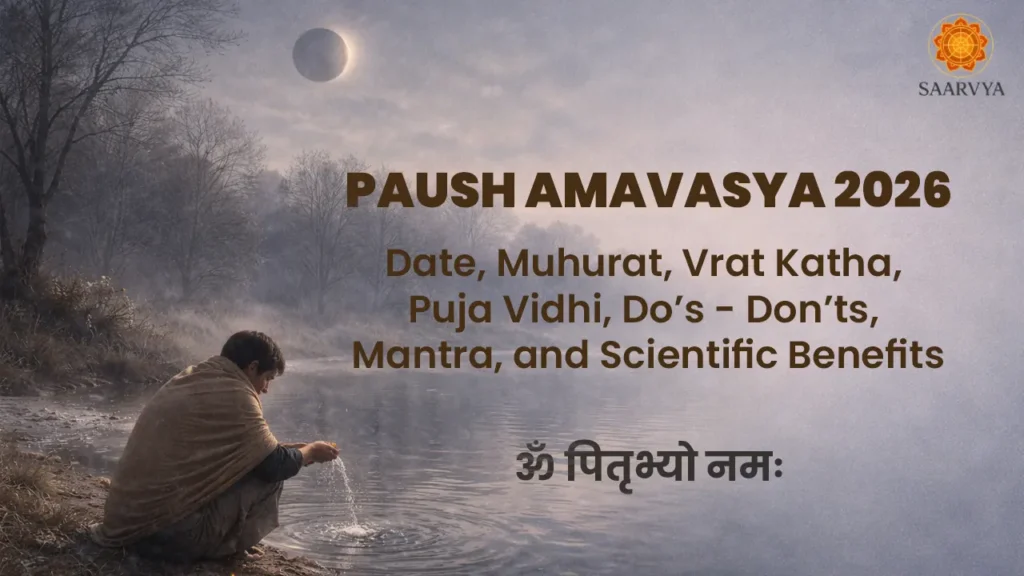

Paush Amavasya 2026 marks the final Amavasya (New Moon) of the year and holds deep importance in Sanatan tradition for ancestor remembrance, karmic cleansing, and inner withdrawal. Observed during the Paush month, this Amavasya is especially linked with shraddha, tarpan, and daan, rituals performed to bring peace to the Pitru lok. Spiritually, it signifies closure of karmic debts, unresolved ancestral energies, and the year’s accumulated impressions, while seasonally, it aligns with winter’s introspective rhythm, encouraging restraint, silence, and inner balance rather than outward celebration.
Quick View Table
| Aspect | Details |
|---|---|
| Date (2026) | December 8, 2026 |
| Lunar Month & Paksha | Margashirsha Krishna Paksha (Paush observance as per Amanta system) |
| Tithi Timing | Begins Dec 8, 04:12 AM · Ends Dec 9, 06:21 AM |
| Puja Muhurat | Sunrise to Sunset · Abhijit Muhurat around midday |
| Key Mantra | Om Pitribhyo Namah (for ancestor invocation) |
| Main Rituals | Tarpan with black sesame (til), Peepal parikrama |
| Core Benefits | Pitru shanti, dosha nivaran, inner stability, prosperity |
This quick view is designed for readers who want immediate clarity, especially those searching for Paush Amavasya 2026 date, while the detailed sections below explain why each element matters. The timing reflects the Amavasya span across sunrise, which is why most rituals are advised during daylight hours, with specific acts like tarpan also permitted during Nishita Kaal based on lineage custom and regional Panchang.
Exact Date & Muhurat (New Delhi)
For devotees and householders observing Paush Amavasya 2026, clarity on the exact date and ritual timing is essential, as Amavasya observances depend not only on the calendar date but on tithi alignment with sunrise. According to the standard Drik Panchang calculations for New Delhi, Paush Amavasya will be observed on Tuesday, December 8, 2026.
The Amavasya tithi begins at 04:12 AM on December 8 and continues until 06:21 AM on December 9. Since the tithi prevails during sunrise on December 8, that day is considered valid for all primary observances such as snan, tarpan, daan, and fasting. Parana (breaking the fast) is recommended after sunrise on December 9, 2026, once the Amavasya tithi has fully concluded.
From a ritual standpoint, Paush Amavasya does not require a narrowly restricted muhurat like some other vratas. The most widely accepted window for worship is sunrise to sunset, as daylight hours are considered sattvic and stable for ancestor-related rites. However, families following stricter Pitru traditions may also perform tarpan during Nishita Kaal (midnight), which symbolically represents the liminal state between worlds and is mentioned in several Smriti texts for ancestor appeasement.
For auxiliary timing decisions such as choosing a calm period for daan or Peepal parikrama, many devotees consult Choghadiya Muhurat from their local Panchang. While not mandatory, it helps those who wish to align actions with planetary harmony, especially during a spiritually sensitive Amavasya like this one, which closes the lunar cycle of the year.
To place this observance in context, the Amavasya sequence around it is as follows:
| Nearby Amavasya | Date | Context |
|---|---|---|
| Kartik Amavasya | Pre-Paush, linked with the Diwali cycle | Pre-Paush, linked with Diwali cycle |
| Paush Amavasya | December 8, 2026 | Final Amavasya of 2026 |
| Magha Amavasya | January 7, 2027 | Leads into Mauni Amavasya phase |
This timing framework helps devotees plan not only rituals but also mental preparation, as Paush Amavasya is traditionally seen as a threshold where the year’s karmic residue is consciously addressed before the next solar cycle deepens.
Mythological Story (Vrat Katha)
The Vrat Katha of Paush Amavasya 2026 is traditionally narrated to remind devotees why ancestor remembrance is not a symbolic ritual but a dharmic responsibility rooted in balance between the living and the departed. Ancient texts and oral traditions describe Paush Amavasya as a spiritually sensitive night when ancestral realms are closest to the earthly plane, making sincere acts of remembrance especially effective.
One widely told story speaks of a learned but impoverished Brahmin who was deeply devoted to daily worship yet repeatedly ignored Paush Amavasya rites, believing that regular prayers were sufficient. Despite his piety, his household suffered continuous hardship failed harvests, illness, and social decline. Troubled, he approached a sage who, through meditation, revealed that the suffering was not due to present-life sins but unresolved Pitru rin ancestral debt caused by neglect of tarpan and daan on Paush Amavasya.
Following the sage’s guidance, the Brahmin observed the Amavasya with humility. He bathed before sunrise, performed tarpan using water, black sesame, and rice, and offered simple daan according to his capacity. Most importantly, he circumambulated the Peepal tree with focused remembrance of his ancestors, seeking forgiveness rather than favors. Scriptures say that within a year, stability returned to his life not sudden wealth, but freedom from recurring obstacles, symbolizing restored karmic flow.
The Vishnu Purana and related Smriti literature reinforce this teaching by stating that acts performed on Paush Amavasya carry amplified merit when done without expectation. A commonly cited verse notes that 108 Peepal parikramas on Paush Amavasya grant punya comparable to a Kashi yatra, not because the ritual itself is superior, but because the intent aligns fully with dharma, restraint, and gratitude. This emphasis explains why Paush Amavasya rituals are intentionally simple focused on remembrance, not display.
At its core, the Vrat Katha teaches that neglecting ancestors does not invite punishment but imbalance. Conversely, honoring them on Paush Amavasya restores continuity across generations, allowing both the living and the departed to progress peacefully. This narrative framework is why elders insist that Paush Amavasya is less about fear of dosha and more about conscious closure of debts, regrets, and forgotten lineages.
Puja Vidhi
The Puja Vidhi of Paush Amavasya 2026 is intentionally simple, inward-focused, and free from grandeur. Unlike festival pujas meant for celebration, this Amavasya emphasizes sincerity, restraint, and remembrance. The steps below follow commonly accepted Smriti and household traditions, with flexibility for regional customs.
Snan (Purification Bath at Dawn)
The day begins with an early-morning snan, ideally before sunrise. Bathing on Paush Amavasya is symbolic of cleansing not just the body but accumulated mental and karmic residue of the year. Those near sacred rivers perform snan-daan there, while others can bathe at home, adding a few drops of Ganga jal if available. During the bath, the mantra “Om Apavitrah Pavitro Va…” is traditionally recited to invoke inner purity, reminding the devotee that intent matters more than location.
Altar Setup and Sankalp
After bathing, a simple altar is prepared often facing east or north. A Peepal leaf or small wooden plank serves as the base, representing stability and continuity. A kalash filled with water, black sesame (til), rice grains, and a cow-ghee deepak are placed carefully. Before beginning, a sankalp is taken, mentally stating that the rituals are being performed on Paush Amavasya for Pitru shanti and karmic balance, without seeking material gain.
Tarpan for Ancestors
Tarpan is the central ritual of Paush Amavasya. Water mixed with black sesame and rice is offered with cupped hands while invoking ancestors from three generations paternal and, where tradition allows, maternal lineages as well. Each offering is accompanied by quiet remembrance rather than loud chanting. The commonly used mantra “Om Pitribhyo Namah” is repeated multiple times, often 21 repetitions, symbolizing continuity rather than completion. The act signifies nourishment and acknowledgment, not appeasement through fear.
Daan and Peepal Parikrama
After tarpan, daan is performed according to capacity. Offering food grains, warm clothing, or simple meals to Brahmins, elders, or the needy is preferred, especially during Paush’s winter context. In the evening, devotees circumambulate the Peepal tree, traditionally 108 times, though fewer rounds done with focus are equally acceptable. Each step is meant to cultivate humility and patience qualities associated with ancestor blessings.
Aarti and Night Diya
The day concludes with a calm aarti, often using “Om Jai Jagdish Hare”, acknowledging Vishnu as the sustainer of lineage and dharma. A diya is kept lit overnight, symbolizing continuity of consciousness through darkness. This final act marks surrender rather than request, closing the observance of Paush Amavasya with stillness and gratitude.
This step-by-step Vidhi reflects why Paush Amavasya is regarded as a ritual of closure—simple actions, when performed with awareness, are believed to restore balance across generations.
Do’s & Don’ts on Paush Amavasya
Observing Paush Amavasya 2026 is less about rigid rules and more about cultivating restraint, clarity, and respect especially because the day is dedicated to ancestors and inner balance. The traditional Do’s & Don’ts exist to support that mindset rather than to create fear or restriction.
| Do’s | Why It Matters |
|---|---|
| Observe a light fast (fruits, milk, simple sattvic food) | Fasting on Paush Amavasya reduces sensory overload and supports mental calm, making rituals like tarpan more attentive and sincere. |
| Perform tarpan and daan | These acts directly address Pitru rin (ancestral debt), which is central to the spiritual purpose of the day. |
| Meditate or sit quietly near a Peepal tree | The Peepal is associated with longevity and ancestral continuity; stillness here encourages introspection rather than outward activity. |
| Keep a diya lit, especially after sunset | Light symbolizes awareness during darkness, reinforcing the idea of continuity beyond physical life. |
| Maintain silence or minimal speech when possible | Reduced speech helps conserve mental energy and aligns with the inward nature of the Amavasya. |
Don’ts (What Is Traditionally Avoided)
| Don’ts | Reason |
|---|---|
| Avoid non-vegetarian food, alcohol, garlic, onion | Such foods are considered tamasik and may disturb mental steadiness on a day meant for subtle remembrance. |
| Do not cut hair or nails | Traditionally seen as acts of physical disposal, which symbolically conflicts with ancestor-honoring rites. |
| Avoid arguments, travel, or confrontations | Emotional agitation is believed to weaken the intention behind rituals and disturb inner balance. |
| Do not sleep during daytime | Day sleep is discouraged on Amavasya as it increases lethargy and dullness of awareness. |
| Avoid starting new ventures or taking loans | Paush Amavasya is for closure and settlement, not initiation or expansion. |
These guidelines are not meant to be enforced harshly. Scriptures consistently emphasize that intention overrides perfection. Even partial observance done with awareness on Paush Amavasya is considered more meaningful than strict ritual without understanding.
Scientific Temperament
While Paush Amavasya 2026 is rooted in spiritual and ancestral traditions, many of its prescribed practices align naturally with physiological and psychological principles especially when viewed through a modern, rational lens. Importantly, these observations do not replace faith-based meanings; they help explain why such observances may have evolved and endured.
One of the central practices of Paush Amavasya is light fasting, often limited to fruits, milk, or a single simple meal. From a biological standpoint, short-term fasting activates metabolic pathways similar to intermittent fasting, encouraging the body to shift from glucose dependency toward fat utilization. This metabolic switch is associated with reduced inflammatory markers and improved cellular repair processes, which is particularly relevant during winter when digestion tends to slow.
The Amavasya phase, characterized by minimal moonlight, also subtly affects human behavior. Lower ambient night light reduces sensory stimulation and may support deeper rest and introspection. Some chronobiology studies suggest that reduced nocturnal light exposure helps stabilize melatonin cycles, indirectly aiding sleep quality and mental clarity conditions that favor calm rituals, meditation, and self-reflection encouraged on Paush Amavasya.
The use of black sesame (til) in tarpan and daan has nutritional logic as well. Sesame seeds are rich in antioxidants, healthy fats, and minerals like calcium and iron, making them especially suitable for winter consumption. Offering sesame-based food items or oil lamps during Paush aligns with seasonal dietary wisdom rather than symbolic ritual alone.
Even practices like Peepal parikrama have physical implications. Slow circumambulation in cold weather promotes gentle movement, aiding blood circulation without stressing the body. When combined with controlled breathing and silence, it functions similarly to walking meditation, helping regulate the nervous system.
Seen this way, Paush Amavasya does not conflict with rational thought. Instead, it reflects an ancient framework where seasonal rhythm, mental health, and social responsibility particularly toward ancestors and elders were integrated into observance. The scientific temperament section does not attempt to “prove” belief, but it shows that many customs associated with Paush Amavasya align with practical well-being and psychological balance.
Spiritual Benefits & Phala
The spiritual phala of Paush Amavasya 2026 is traditionally understood not as instant rewards, but as gradual restoration of balance within the individual, the family lineage, and one’s karmic flow. Scriptures and oral traditions repeatedly emphasize that this Amavasya works subtly, addressing causes rather than symptoms.
One of the foremost benefits associated with Paush Amavasya is Pitru shanti the peaceful resolution of ancestral unrest. In Sanatan thought, ancestors are not distant entities but part of an ongoing continuum. When tarpan and remembrance are performed with sincerity, it is believed that unresolved ancestral impressions (Pitru rin) are eased, allowing the present generation to move forward without unexplained stagnation or repetitive life obstacles.
Another widely cited phala is dosha nivaran, especially those linked to lineage, such as Pitru dosha. Rather than viewing such doshas as curses, classical texts describe them as indicators of neglected duties. Paush Amavasya, being the final Amavasya of the year, is symbolically suited for closure making it a powerful occasion for consciously acknowledging and settling inherited karmic responsibilities.
On a personal level, devotees often associate Paush Amavasya observance with mental clarity and emotional stability. The restraint practiced through fasting, silence, and simplified routine helps dissolve accumulated restlessness. Over time, this cultivates patience, humility, and a grounded approach to challenges qualities repeatedly praised in Dharmic literature as signs of inner prosperity.
Household traditions also link Paush Amavasya to long-term prosperity and well-being, not as sudden wealth but as continuity stable livelihood, harmonious family relationships, and freedom from recurring crises. Texts caution that these outcomes are not transactional; they arise when remembrance is performed without expectation, reinforcing the ethic of gratitude over demand.
Ultimately, the spiritual benefit of Paush Amavasya lies in its reminder that progress is collective, not isolated. By honoring those who came before, the individual aligns with a larger rhythm of duty, continuity, and release an alignment that Sanatan philosophy identifies as the foundation of moksha-oriented living, even within household life.
Key Mantras for Paush Amavasya
Mantras used during Paush Amavasya 2026 are not meant for intense ritualism or loud recitation. Traditionally, they are chanted softly, with clarity of intention and emotional steadiness. The emphasis is on remembrance (smarana) rather than invocation of power. Each mantra serves a specific purpose within the broader framework of ancestor honor, mental grounding, and dharmic alignment.
| Deity / Ritual Context | Mantra | Recommended Repetitions |
|---|---|---|
| Pitru Tarpan | Om Pitribhyo Namah | 21 times |
| Peepal Parikrama | Om Namo Bhagavate Vasudevaya | 108 times |
| Shani (if Amavasya falls on Saturday) | Om Sham Shanicharaya Namah | 23 times |
| General Amavasya Invocation | Om Amavasya Devatabhyo Namah | 11 times |
Understanding the Role of These Mantras
The Pitru tarpan mantra is intentionally simple. Unlike Vedic hymns that require precision in accent and meter, this mantra focuses on bhava the emotional state of gratitude and acknowledgment. Repeating it 21 times symbolically represents continuity across generations rather than numerical completion.
During Peepal parikrama, the Vishnu mantra is preferred because Vishnu is regarded as the sustainer of lineage and cosmic order. Chanting while walking regulates breath and attention, making the act meditative rather than mechanical. The number 108, while symbolic, also provides rhythm and discipline to the practice.
If Paush Amavasya coincides with Saturday, some households include a Shani mantra, not out of fear, but to acknowledge Saturn’s association with karma, time, and ancestral patterns. This addition is optional and varies by tradition.
The general Amavasya mantra is often used at the beginning or end of rituals to mentally mark the sacred boundary of the observance. It helps anchor the practitioner, especially those unfamiliar with detailed rites.
Importantly, scriptures consistently note that incorrect pronunciation does not nullify sincerity in ancestor-related rituals. Silence, remembrance, and emotional clarity are considered equally potent. Mantras on Paush Amavasya are thus tools for focus not tests of ritual mastery.
Frequently Asked Questions
Paush Amavasya 2026 kab hai?
Paush Amavasya 2026 will be observed on December 8, 2026. The Amavasya tithi begins at 04:12 AM on December 8 and ends at 06:21 AM on December 9, making December 8 the valid day for fasting, tarpan, and daan.
Paush Amavasya ka vrat kaise rakhein?
The vrat is usually observed with fruits, milk, or a single light sattvic meal. Devotees perform snan at dawn, offer tarpan to ancestors, practice silence or meditation, and break the fast after sunrise on the next day.
Paush Amavasya vrat ke kya labh hote hain?
Traditional texts associate Paush Amavasya with Pitru shanti, resolution of ancestral imbalances, mental clarity, and gradual removal of recurring obstacles. On a practical level, fasting and restraint support emotional balance and introspection.
Pregnant women Paush Amavasya ka vrat kar sakti hain?
Pregnant women are generally advised to avoid strict fasting. A light observance with fruits and fluids is considered acceptable, but health and medical guidance should always take priority over ritual discipline.
Agar galti se tamasik bhojan ho jaye to kya karein?
If restricted food is consumed unintentionally, traditions suggest maintaining mental calm and performing an additional tarpan or daan on the next Amavasya. Scriptures emphasize intention over error, especially in ancestor-related observances.