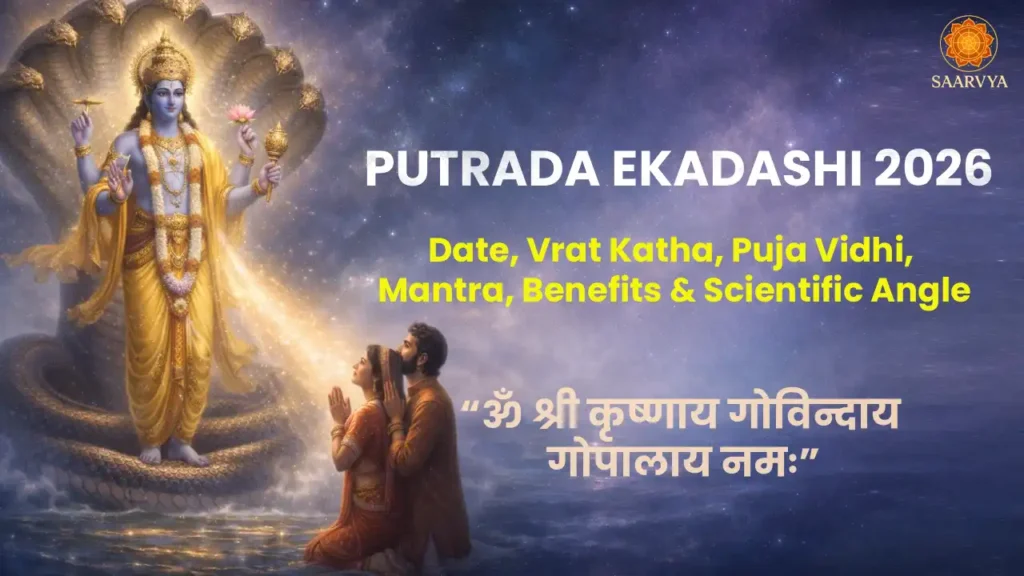

Putrada Ekadashi is observed as a deeply significant vrata associated with the blessing, protection, and wellbeing of children. The word Putrada is derived from putra (child) and da (giver), symbolising an Ekadashi that bestows progeny and safeguards one’s lineage. This sacred observance is especially revered by couples desiring children and by parents praying for their children’s health, character, and success. Traditionally, it is observed twice a year once in the Pausha–Magha period and once during Shravana, each carrying the same devotional essence centred on Lord Vishnu.
Putrada Ekadashi 2026 is a sacred fast dedicated to Lord Vishnu, observed mainly by couples desiring children and by parents praying for their children’s health, protection, and success. Devotees avoid grains, perform Vishnu worship, listen to the Putrada Ekadashi Vrat Katha, and break the fast during Dwadashi Parana time. This Ekadashi is traditionally associated with blessings of progeny, family harmony, spiritual merit, and overall prosperity when observed with faith and discipline.
| Also Read |
|---|
| Shattila Ekadashi 2026: Date, 6 Til Rituals, Vrat Katha, Puja Vidhi, Mantra & Benefits |
| Saphala Ekadashi 2026: Date, Vrat Katha, Puja Vidhi, Mantra, Benefits & Scientific Angle |
Putrada Ekadashi 2026 Dates, Tithi & Parana Time
Putrada Ekadashi is observed twice in a year, and both observances are considered equally sacred in scriptures, though regional emphasis varies. One falls in the Pausha–Magha period, while the other occurs in the Shravana month. In 2026, devotees may choose to observe one or both, depending on family tradition, sampradaya, or personal sankalpa.
As with all Ekadashi vratas, Parana (breaking the fast) must be done on Dwadashi, strictly after sunrise, within the Dwadashi tithi, and never during Hari Vasara (the initial quarter of Dwadashi). Correct Parana timing is essential for the completion of the vrata.
Pausha Putrada Ekadashi 2026 (Pausha Shukla)
In 2026, Pausha Putrada Ekadashi falls on Pausha Shukla Ekadashi. According to the provided tithi details, the Ekadashi begins on 28th Pausha at 4:15 PM (IST) and ends on 29th Pausha at 06:24 PM (IST).
Devotees observe the fast throughout the Ekadashi tithi and perform Parana on Dwadashi, after sunrise and once Hari Vasara has passed. Since sunrise timings differ across cities, readers are advised to confirm city-specific Parana windows using a reliable local panchang or temple calendar.
This observance is particularly emphasised in North India and among many Vaishnava households, where it is regarded as the primary Putrada Ekadashi of the year.
Shravana Putrada Ekadashi 2026
Shravana Putrada Ekadashi 2026 falls on Sunday, 23 August 2026, with Parana on Monday, 24 August 2026, typically in the morning hours (for example, around 06:05–08:35 AM in some Indian panchangs). Exact timings should always be verified locally.
This Ekadashi occurs during Shravana Shukla Paksha and is closely associated with Bal-Krishna devotion, Jhulan Yatra traditions, and prayers for child welfare. It is widely observed across India and is especially popular among families praying for the wellbeing, education, and moral growth of their children.
Putrada Ekadashi 2026 (India Focus)
| Type | Date (2026) | Month & Paksha | Parana Guideline | Region / Common Use |
|---|---|---|---|---|
| Pausha Putrada Ekadashi | Around Sat, 31 Jan 2026 (Pausha Shukla Ekadashi; confirm city-wise) | Pausha, Shukla Paksha | Dwadashi after sunrise, within tithi; avoid Hari Vasara | North India, many Vaishnava families |
| Shravana Putrada Ekadashi | Sun, 23 Aug 2026 | Shravana, Shukla Paksha | Parana next morning (e.g., 24 Aug, early morning) | Widely followed, child-welfare focus |
Note: Dates and timings are based on lunar calculations and can vary slightly by location. Always consult your local panchang for precise observance and Parana timing.
Meaning of “Putrada” and Devotees’ Intent
The term Putrada is formed from two Sanskrit roots putra (child) and da (giver). In spiritual literature, however, putra is not limited to the idea of a male heir. It broadly signifies offspring, continuity, and the carrying forward of dharma. Putrada Ekadashi is therefore understood as a vrata that supports the blessing of children, the protection of family lineage, and the nurturing of righteous values within the next generation.
Traditionally, this Ekadashi is observed by two primary groups of devotees. The first includes childless couples who seek the blessing of progeny not merely childbirth, but the birth of healthy, virtuous, and long-lived children. The second group includes parents who already have children, who observe the vrata as a prayer for their children’s wellbeing, education, moral strength, and freedom from illness or misfortune.
Importantly, Putrada Ekadashi is not reduced to a single desire. Scriptural interpretations repeatedly stress that while the vrata is renowned for child-related blessings, it also grants general spiritual merit, purification of past karmas, and stability in household life. In this sense, the observance works at multiple levels family, emotional, karmic, and spiritual rather than being limited to biological outcomes alone.
The emphasis on children in this vrata also reflects a deeper Sanatani worldview. In dharmic thought, children are seen as carriers of samskara, entrusted with sustaining ethical, cultural, and spiritual continuity. Putrada Ekadashi thus becomes a day to consciously realign one’s intentions toward responsibility, nurture, and self-discipline qualities essential for both parenting and spiritual growth.
Lord Vishnu as Giver of Children
Putrada Ekadashi is dedicated to Lord Vishnu, revered as the preserver and sustainer of cosmic order. In this role, Vishnu is not only the protector of the universe but also the guardian of family harmony and generational continuity. Many households worship him on this day as Narayan, while others focus on Bal-Krishna or Laddu Gopal, symbolising innocence, divine childhood, and joyful protection.
Puranic texts such as the Padma Purana and Bhavishya Purana (in varying recensions) praise Putrada Ekadashi as a vrata that destroys sins obstructing progeny and fulfils heartfelt prayers offered with sincerity. These references consistently highlight Vishnu’s compassion granting not only children, but also the wisdom to raise them with dharmic values.
Symbolically, worshipping Vishnu for child blessings reflects a subtle teaching: creation must be supported by preservation. Just as Vishnu maintains cosmic balance, parents are reminded of their role in preserving emotional stability, ethical conduct, and spiritual awareness within the family. The vrata therefore shifts focus from mere desire to preparedness and responsibility, aligning human intention with divine order.
Classic Putrada Ekadashi Vrat Katha – Outline
The Putrada Ekadashi Vrat Katha is narrated in several Puranic sources, most commonly associated with the Padma Purana. Though names and minor details vary across versions, the central theme remains unchanged: unfulfilled parenthood caused by past karmas is transformed through devotion, discipline, and surrender to Lord Vishnu.
The Childless King and Queen
In ancient times, there ruled a righteous king often referred to as Suketuman or Mahijit in different tellings who governed his kingdom with justice, compassion, and adherence to dharma. His kingdom prospered, his people were content, and yet a deep sorrow haunted the royal household: the king and queen were childless.
For the royal couple, this absence was not merely emotional. In the dharmic worldview of the time, lack of progeny raised concerns about the continuation of lineage, performance of ancestral rites, and preservation of dharma after their lifetime. The queen grieved silently, while the king carried the burden of anxiety for the future of his people and dynasty.
The Crisis and Search for Guidance
As years passed without resolution, the king grew increasingly troubled. Despite charity, yajnas, and righteous living, the absence of a child persisted. Acknowledging that worldly efforts alone could not remove karmic obstructions, the king decided to seek spiritual counsel.
He journeyed to a forest hermitage where enlightened sages resided. After listening patiently to the king’s sorrow, the sages revealed a difficult truth: past-life karmas were obstructing progeny. These karmas were not punishments but unresolved impressions requiring conscious correction.
The Divine Prescription
Moved by compassion, the sages prescribed a specific known remedy not a ritual of excess, but a vrata of discipline and devotion. They instructed the king and queen to observe Putrada Ekadashi, with sincerity, purity of conduct, fasting, Vishnu worship, night vigil, and proper Dwadashi Parana.
The sages explained that this Ekadashi was especially powerful because it aligned human intention with Vishnu’s sustaining grace, allowing karmic knots related to lineage and creation to loosen naturally.
Fulfilment and Grace
The royal couple followed the instructions exactly. They observed the fast together, restrained their senses, worshipped Lord Vishnu with humility, listened to the Putrada Ekadashi Vrat Katha, and completed the vrata with charity and correct Parana.
In time, by Vishnu’s grace, the queen conceived and later gave birth to a virtuous, healthy son. The kingdom rejoiced, not merely because an heir was born, but because harmony, stability, and hope were restored. The child grew to embody righteousness, ensuring continuity of dharma and prosperity for generations.
Phala-Shruti (Result of the Vrat)
The Katha concludes with a clear declaration:
Those who observe Putrada Ekadashi with faith, listen to this sacred story, and complete the vrata correctly are blessed with progeny, protection of children, removal of child-related suffering, and enduring spiritual merit.
Spiritual Interpretation of the Katha
At a symbolic level, the story extends beyond biological parenthood. Childlessness represents blocked creative energy, whether in relationships, purpose, or life direction. The king’s humility in seeking guidance reflects the need to acknowledge the limits of control and surrender to a higher order.
The child born through the vrata symbolises renewal of dharma, the birth of a sattvic mind capable of carrying values forward. In this light, Putrada Ekadashi teaches that when intention, discipline, and devotion align, new beginnings naturally arise, whether as children, ideas, or meaningful life transitions.
Dashami Preparation (Day Before)
Preparation for Putrada Ekadashi begins on Dashami, the day preceding the fast. This preparatory phase is considered essential because it sets the mental and physical tone for the observance. Traditionally, devotees eat one simple, saatvik meal before sunset, consciously avoiding heavy, oily, overly spicy food, as well as non-vegetarian items. The intention is to gradually reduce sensory indulgence rather than abruptly imposing restraint on Ekadashi day.
Equally important is behavioural discipline. Scriptures and traditional guides advise maintaining brahmacharya, avoiding anger, arguments, harsh speech, and excessive entertainment. The Dashami discipline is meant to calm emotional turbulence, which is especially significant for couples praying for children, as the vrata emphasises harmony between mind, body, and intention.
Couples desiring progeny are encouraged to take a joint sankalpa on Dashami itself, mentally resolving to observe Putrada Ekadashi together for child blessing and family wellbeing. This shared resolve symbolises unity, patience, and mutual responsibility, which are central themes of this vrata.
Ekadashi Day – Morning Ritual
Snan and Sankalpa
On the morning of Putrada Ekadashi, devotees ideally wake up during Brahma Muhurta or at least early morning. A bath is taken to signify purification; some households add a few drops of Ganga jal to the water as a symbolic reminder of sacred rivers and inner cleansing.
Clean clothes are worn, traditionally in white or yellow, colours associated with purity and sattva. If possible, husband and wife sit together during the initial prayer, reinforcing the shared nature of the sankalpa.
The sankalpa is spoken aloud or mentally, clearly stating the intention of observing Putrada Ekadashi. It usually includes one’s name, family lineage (if known), and the purpose such as praying for progeny, children’s health, or protection offered under the grace of Lord Vishnu. This conscious articulation transforms the fast from routine observance into a focused spiritual commitment.
Altar Setup and Main Puja
The puja space is cleaned and prepared with simplicity. An image or idol of Lord Vishnu often accompanied by Goddess Lakshmi or Laddu Gopal is placed on the altar. A kalash, diya, incense, flowers, and fruits are arranged neatly.
Worship begins by lighting a ghee diya, followed by offering incense and flowers. Tulsi leaves, collected earlier (as tulsi is not plucked on Ekadashi), are offered at Vishnu’s feet, as tulsi symbolises devotion and purity. Naivedya consists of Ekadashi-appropriate food, such as fruits, milk, or lightly prepared vrat dishes.
Devotees then recite Vishnu Sahasranama, selected verses from the Bhagavad Gita, or child-focused Krishna prayers. Couples often chant together, reinforcing emotional bonding and shared hope. Listening to or reading the Putrada Ekadashi Vrat Katha in full is considered a key part of the puja, followed by a calm, unhurried aarti.
Daylong Observance & Night Worship
Throughout the day, the fast is maintained according to one’s capacity nirjala, water-only, fruit-based, or Ekadashi-friendly meals. What matters most is steadiness of mind and intention, not the strictness of deprivation. Traditional guidance advises avoiding daytime sleep, as Ekadashi is meant to be a day of alertness and mindful living.
In the evening, families often engage in bhajan, kirtan, or nama-japa. Some observe partial night vigil, while others extend prayer time before resting. The night worship symbolises vigilance remaining awake to one’s responsibilities and inner state, especially relevant for those seeking the blessing of parenthood.
Dwadashi Parana (Breaking the Fast)
The vrata concludes on Dwadashi, the day after Ekadashi. The fast must be broken after sunrise, within Dwadashi tithi, and only once Hari Vasara has ended. This timing is essential, as Parana completes the vrata cycle.
Before eating, devotees offer a short prayer to Lord Vishnu and, if possible, perform charity such as donating food, clothes, or dakshina. Traditional advice suggests breaking the fast at home, beginning with water or fruit, followed by a simple, sattvik meal. This gentle transition reflects gratitude and closure rather than indulgence.
Putrada Ekadashi Food Guidelines
Food discipline on Putrada Ekadashi is not meant to create hardship; it is intended to support clarity of mind, lightness of body, and emotional balance. Since this vrata is closely linked with prayers for children and family wellbeing, traditional guidance emphasises purity, moderation, and consistency rather than extreme austerity.
The core dietary principle of Putrada Ekadashi is complete avoidance of grains and pulses. Grains are traditionally believed to increase heaviness and restlessness on Ekadashi, while a lighter diet helps sustain alertness and devotional focus throughout the day.
Allowed and Restricted Foods on Putrada Ekadashi
| Category | Allowed on Putrada Ekadashi | To Avoid on Putrada Ekadashi |
|---|---|---|
| Grains & pulses | Completely avoid – no rice, wheat, barley, lentils, beans | Rice, roti, dal, khichdi, cereals, bakery items |
| Vegetables | Light options like potato, sweet potato, arbi (if tradition permits) | Onion, garlic, leafy greens, heavy mixed curries |
| Flours & starch | Singhara, kuttu, rajgira, sabudana, samak rice (vrat flours) | Atta, maida, suji, multigrain flours |
| Fruits & nuts | Seasonal fruits, coconut, dry fruits, makhana | Canned fruits with additives or preservatives |
| Dairy | Milk, curd, ghee, paneer (mildly spiced) | Overly rich sweets, packaged flavoured milk |
| Drinks | Water, lemon water, herbal teas (if custom permits) | Alcohol, soft drinks, energy drinks, smoking |
While these guidelines are widely followed, regional and sampradaya-based variations exist. Some traditions allow certain vegetables or flours, while others follow stricter rules. The essence of the vrata lies in intentional simplicity, not rigid uniformity.
It is also important to approach fasting with awareness of health. Pregnant women, people with diabetes, or those with serious medical conditions should consult a healthcare professional and choose milder forms of fasting. Putrada Ekadashi encourages balance honouring the body while cultivating discipline.
The deeper symbolism of these food rules lies in restraint. By stepping away from habitual foods, devotees practise letting go of automatic cravings, reinforcing patience and emotional steadiness qualities considered vital for parenting and spiritual maturity.
Do’s for Maximum Putrada Phala
Observing Putrada Ekadashi with sincerity involves aligning external practice with inner conduct. The vrata is believed to yield its fullest results when discipline is accompanied by emotional balance and ethical awareness.
Devotees are advised to fast according to their capacity, but with a firm commitment to avoiding grains. Couples who are praying for children are traditionally encouraged to observe the vrata together, as joint observance symbolises unity, patience, and shared responsibility qualities essential for family life.
Regular Vishnu or Laddu Gopal worship is central to the day. Lighting lamps, offering tulsi, chanting mantras, and listening to the Putrada Ekadashi Vrat Katha help keep the mind focused on devotion rather than on the discomfort of fasting. Charity is also strongly recommended especially acts related to child welfare, such as donating food, supporting education, temple service, or Gau-seva.
Equally important is mental purity. Maintaining truthfulness, compassion, restraint in speech, and emotional calm throughout the day is considered as significant as ritual correctness. The vrata is meant to cultivate patience and hope, not anxiety or tension.
Don’ts (Common Mistakes to Avoid)
Certain actions are traditionally discouraged because they disrupt the reflective and sattvic nature of Ekadashi. Consumption of grains, meat, eggs, onion, garlic, alcohol, or intoxicants is avoided, as these are believed to increase tamasic tendencies and mental agitation.
Behavioural discipline is equally emphasised. Lying, quarrelling, harsh speech, and indulgence in anger or gossip are considered detrimental to the spiritual merit of the vrata. Excessive daytime sleeping is discouraged, as Ekadashi is meant to be observed with alertness and awareness.
Specific traditional cautions include not plucking tulsi leaves on Ekadashi, avoiding cutting hair or nails, and refraining from shaving. While practices may vary across households, the underlying principle remains consistent: minimise outward distractions to deepen inward focus.
Spiritual & Family Benefits
The most widely known benefit of Putrada Ekadashi is its association with progeny and child welfare. Scriptural narratives describe it as a powerful observance for couples longing for children, while also extending its blessings to families who already have children.
Parents observe this vrata to seek protection from illness, accidents, and misfortune for their children, as well as success in education, career, and character development. The observance is believed to soften karmic obstacles related to family life and restore sukha (happiness), shanti (peace), and stability within the household.
Beyond family-related outcomes, Putrada Ekadashi is also described as a purifier of past karmas. By observing restraint, devotion, and charity, devotees are said to gradually release burdens that obstruct harmony and fulfilment.
Inner and Health-Related Benefits
At a subtler level, the vrata cultivates self-control, patience, and emotional resilience qualities that are especially relevant for couples navigating stress related to infertility or parenting concerns. Sharing a common sankalpa can strengthen emotional bonding and reduce feelings of isolation or anxiety.
From a health perspective, sensible fasting supports digestive rest and mental clarity when done mindfully. Reduced food intake for a day encourages awareness of eating habits and can foster a healthier relationship with food and self-discipline over time.
Intermittent Fasting on Ekadashi – Modern View
When viewed through a modern lens, Ekadashi fasting resembles gentle intermittent fasting, practised once every fortnight. Such periodic fasting has been associated with improved metabolic flexibility, better insulin response, and activation of cellular repair processes, often discussed under autophagy.
A light, grain-free diet reduces digestive load, which may help people who experience heaviness or bloating from frequent grain consumption. However, these benefits are supportive in nature and should not be seen as medical treatment.
Emotional & Psychological Layer
The combination of fasting, prayer, and storytelling offers a structured emotional framework for coping with child-related stress. Rituals provide a sense of agency and hope, while mantra and devotion promote calmness and emotional regulation.
Importantly, traditional teachings emphasise that Putrada Ekadashi complements, not replaces, medical care. Couples are encouraged to continue appropriate medical treatment alongside spiritual practice, integrating faith with practical responsibility.
Powerful Mantras for Putrada Ekadashi
Mantra japa on Putrada Ekadashi is meant to calm the mind, purify intention, and anchor the devotee in Vishnu-smarana throughout the vrata. The emphasis is on steadiness and sincerity, not numerical excess.
Core Vishnu Mantra
“ॐ नमो भगवते वासुदेवाय”
This is the most widely recommended mantra for Ekadashi. Chanting it 108 times is considered sufficient for most householders. Those who are able may extend the count to 1008 repetitions, especially if observing the fast with a focused sankalpa related to children or family wellbeing.
Child-Focused Krishna Mantra (Laddu Gopal Worship)
“ॐ श्री कृष्णाय गोविन्दाय गोपालाय नमः”
This mantra is traditionally chanted by parents praying for the health, protection, and moral growth of children. It may be repeated gently throughout the day, even without a mala, allowing remembrance to flow naturally.
Simple Parana Sankalpa (After Dwadashi Fast-Break)
“हे कमलनयन भगवान, आज द्वादशी पर आपका प्रसाद स्वरूप यह अन्न ग्रहण कर रहा/रही हूँ। कृपया मेरी संतान और कुल की रक्षा करें।”
This short prayer expresses gratitude and seeks continued protection for children and family lineage.
A brief kshama-prarthana is also customary, requesting forgiveness for any mistakes in fasting, timing, or ritual. This reinforces humility and ensures the vrata concludes with emotional balance rather than fear of imperfection.
Frequently Asked Questions
When are Pausha and Shravana Putrada Ekadashi in 2026 and what are their Parana timings?
Pausha Putrada Ekadashi falls on Pausha Shukla Ekadashi, with Ekadashi tithi starting on 14th Magh at 2:21 PM (IST) and ending on 15th Magh at 12:00 PM (IST). Shravana Putrada Ekadashi is on 23 August 2026, with Parana on 24 August morning. Exact Parana timing should be confirmed city-wise.
Is Putrada Ekadashi only for those who want a son, or for daughters too?
Putrada Ekadashi is for healthy, virtuous children of any gender. Scriptural interpretation emphasises progeny and lineage, not preference for sons.
Can single people or parents with grown-up children keep Putrada Ekadashi fast?
Yes. Even those without child-related wishes may observe Putrada Ekadashi for family harmony, spiritual merit, and protection of younger relatives or future generations.
What if someone cannot do a nirjala fast—will fruit-only or Ekadashi-food fasting still give benefits?
Yes. The vrata’s merit depends on intention, restraint, and devotion, not extreme austerity. Mild fasting is fully acceptable.
Can medical treatment for infertility continue alongside Putrada Ekadashi vrata?
Yes. Traditional understanding views the vrata as complementary, not a replacement for medical care. Faith and practical effort are meant to work together.
What mistakes reduce the punya of Putrada Ekadashi?
Eating grains knowingly, breaking the fast during Hari Vasara, engaging in anger or deceit, and neglecting Parana timing are commonly mentioned lapses. Accidental errors can be corrected through sincerity and kshama-prarthana.