
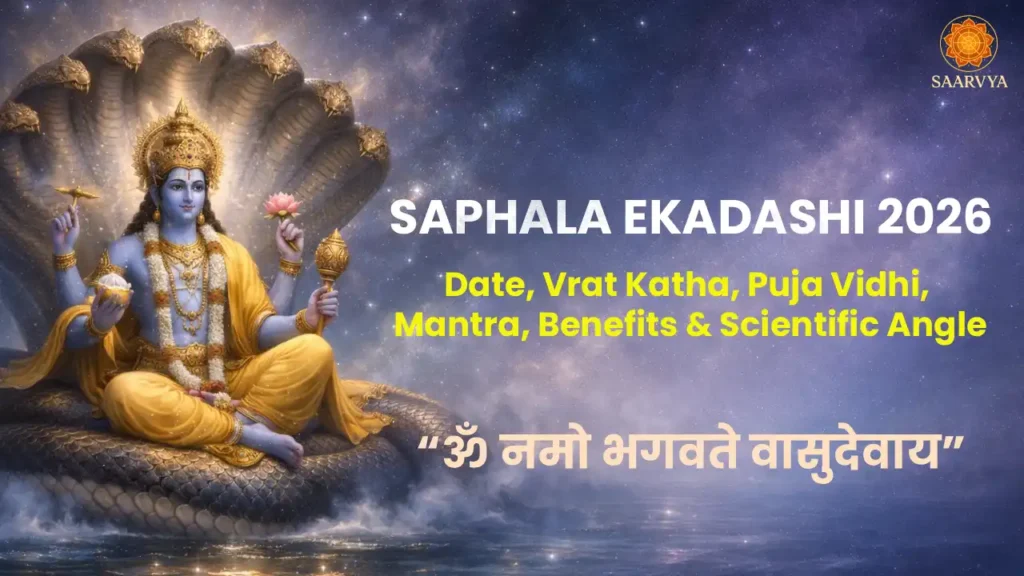

Saphala Ekadashi is observed as a sacred vrata that symbolises turning effort into success and intention into fulfilment. The word Saphala literally means “fruitful” or “successful,” reflecting the belief that this Ekadashi helps remove obstacles and make endeavours meaningful. It falls in the Pausha month during Krishna Paksha (December–January) and is dedicated to Lord Vishnu. Devotees observe this fast to seek prosperity, inner clarity, and Vishnu’s grace in this life and beyond.
Saphala Ekadashi in 2026 is observed on the Ekadashi of Pausha Krishna Paksha and is dedicated to Lord Vishnu. Devotees observe a vrata by avoiding grains, performing Vishnu puja, listening to the Saphala Ekadashi Vrat Katha, and breaking the fast during Dwadashi Parana time. This observance is traditionally associated with success, prosperity, removal of obstacles, and steady spiritual upliftment when practiced with discipline and devotion.
| Also Read |
|---|
| Putrada Ekadashi 2026: Date, Vrat Katha, Puja Vidhi, Mantra, Child Blessings & Scientific Benefits |
| Shattila Ekadashi 2026: Date, 6 Til Rituals, Vrat Katha, Puja Vidhi, Mantra & Benefits |
Saphala Ekadashi 2026 Date, Tithi & Parana Time
Saphala Ekadashi occurs in the Pausha month during Krishna Paksha, typically falling between late December and early January in the Gregorian calendar. In 2026, the observance will follow the lunar tithi system, which means the exact civil date and timings can vary slightly by location due to sunrise–sunset differences.
As with all Ekadashi vratas, Parana (breaking the fast) must be done on Dwadashi, after sunrise, and not during Hari Vasara (the first quarter of Dwadashi). This timing is considered crucial to receive the full spiritual merit of the vrata. Devotees are advised to consult their local panchang or temple calendar for precise timings applicable to their city.
Saphala Ekadashi 2026 (India Focus)
| Detail | Information |
|---|---|
| Lunar month | Pausha Krishna Paksha Ekadashi (waning phase) |
| Dedicated deity | Lord Vishnu (Narayan / Achyuta) |
| Core theme | Success, fulfilment of efforts, removal of obstacles |
| Fasting focus | Ekadashi-style fast, avoidance of grains, Vishnu bhakti |
| Parana guideline | Breakfast on Dwadashi after sunrise, within Dwadashi tithi, avoiding Hari Vasara |
Note: Exact clock timings should always be verified from a reliable regional panchang, especially if you are observing the vrata strictly or performing temple-based rituals.
Meaning of “Saphala” and Ekadashi Basics
The word Saphala comes from Sanskrit and means fruitful, successful, or fulfilled. In the context of this vrata, it refers not only to material success but also to actions yielding meaningful outcomes aligned with dharma. Saphala Ekadashi is therefore understood as a sacred observance that helps convert effort into result especially when previous attempts feel blocked, delayed, or repeatedly unsuccessful.
Ekadashi itself occurs on the eleventh lunar day of both the waxing and waning phases of the Moon. Traditionally, it is associated with the discipline of the eleven indriyas the five senses of perception, five organs of action, and the mind. By consciously regulating food, sleep, and sensory engagement on Ekadashi, devotees aim to restore balance between desire, action, and awareness.
Across Vaishnava traditions, Ekadashi is dedicated to Lord Vishnu, the preserver principle in Sanatana Dharma. Each Ekadashi has a distinct name, legend, and subtle emphasis. In this sequence, Saphala Ekadashi is regarded as especially relevant for those seeking to make their efforts count whether in worldly responsibilities or spiritual practice.
Why Devotees Observe Saphala Ekadashi
Devotees observe Saphala Ekadashi to seek relief from stagnation and to invite clarity where confusion dominates. Classical descriptions link this vrata to prosperity, victory over obstacles, and the accumulation of punya (spiritual merit) that supports both present-life wellbeing and future spiritual progress.
Many practitioners are drawn to this observance during phases of repeated failure, career delays, unstable finances, strained relationships, or loss of direction. The symbolism is clear: when actions are purified through restraint, devotion, and awareness, even ordinary efforts begin to bear fruit. Scriptural narratives further state that sincere observance leads to Vishnu’s grace, culminating after the enjoyment of righteous worldly success in attainment of Vishnu Loka.
More subtly, this Ekadashi is also about inner success: gaining mastery over impulses, redirecting wasted energy, and aligning personal will with a higher sustaining order.
Saphala Ekadashi Vrat Katha – Full Story Outline
The traditional Saphala Ekadashi Vrat Katha is narrated against the backdrop of the cold Pausha month, a time symbolically associated with scarcity, reflection, and inner reckoning. Ancient texts describe a powerful king who ruled a prosperous kingdom with wisdom and discipline. However, his greatest sorrow was his own son, a prince who consistently chose indulgence over responsibility.
The Fallen Prince
The prince squandered his life in gambling, intoxication, violence, and disrespect toward elders, brahmanas, and even the devas. His reckless actions brought shame to the royal household and unrest within the kingdom. Despite repeated warnings and opportunities for reform, the prince remained trapped in destructive habits. Eventually, the king, bound by dharma,a exiled his own son, unable to tolerate the erosion of moral order.
Stripped of royal comfort, the prince wandered into a forest, destitute, hungry, and abandoned. The forest, harsh and unforgiving, mirrored his inner emptiness. His former life of excess had left him incapable of discipline, devotion, or hope.
The Unconscious Observance
One evening, exhausted and starving, the prince collapsed beneath a tree. Unaware of lunar calendars or sacred observances, he unknowingly found himself on the night of Saphala Ekadashi. Nearby, a small group of devotees were performing a simple Vishnu worship, lighting lamps and chanting the Lord’s names.
The prince remained awake through the night not out of devotion, but due to hunger and despair. He heard the chanting, saw the lamps, and spent the night in silent witness. By accident, he fulfilled the three core disciplines of Ekadashi: fasting, jagran (wakefulness), and association with Vishnu’s name.
Divine Transformation
Scriptural narration explains that Lord Vishnu’s grace does not depend solely on intent, but also on alignment. The prince’s unconscious participation in the sanctity of Saphala Ekadashi dissolved the weight of his accumulated sins. His karmic trajectory shifted.
In subsequent time, the prince experienced a complete transformation either through reformation in the same life or rebirth as a virtuous ruler, depending on textual variation. He became disciplined, prosperous, and just, eventually ruling successfully and living in harmony with dharma.
Phala-Shruti (Result of the Vrat)
The story concludes with a clear assurance:
Anyone who observes Saphala Ekadashi with faith whether through full ritual or sincere effort attains success, forgiveness of sins, prosperity, and spiritual elevation, ultimately reaching Vishnu Loka after the completion of worldly duties.
Symbolic and Spiritual Interpretation
At a deeper level, the fallen prince represents the restless human mind, endlessly dissipating energy through uncontrolled desires. His exile signifies the inevitable consequences of ignoring discipline and awareness.
The accidental fasting and wakefulness underline a profound idea in Sanatana Dharma: even unconscious alignment with sacred rhythm can initiate transformation. Saphala Ekadashi thus teaches that failure is not final; discipline, restraint, and surrender can convert wasted potential into fulfilment.
Step-by-Step Puja Vidhi at Home
The Puja Vidhi of Saphala Ekadashi is designed to be simple yet deeply intentional. Unlike elaborate rituals, this vrata emphasises discipline, purity, and focused devotion to Lord Vishnu. The process unfolds gradually from mental preparation to the final Parana, allowing the devotee to align body, mind, and intention with the sanctity of the Ekadashi tithi.
Preparation for Pausha Krishna Dashami
Preparation for the vrata begins on Dashami, the day before Ekadashi. Traditional guidance advises eating a light, saatvik meal in the evening, avoiding heavy, oily, tamasic, or non-vegetarian food. Many practitioners also avoid grains from Dashami night itself, as this helps the body gradually adjust to the fast.
Equally important is mental preparation. One is encouraged to consciously reduce distractions, cultivate calmness, and resolve to observe the vrata according to one’s health and capacity. Depending on physical condition and tradition, devotees may choose:
- Nirjala vrata (without food and water),
- Water-only fasting, or
- Phalahar / Ekadashi-friendly meals (fruits, milk, nuts).
The intention is not self-punishment, but mindful restraint.
Morning Routine on Ekadashi Day
On the day of Saphala Ekadashi, devotees wake up early ideally during Brahma Muhurta and take a bath to symbolise inner and outer purification. Clean, light-coloured clothes are traditionally preferred, reflecting simplicity and clarity.
The altar or puja space is cleaned, and an image or idol of Lord Vishnu (Narayan, Achyuta, or Lakshmi Narayan) is placed respectfully. A diya, incense, flowers, tulsi leaves, and a kalash (if used in your tradition) are arranged.
Before beginning worship, the devotee takes a Sankalpa, a verbal declaration of intent. This includes one’s name, gotra (if known), the mention of Saphala Ekadashi 2026, and the purpose of the vrata, such as success in endeavours, removal of obstacles, or spiritual growth. Sankalpa anchors the ritual in conscious will.
Main Worship Steps
The main puja begins by lighting a ghee diya, followed by offering incense and flowers. Tulsi leaves are placed at Vishnu’s feet, as tulsi is considered especially dear to him. Simple bhoga prepared without grains such as fruits, milk, dry fruits, or traditional Ekadashi dishes, is offered with devotion.
Chanting forms the heart of the worship. Devotees may recite:
- Selected verses from the Bhagavad Gita,
- Vishnu Sahasranama, or
- A chosen Vishnu mantra with a mala.
Listening to or reading the Saphala Ekadashi Vrat Katha with family is considered particularly auspicious, as it reinforces the vrata’s spiritual lesson. The puja concludes with aarti, offered calmly and without haste.
Evening Worship and Jagran
As evening approaches, emphasis shifts toward deep daan—the offering of lamps. Lighting lamps in a temple, near a peepal tree, or in a clean sacred space at home is considered highly beneficial on this Ekadashi.
Bhajan, nama-japa, or quiet contemplation may continue into the night. While a complete night-long jagran is optional, staying awake for at least part of the night is regarded as spiritually rewarding. The idea is to remain mentally alert and inwardly attentive, rather than physically exhausted.
Dwadashi Parana (Breaking the Fast)
The vrata concludes on Dwadashi, the day after Ekadashi. The fast must be broken after sunrise, within the Dwadashi tithi, and never during Hari Vasara (the initial quarter of Dwadashi). This timing is crucial and should be checked carefully using a reliable panchang.
Parana is ideally done gently beginning with water or fruit, followed by a simple saatvik meal. Many devotees also perform charity before eating, offering food, clothes, or donations to the needy as an act of gratitude and humility.
Ekadashi Food Rules (Diet Table)
Dietary discipline is a core component of Saphala Ekadashi, not merely as a restriction but as a conscious method of reducing sensory load and cultivating awareness. Traditional Ekadashi rules focus on avoiding grains and pulses, as they are believed to increase tamasic heaviness and digestive strain on this lunar day. The aim is to keep the body light so the mind remains steady and receptive.
What to Eat and What to Avoid on Saphala Ekadashi
| Category | Allowed on Saphala Ekadashi | To Avoid on Saphala Ekadashi |
|---|---|---|
| Grains & pulses | None – complete avoidance is recommended | Rice, wheat, barley, dal, beans, all cereals |
| Root vegetables | Potato, sweet potato (if permitted by your tradition) | Onion, garlic, mixed heavy roots |
| Flours | Singhara, sabudana; some traditions allow kuttu or samak | Atta, maida, suji, multigrain flours |
| Fruits & nuts | Fresh fruits, coconut, dry fruits, peanuts, makhana | Canned fruits, heavily processed sweets |
| Dairy | Milk, curd, ghee, paneer (light preparation) | Flavoured or packaged dairy, very heavy sweets |
| Drinks | Water, lemon water (without salt if restricted), herbal teas | Alcohol, soft drinks, energy drinks |
While the table provides a general framework, it is important to note that sampradaya-based variations exist. Some Vaishnava traditions follow stricter rules, while others permit limited root vegetables or flours. Health conditions must also be respected Ekadashi fasting is about awareness and restraint, not physical strain.
The deeper purpose of this diet is symbolic. By voluntarily setting aside habitual foods, devotees train the mind to detach from routine cravings, reinforcing the central teaching of Ekadashi: mastery over the senses leads to inner clarity and outer success.
Do’s (For Best Results)
Observing Saphala Ekadashi with sincerity involves more than fasting alone. The vrata is most effective when external discipline is supported by inner alignment and ethical conduct.
First, observe the fast according to your physical capacity, but remain firm about avoiding grains. Even a mild fast, when done with awareness and devotion, carries spiritual value. Ekadashi is ultimately about restraint, not rigidity.
Second, engage in Vishnu bhakti throughout the day. Offering tulsi, lighting lamps, and chanting Vishnu mantras help anchor the mind in remembrance. Deep daan—especially in the evening is emphasised in many traditions of Saphala Ekadashi as a way of symbolically removing inner darkness.
Listening to or reading the Saphala Ekadashi Vrat Katha is equally important. The story is meant to be reflected upon, reminding devotees how discipline and alignment can transform failure into fulfilment.
Charity completes the observance. Offering food, clothes, or monetary help to the needy, temples, or Gau-seva channels gratitude into action. Alongside these practices, maintaining purity of thought truthfulness, patience, forgiveness, and kindness ensures that the vrata remains spiritually fruitful.
Don’ts (Common Mistakes to Avoid)
Certain actions are traditionally discouraged during Ekadashi because they disturb mental and emotional equilibrium. Consumption of grains, meat, eggs, alcohol, and overly tamasic foods is avoided, as such foods are believed to increase restlessness and dullness.
Breaking the fast prematurely or during Hari Vasara on Dwadashi is considered a significant mistake. Parana timing should always be checked carefully, as it completes the vrata cycle correctly.
Behavioural discipline is equally important. Anger, gossip, harsh speech, dishonesty, and excessive sensory stimulation such as prolonged media consumption are discouraged, as they counteract the introspective purpose of the day.
Lastly, while devotion is encouraged, overexertion is not. Those observing stricter forms of fasting should avoid unnecessary physical strain and listen to their body. Ekadashi is meant to refine awareness, not exhaust it.
Spiritual and Karmic Merit of Saphala Ekadashi
The spiritual significance of Saphala Ekadashi lies in its emphasis on conversion—the transformation of effort, intention, and even past mistakes into meaningful outcomes. Classical texts describe this Ekadashi as especially potent for neutralising accumulated karmic burdens and redirecting life toward dharmic alignment. When observed with faith, restraint, and devotion, the vrata is said to generate punya equivalent to major yajnas and pilgrimages, though symbolically rather than as a literal comparison.
At a karmic level, this observance is believed to help devotees recognise patterns of wasted energy habits, attachments, or actions that do not lead to growth. Through fasting, prayer, and mindful conduct, these tendencies are gradually refined. In this sense, Saphala Ekadashi is not about instant rewards, but about making one’s life trajectory fruitful, step by disciplined step, under the sustaining grace of Lord Vishnu.
Success, Prosperity and Vishnu Loka
Because of its central theme of fulfilment, Saphala Ekadashi is traditionally recommended for those seeking success in career, business, education, legal matters, or important life ventures. Scriptures describe that sincere observance brings stability, clarity of decision-making, and favourable outcomes not through magic, but through inner alignment and ethical action.
Beyond worldly success, the vrata is also associated with spiritual culmination. Textual praise states that after enjoying righteous prosperity in this world, a devotee who regularly observes Ekadashi with devotion ultimately attains Vishnu Loka, the abode of Lord Vishnu. This is understood as the soul’s return to a state of harmony, free from repeated cycles of unrest and dissatisfaction.
Health and Mind Benefits of Ekadashi Fasting
From a modern perspective, Ekadashi fasting aligns closely with principles now recognised in intermittent fasting. Abstaining from heavy foods especially grains once every fortnight allows the digestive system to rest, which may support improved metabolic flexibility and insulin sensitivity. Periodic fasting is also associated in contemporary research with cellular repair mechanisms, often discussed under the concept of autophagy.
Reduced digestive load frees mental and physical energy, which explains why many practitioners report greater clarity, calmness, and focus on Ekadashi. This experiential benefit corresponds closely with traditional descriptions that Ekadashi supports meditation, mantra japa, and contemplative practices.
Lunar Cycle, Emotions and Ekadashi
Traditional understanding links Ekadashi to the lunar cycle’s influence on the human body and mind. Since the body is largely composed of fluids, changes in lunar gravitational pull were observed to subtly affect emotional and mental states. Reducing food intake during such phases is believed to stabilise mood and minimise restlessness.
When fasting is combined with prayer, mantra, and periods of silence, it can help cultivate self-control and emotional regulation. Over time, this disciplined rhythm may reduce impulsive cravings and promote a balanced relationship with food, desire, and attention.
Health note: Individuals with diabetes, pregnancy, eating disorders, or severe medical conditions should consult a healthcare professional and choose milder forms of fasting. Ekadashi observance should always respect bodily limits.
Recommended Mantras & Japa Count
Mantra japa on Ekadashi is meant to steady the mind and keep awareness anchored in Vishnu-smarana throughout the day. On Saphala Ekadashi, simplicity and sincerity matter more than the number of rituals performed.
Universal Vishnu Mantra
“ॐ नमो भगवते वासुदेवाय”
This is the most commonly recommended mantra for Ekadashi. Chanting it 108 times with a mala is considered sufficient for householders, while those who are able may extend the japa to 216 or 1008 repetitions, depending on time and capacity.
Simple Nama-Japa
“श्रीकृष्ण गोविन्द हरे मुरारे, हे नाथ नारायण वासुदेव”
This form of remembrance can be done mentally during daily activities, especially while fasting. Continuous, gentle repetition helps maintain inner focus without strain.
At the end of the day or after Parana, devotees traditionally offer a kshama-prarthana, seeking forgiveness for any mistakes in fasting, timing, or ritual. This reinforces humility and completes the vrata with emotional balance rather than anxiety about perfection.
Frequently Asked Questions
When is Saphala Ekadashi in 2026 and what is the best time for Parana?
Saphala Ekadashi falls in Pausha Krishna Paksha. Parana should be done on Dwadashi after sunrise, within Dwadashi tithi, avoiding Hari Vasara. Local panchang timings should always be checked.
What are the main benefits of Saphala Ekadashi vrat?
The vrata is traditionally associated with success in efforts, removal of obstacles, accumulation of spiritual merit, and gradual inner clarity through discipline and devotion.
Can I drink tea or coffee while fasting on Saphala Ekadashi?
Traditionally, tea and coffee are avoided as they stimulate the senses. However, those with health concerns may take mild alternatives after consulting their body’s needs.
Is Saphala Ekadashi good for career and business success?
Scriptural tradition links this Ekadashi to making efforts fruitful. While not a substitute for action, it supports clarity, discipline, and ethical alignment qualities essential for success.
Who should avoid strict nirjala fasting on Saphala Ekadashi?
Pregnant women, people with diabetes, chronic illness, or those advised otherwise by doctors should avoid strict fasting and choose milder observance.
What if I accidentally eat grains on Ekadashi does the fast become invalid?
Accidental consumption does not nullify devotion. One should continue the vrata sincerely, maintain restraint thereafter, and include a kshama-prarthana.