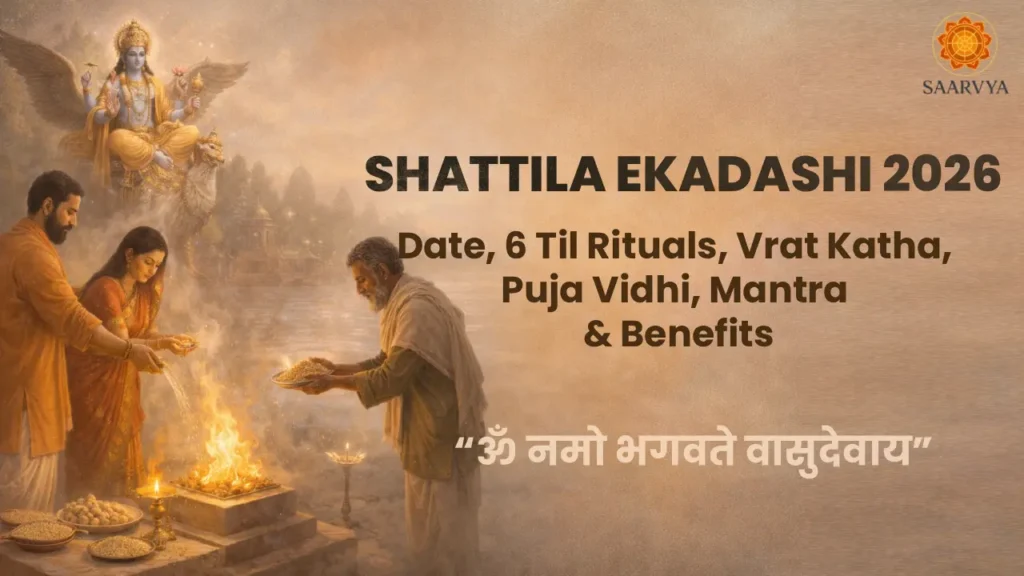

Shattila Ekadashi is a powerful observance centred on purification, generosity, and the conscious removal of scarcity both material and spiritual. The word Shattila is derived from shat (six) and tila (sesame), referring to the six sacred ways in which sesame is used on this Ekadashi for cleansing and charity. It falls on Magh Krishna Ekadashi and is regarded as the first Ekadashi of 2026, coinciding with the Makar Sankranti period in many calendars. This vrata is traditionally associated with the destruction of sins, relief from poverty (daridrya-nash), and the restoration of abundance through til-based worship and daan.
Shattila Ekadashi 2026 will be observed on Wednesday, 14 January 2026 (Magh Krishna Ekadashi). On this day, devotees fast without grains, worship Lord Vishnu with sesame (til) offerings, perform the six sacred til rituals til-bath, til-ubtan, til-havan, til-tarpan, til-bhog, and til-daan and break the fast during Dwadashi Parana time the next morning. The observance is traditionally associated with the removal of poverty and past sins, purification of karma, and the attainment of lasting prosperity and spiritual merit.
| Also Read |
|---|
| Putrada Ekadashi 2026: Date, Vrat Katha, Puja Vidhi, Mantra, Child Blessings & Scientific Benefits |
| Saphala Ekadashi 2026: Date, Vrat Katha, Puja Vidhi, Mantra, Benefits & Scientific Angle |
Shattila Ekadashi 2026 Date, Tithi & Parana Timing
Shattila Ekadashi falls in the Magh month during Krishna Paksha, a period associated with austerity, purification, and charitable giving. In 2026, the Ekadashi tithi begins on 13 January at approximately 2:21–2:22 PM (IST) and ends on 14 January at approximately 12:00–12:01 PM (IST). Accordingly, the fast is observed on Wednesday, 14 January 2026.
As with all Ekadashi vratas, Parana (breaking the fast) must be done on Dwadashi, after sunrise and not during Hari Vasara (the first quarter of Dwadashi). For Shattila Ekadashi 2026, Parana will be on Thursday, 15 January 2026, within the appropriate morning window as per one’s local panchang.
Shattila Ekadashi 2026 (India)
| Detail | Information |
|---|---|
| Ekadashi name | Shattila Ekadashi (Sat-tila Ekadashi) |
| Month & Paksha | Magh month, Krishna Paksha |
| Vrat date (fast) | Wednesday, 14 January 2026 |
| Ekadashi tithi | Begins 13 Jan ~2:21–2:22 PM; ends 14 Jan ~12:00–12:00 PM |
| Parana date | Thursday, 15 January 2026 |
| Parana time (Delhi example) | ~7:15–9:20/9:21 AM (after Hari Vasara ends) |
| Presiding deity | Lord Vishnu / Krishna (sesame offerings) |
| Core focus | Removal of poverty and sins; increase of dhan, anna, and spiritual merit through til-daan |
Note: Tithi boundaries and Parana windows vary by location. Always confirm city-specific timings with a reliable local panchang or temple calendar before observing the vrata.
Meaning and Importance of “Shat + Tila”
The name Shattila Ekadashi itself reveals the core teaching of this vrata. “Shat” means six, and “tila” means sesame. Scriptures describe this Ekadashi as the day when sesame is used in six sacred ways to cleanse sins, correct imbalance caused by greed or neglect of charity, and restore the natural flow of prosperity (anna and dhan) in life.
Unlike many vratas that focus mainly on austerity, Shattila Ekadashi places equal if not greater emphasis on daan (giving). The six til practices symbolically cover the entire cycle of life:
- cleansing the body,
- softening the ego,
- offering to fire and ancestors,
- nourishing oneself,
- and finally nourishing others.
Because of this completeness, Shattila Ekadashi is regarded as especially potent for people experiencing poverty, food insecurity, repeated financial blocks, or a sense of spiritual dryness. Traditional texts repeatedly state that fasting without generosity on this day yields limited results, while even modest charity done sincerely can produce transformative outcomes.
At a deeper level, this Ekadashi addresses the imbalance between accumulation and circulation. When resources, emotions, or effort are hoarded rather than shared, stagnation arises. Shattila Ekadashi teaches that prosperity flows where compassion flows.
Why Sesame (Til) Is Central
Sesame (tila) occupies a unique place in Sanatani ritual life. It is traditionally associated with Shani, ancestral peace (pitṛ-karya), and acts of purification such as tarpan and pinda daan. Because sesame survives harsh climates and contains rich nourishment, it is seen as a symbol of resilience, sustenance, and continuity.
On Shattila Ekadashi, sesame serves three roles simultaneously:
- Snaan (cleansing): Til is used with water or as a paste to symbolically wash away karmic residue.
- Bhog (sustenance): Til-based food nourishes the body during fasting without heaviness.
- Daan (compassion): Donating til, til-sweets, or oil directly feeds others, addressing hunger and lack.
This is why Shattila Ekadashi is often described as a vrata that does not merely pray for abundance but actively creates the karmic conditions for abundance. Sesame becomes the medium through which inner purification and outer generosity meet.
Shattila Ekadashi Vrat Katha – Story Outline
The Shattila Ekadashi Vrat Katha is not just a story about reward and punishment it is a sharp spiritual mirror. It points to a common human tendency: we may perform many rituals, prayers, or fasts, yet still remain inwardly “dry” because the heart does not soften into generosity. This is why the Katha is remembered so strongly it teaches that devotion without compassion becomes hollow.
The Devout but Miserly Brahmani
In an ancient city lived a brahmani known for her discipline. She observed many vratas, worshipped regularly, and followed strict rules of purity. People respected her because she appeared spiritually advanced. Yet there was one deep flaw in her character: she was extremely miserly.
Despite living a life of ritual devotion, she was reluctant to share food, give charity, or help the needy. Even when hungry travellers or poor families approached her, she would avoid giving anything meaningful. Her spirituality remained tightly locked within her own boundary her altar, her vows, her personal merit. It never expanded into the wider dharmic ethic of seva and daan.
This inner dryness is precisely what the story highlights. In Sanatana Dharma, wealth is not seen as inherently impure selfishness is. A person may fast and pray, but if they cannot give even a small portion to someone in need, their devotion is considered incomplete.
Vishnu’s Observation and Narada’s Intervention
Lord Vishnu, who is described as Bhakta-vatsala (one who protects devotees), noticed her sincere ritual effort but also her inner contraction. Rather than rejecting her, Vishnu chose to correct her understanding.
He sent Devarshi Narada, the cosmic messenger of dharma, to teach her a lesson. Narada’s role in such stories is important: he does not punish; he reveals. He exposes the hidden gap between outer religiosity and inner transformation.
Narada approached the brahmani in disguise, appearing as a poor seeker asking for food or charity. The brahmani hesitated. She did not want to give grains, til, sweets, or anything of value. Yet she also did not want to appear uncharitable.
So she chose the easiest way to protect her image while keeping her wealth untouched.
The “Clay Donation” and the Hollow Reward
In one popular version of the story, she offered Narada a lump of clay a symbolic “donation” that cost her nothing. She believed she had done enough to satisfy religious duty without actually giving nourishment.
After death, due to her vratas and ritual merit, she attained a beautiful heavenly realm and was granted a grand palace. At first, she felt rewarded: “My devotion has borne fruit.”
But soon, she discovered something disturbing.
Her palace was empty.
There was no food, no wealth, no abundance only walls, space, and silence. She was surrounded by the appearance of reward, yet she suffered scarcity even there. The Katha describes her distress vividly: she had reached a higher realm, but she still felt hunger and lack.
This is the turning point. The story is not saying “you will be punished if you don’t give.” It is revealing a subtler truth: if you don’t create nourishment for others, you may end up creating emptiness for yourself. A life of hoarding produces a karmic imprint of scarcity no matter how many rituals are performed.
Revelation and the Remedy of Shattila Ekadashi
Confused and desperate, she asked divine women or Narada himself, “Why am I suffering here? I observed vratas. I worshipped. I maintained purity.”
Narada explained gently: her vratas were real, but her compassion was absent. Charity was not an “extra” it was a necessary completion. Her clay donation symbolised a “dead” generosity: outwardly correct, inwardly barren. Therefore, her reward became similarly hollow: a palace without sustenance.
Then Narada gave her the remedy: observe Shattila Ekadashi properly. Not as a dry fast, but as a living vrata with six forms of til use especially til-daan, genuine giving of sesame and food.
Transformation and Fulfilment
The brahmani followed the guidance with sincerity. She performed the til-based rituals, worshipped Lord Vishnu with humility, and most importantly, she gave charity with a softened heart.
As the story narrates, her palace once empty became filled with food, wealth, divine opulence, and peace. Her destiny shifted. She did not lose her ritual discipline; rather, it matured into a fuller dharmic life where devotion and compassion became one.
The Katha concludes with the message that through Shattila Ekadashi, she gained both bhoga (righteous enjoyment) and moksha (spiritual elevation). In other words, abundance was restored not merely as money, but as inner wholeness.
Phala-Shruti (Fruit of the Vrat)
The traditional phala-shruti declares that one who observes Shattila Ekadashi with sincere fasting and sesame-based charity becomes free from major sins and the karmic causes of poverty. Texts often praise it as giving merit equal to great yajnas and many cow donations symbolically emphasising its extraordinary spiritual potency.
Symbolic Interpretation
The brahmani represents a mindset many people unknowingly carry: “I will worship, but I will not share.” The Katha challenges this. It says ritual without compassion leads to empty fruit achievements that look successful but feel hollow.
The clay donation symbolises generosity without life giving that does not truly nourish. Sesame donation, by contrast, represents living charity, because sesame is food, oil, warmth, and sustenance. It feeds bodies and also feeds the karmic field with compassion.
Shattila Ekadashi, therefore, is not just a day for fasting it is a day for opening the heart, the kitchen, and the hand. It transforms scarcity consciousness into flow consciousness, not by superstition, but by deep dharmic psychology: what we release with love, returns as abundance in many forms.
The 6 Ways to Use Til on Shattila Ekadashi
What makes Shattila Ekadashi unique among all Ekadashis is that it prescribes six specific, practical actions using sesame (til). These are not symbolic add-ons; they are deliberate karmic tools designed to cleanse, nourish, and reopen the flow of abundance. Together, they cover body, mind, ancestors, society, and the divine, making this vrata unusually complete.
Rather than viewing these as rigid rituals, it helps to understand them as six movements of energy—from purification to generosity.
Six Til Uses on Shattila Ekadashi
| No. | Til Practice | What to Do | Inner Meaning |
|---|---|---|---|
| 1 | Til-Snaan (Sesame Bath) | Bathe with water mixed with black or white sesame seeds | Cleanses physical and subtle impurities; washes away accumulated karmic heaviness |
| 2 | Til-Ubtan (Sesame Paste) | Apply crushed til mixed with water or oil before bathing | Softens inner dryness, reduces ego rigidity, restores receptivity |
| 3 | Til-Havan | Offer sesame seeds into sacred fire or diya | Surrenders karmic impurities to Agni; invokes purification and prosperity |
| 4 | Til-Tarpan | Offer til with water to ancestors and devas | Pacifies pitṛs; balances ancestral karmas affecting food and wealth |
| 5 | Til-Bhog / Bhojan | Consume til-based vrat food like til laddoo or roasted sesame | Internalises strength, nourishment, and resilience |
| 6 | Til-Daan (Sesame Charity) | Donate sesame, til sweets, oil, food, or money | Opens the flow of dhan and anna; directly counteracts poverty consciousness |
Why All Six Matter (Not Just One)
Many devotees ask whether performing only til-daan is enough. While charity is the most crucial element, scriptures emphasise that Shattila Ekadashi works best when all six are attempted, even in simple form. The reason is psychological and karmic.
- Til-snaan and ubtan deal with purification
- Til-havan and tarpan deal with release and reconciliation
- Til-bhog deals with receiving without guilt
- Til-daan deals with giving without fear
Together, they heal the full cycle of scarcity: fear of lack, guilt around enjoyment, unresolved ancestral imprints, and resistance to giving.
Practical Flexibility (Important)
Scriptural intent is participation, not perfection.
- If one cannot perform a full homa, offering sesame into a diya is acceptable.
- If til-tarpan is unfamiliar, donating til in the name of ancestors is sufficient.
- If health does not permit fasting strictly, til-bhog becomes even more important.
What must not be skipped lightly is til-daan, because Shattila Ekadashi specifically addresses daridrya (poverty) caused by karmic withholding. Giving even a small quantity with sincerity directly corrects this pattern.
Deeper Insight: Why Sesame Works Symbolically
Sesame is one of the few foods that is:
- long-lasting
- energy-dense
- warming
- usable as food, oil, medicine, and ritual substance
In dharmic psychology, this makes til a symbol of sustainable abundance not excess, not luxury, but nourishment that endures. Using sesame across six dimensions teaches the devotee how to cleanse without rejecting life, and give without becoming empty.
This is why Shattila Ekadashi is repeatedly praised as a vrata that does not merely promise prosperity, but re-educates the relationship with resources themselves.
Dashami Preparation (13 January 2026)
Preparation for Shattila Ekadashi begins on Dashami, not as a formality but as the foundation of the vrata. Shattila is a day where fasting is inseparable from til-based discipline and daan, so the day before is used to reduce distraction and gather what you’ll need—both materially and mentally.
On the evening of 13 January 2026, it is advised to eat a light, sattvic dinner before sunset. Avoid heavy fried food, excess spices, non-vegetarian items, alcohol, and anything that increases restlessness or lethargy. The goal is to enter Ekadashi with a clean digestive state and a calmer mind. If you follow a stricter tradition, you may also reduce or avoid grains from Dashami night itself, but that depends on your family practice.
Dashami is also when you prepare the “til ecosystem” of Shattila:
- Black or white sesame seeds (til)
- Til oil (for lamp or charity)
- Til laddoo / roasted til (or ingredients to make them)
- Tulsi leaves, flowers, diya, incense
- Donation items: til, oil, blankets, food packets, or money—kept ready so charity is not delayed
Most importantly, decide your fasting style honestly:
- Nirjala (only for healthy, experienced devotees)
- Phalahar (fruits, milk, nuts)
- Til-based light meals (especially if you are doing physical work, travelling, or have health constraints)
Shattila Ekadashi is not meant to break the body; it is meant to soften the heart and sharpen the mind.
Ekadashi Morning – Snan & Sankalpa
The morning of 14 January 2026 begins with purification using sesame because the vrata is meant to cleanse both the visible body and the invisible karmic residue.
Wake up early, ideally before sunrise. Begin with til-snaan by adding a small quantity of sesame seeds to bath water. If your tradition permits, apply til-ubtan a paste made by crushing sesame and mixing it with water or a little oil before bathing. This is not merely cosmetic; it symbolises removing the “dry crust” of ego and negativity.
Wear clean, light-coloured clothes and sit at your altar facing East or North, as commonly advised in household worship.
Then take a clear sankalpa a verbal intention that gives spiritual direction to the day. Mention:
- your name (and gotra if known),
- location,
- the date (Shattila Ekadashi, 14 Jan 2026),
- and your intention: purification of sins, removal of poverty/scarcity, cultivation of generosity, and devotion to Vishnu.
Sankalpa matters because Shattila is not a “mechanical” ritual day. The inner decision to transform scarcity-thinking is the real vrata.
Main Puja to Lord Vishnu
Place a picture or idol of Lord Vishnu or Krishna on the altar. Light a diya—ideally with til oil, as sesame oil itself is part of the Shattila spirit. Begin the puja calmly, without hurry.
Offer:
- Sesame seeds (til)
- Til laddoo or roasted til
- Tulsi leaves
- flowers and fruits suitable for Ekadashi
A simple and meaningful act is offering water mixed with sesame at the Lord’s feet. After the puja, that water can be treated as sacred and sipped in small quantity as charanamrit (only if hygienically prepared).
Chanting is central. You may recite:
- Vishnu Sahasranama, or
- a chosen mantra such as “Om Namo Bhagavate Vasudevaya” using a mala
Then read or listen to the Shattila Ekadashi Vrat Katha, because the story carries the ethical teaching: fasting without charity becomes “dry fruit.” Conclude with aarti.
Daylong Fasting & Devotional Practice
Throughout the day, maintain the fast as per your capacity. The key Shattila principle is not how hungry you become, but how sattvic and generous you remain.
Spend the day with:
- mantra-japa,
- bhajan,
- reading scriptures,
- planning charity,
- and consciously avoiding anger, gossip, harsh speech, or excessive screen consumption
In the evening, if possible, perform a small til-havan. If a full homa is not possible, offer sesame into a diya flame or a small fire while chanting Vishnu’s name. Even this minimal act carries the symbolic meaning of offering karmic impurities into transformation.
Dwadashi Parana (15 January 2026)
The vrata completes on 15 January 2026, the Dwadashi day. Begin with a brief Vishnu prayer again, then complete what Shattila emphasises most strongly: til-daan.
Donate in any sincere form:
- sesame seeds,
- til sweets,
- sesame oil,
- food packets,
- warm clothes/blankets,
- or money to someone genuinely in need, temple seva, or a service organisation
Then break the fast during the Parana window. For many Delhi-based panchangs, the window is roughly 7:15/7:16 AM to 9:20/9:21 AM, after Hari Vasara ends. Since timings vary by city, check locally.
Break the fast gently with sattvic food. Avoid heavy, spicy, tamasic meals—Shattila is meant to restore flow, not create rebound indulgence.
Fasting Guidelines & Vrat Diet
The dietary discipline of Shattila Ekadashi is intentionally simple, because the emphasis of this vrata is not indulgence-free austerity but purity, lightness, and generosity. Food choices on this day are designed to keep the body nourished without burdening digestion, so mental clarity and devotional focus are preserved.
The primary rule is complete avoidance of grains and pulses. Along with this, foods that increase heaviness, lethargy, or sensory agitation are traditionally excluded. Sesame, being the spiritual centre of this Ekadashi, is encouraged in safe and simple forms.
Shattila Ekadashi Food Rules
| Category | Allowed | To Avoid |
|---|---|---|
| Grains & pulses | None – complete avoidance | Rice, wheat, barley, lentils, beans, rotis, bread, biscuits |
| Vegetables | Light vrat vegetables like potato, sweet potato, arbi (tradition-dependent) | Onion, garlic, heavy curries, overly spicy vegetables |
| Til items | Til laddoo, roasted til, til chikki (without grain flour) | Commercial til sweets containing maida or grain flours |
| Fruits & nuts | Seasonal fruits, coconut, dry fruits, makhana | Canned or highly sugared preserved fruits |
| Dairy | Milk, curd, ghee, paneer (light preparation) | Heavy, packaged sweets; flavoured dairy with additives |
| Drinks | Water, lemon water, mild herbal teas | Alcohol, soft drinks, energy drinks, intoxicants |
The intention behind these rules is restraint without denial. Til-based food is especially valued because it nourishes the body while reinforcing the symbolic theme of abundance through simplicity.
Health note: People with diabetes, pregnancy, eating disorders, or chronic medical conditions should consult a healthcare professional and adopt a milder form of fasting. Shattila Ekadashi prioritises awareness over extremity.
Do’s (For Daridrya-Nash and Prosperity)
To receive the full spiritual essence of Shattila Ekadashi, certain practices are emphasised more strongly than strict fasting.
First, observe the fast according to your capacity, but strictly avoid grains, meat, onion, and garlic. The vrata loses its meaning if physical strain replaces inner clarity.
Second, use sesame in as many of the six prescribed ways as practically possible, with special importance given to til-daan. Charity on this Ekadashi is not optional it is the heart of the observance. Even a small donation, when given sincerely, carries deep karmic significance.
Third, worship Lord Vishnu with til offerings, tulsi, and focused devotion. Reading or listening to the full Shattila Ekadashi Vrat Katha reinforces the vrata’s core lesson: abundance flows through compassion, not hoarding.
Charity should ideally include food, sesame, oil, blankets, clothes, or financial help given to the poor, temples, gau-shalas, or organisations feeding the hungry.
Alongside outer actions, maintain mental purity truthfulness, kindness, forgiveness, minimal anger, and calm speech. Shattila Ekadashi addresses scarcity not only in money, but also in mindset.
Don’ts (Mistakes to Avoid)
Certain actions are repeatedly cautioned against in traditional guidance because they undermine the purpose of this Ekadashi.
Do not ignore charity. Scriptures explicitly warn that fasting without daan on Shattila Ekadashi leads to “dry fruit” effort without nourishment.
Avoid lying, cheating, gossip, harsh speech, or exploitative behaviour. Such actions contradict the ethical foundation of the vrata.
Refrain from alcohol, tobacco, non-vegetarian food, and sensual indulgence on Ekadashi and Dwadashi. Oversleeping, binge-watching, or wasting the day in distraction is also discouraged, as Shattila is meant for inner and outer cleansing.
Spiritual & Karmic Benefits
Observing Shattila Ekadashi with sincere til-daan is traditionally described as one of the most powerful means of destroying accumulated sins and karmic causes of poverty. Texts symbolically compare its merit to that of major yajnas and thousands of cow donations, emphasising the depth of its spiritual impact.
Because til-tarpan is part of this observance, Shattila Ekadashi is also believed to pacify ancestral hunger and pitṛ-related karmas, which are traditionally associated with repeated financial obstacles, food insecurity, and instability.
Wealth, Health & Inner Abundance
At the worldly level, this Ekadashi is associated with the removal of daridrya (poverty) and the attraction of stable sources of income, food, and opportunity. Importantly, it does not promise sudden riches, but steady sufficiency and reduced anxiety around lack.
Sesame itself is rich in healthy fats, minerals, and antioxidants, which can support physical wellbeing when consumed sensibly as part of a vrat diet. More subtly, the repeated act of giving trains the mind away from scarcity-thinking and toward trust and flow, which creates lasting inner abundance regardless of income level.
Fasting, Sesame & Well-Being (Scientific & Psychological Angle)
From a modern perspective, Ekadashi fasting resembles intermittent fasting, practised gently once every fortnight. Such periodic fasting has been associated with improved digestion, insulin sensitivity, and cellular repair when done responsibly.
Sesame seeds contain calcium, iron, healthy fats, and antioxidants, supporting cardiovascular and bone health when included moderately. Their warming nature also suits the Magh season.
Charity & Mental Health
Psychologically, acts of giving are linked with reduced stress, improved mood, and a greater sense of meaning. Shattila Ekadashi directly addresses anxiety around lack by replacing hoarding behaviour with compassionate action.
Ritual structure, mantra repetition, and disciplined eating also help reset habits, making this Ekadashi a powerful checkpoint for shifting from a mindset of “not enough” to “sufficient and shared.”
Recommended Mantras for Shattila Ekadashi
Primary Vishnu Mantra
“ॐ नमो भगवते वासुदेवाय”
– chant at least 108 times, more if comfortable.
Vishnu/Krishna Nama-Japa
“हरे कृष्ण हरे कृष्ण कृष्ण कृष्ण हरे हरे,
हरे राम हरे राम राम राम हरे हरे”
Prayer During Til-Daan
“हे विष्णु, इस तिल दान से मेरी और सबकी दरिद्रता, पाप और दुर्भाग्य दूर कर के घर-घर में अन्न और सौभाग्य की वर्षा करें।”
A short kshama-prarthana at the end of the day is advised, seeking forgiveness for any lapses in fasting or charity.
Frequently Asked Questions
What is the exact date and Parana time for Shattila Ekadashi 2026 in my city?
The fast is on 14 January 2026, with Parana on 15 January after sunrise, avoiding Hari Vasara. Exact timings vary by city and should be checked locally.
Why is sesame (til) so important on Shattila Ekadashi?
Sesame is linked with purification, ancestral rites, and nourishment. On this Ekadashi, it represents cleansing, sustenance, and compassionate giving.
Do I need to perform all six til rituals?
Perform as many as practical. Til-daan is essential, while the others enhance completeness.
Can I eat store-bought til sweets?
Yes, if they are grain-free and sattvic. Homemade is preferred but not mandatory.
Is Shattila Ekadashi only for people facing poverty?
No. Anyone can observe it to purify karma, cultivate generosity, and stabilise prosperity.
What if I cannot fast strictly?
Partial fasting with fruits or til-based food, combined with charity and devotion, is fully acceptable.