
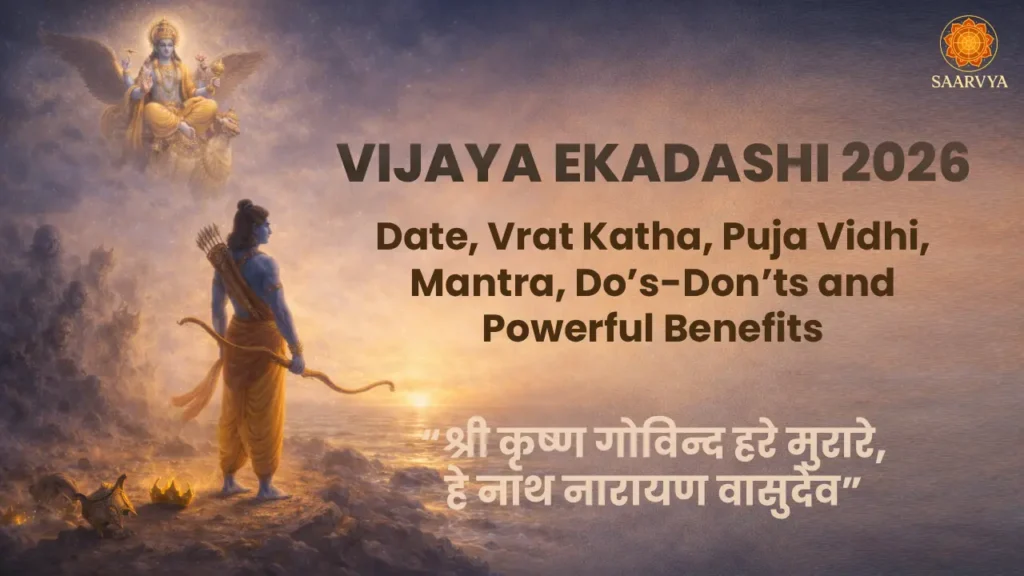

Vijaya Ekadashi is observed on the Phalguna Krishna Ekadashi, and its very name means “victory”—victory over obstacles, sins, and the inner doubts that weaken one’s resolve. This vrat is especially remembered as the Ekadashi that supports success in difficult undertakings, whether they are worldly challenges or spiritual battles. Popular tradition connects this day with Lord Rama’s victory journey, where a vrata-like discipline and divine alignment helped him overcome the seemingly impossible task of crossing the ocean and defeating Ravana. For devotees, Vijaya Ekadashi becomes a day to seek Vishnu’s grace for righteous success, removal of unseen blocks, and steady progress in life.
Vijaya Ekadashi 2026 falls on Friday, 13 February 2026 (Phalguna Krishna Ekadashi). On this day, devotees observe a grain-free fast, worship Lord Vishnu with proper rituals, listen to the Vijaya Ekadashi Vrat Katha, and complete the fast during Dwadashi Parana on 14 February. This vrat is traditionally observed to gain victory over obstacles, remove past sins, and achieve success in important and righteous endeavors.
Date, Tithi, Parana Time (India Focus)
Vijaya Ekadashi occurs during the Krishna Paksha of the Phalguna month, a phase associated with inner cleansing and preparation before renewal. In 2026, the Ekadashi tithi begins on 12 February at 12:22 PM and ends on 13 February at 2:25 PM. Because the tithi spans sunrise on 13 February, the fast is observed on Friday, 13 February 2026.
The Dwadashi Parana—the proper breaking of the fast—falls on Saturday, 14 February 2026. Parana should be done after sunrise and after Hari Vasara ends, and within the Dwadashi tithi, which continues until 4:01 PM that day. For New Delhi, the suitable Parana window is approximately 7:00 AM to 9:14–9:15 AM. As sunrise and Hari Vasara timings vary by location, devotees should always confirm city-specific Parana timings using a trusted local panchang.
Quick View – Vijaya Ekadashi 2026
| Detail | Information |
|---|---|
| Ekadashi name | Vijaya Ekadashi |
| Month & Paksha | Phalguna, Krishna Paksha |
| Vrat date (fast) | Friday, 13 February 2026 |
| Ekadashi tithi | 12 Feb 12:22 PM – 13 Feb 2:25 PM |
| Parana date | Saturday, 14 February 2026 |
| Parana time (Delhi) | ~7:00–9:15 AM |
| Dwadashi ends | 14 Feb at 4:01 PM |
| Presiding deity | Lord Vishnu (often worshipped as Sita-Ram or Krishna) |
| Core focus | Victory in major tasks, removal of obstacles and sins, prosperity, spiritual progress |
Note: Always verify timings with your local panchang for accurate sunrise and Hari Vasara details.
Name Meaning and Scriptural Status
The word “Vijaya” literally means victory or triumph, and in the context of Vijaya Ekadashi, this victory is understood on two levels outer success in difficult undertakings and inner conquest over obstacles created by karma, doubt, and ego. This dual meaning is what gives this Ekadashi its special position among the twenty-four Ekadashis observed throughout the year.
Scriptural references, particularly in the Padma Purana, describe Vijaya Ekadashi as a vrata that grants merit equal to performing major Vedic sacrifices such as the Vajapeya Yajna when observed with sincerity and correct discipline. Such comparisons are not meant to inflate expectations unrealistically, but to emphasize the depth of alignment created when fasting, restraint, devotion, and charity come together on this tithi.
Unlike Ekadashis that focus mainly on purification or renunciation, Vijaya Ekadashi is explicitly connected with success after effort. The vrata does not promise victory without action; instead, it is said to remove the unseen karmic blocks that prevent effort from bearing fruit. This is why it is often recommended before:
- starting an important project
- appearing for examinations or interviews
- entering legal or administrative battles
- making decisive career or business moves
- undertaking spiritually demanding vows or pilgrimages
In traditional understanding, victory achieved without dharma creates new bondage, while victory aligned with Vishnu’s grace leads to both worldly stability and spiritual growth. Vijaya Ekadashi is designed to cultivate that alignment.
Association with Lord Rama and Victory over Obstacles
Popular tradition strongly associates Vijaya Ekadashi with Lord Rama’s victory over Ravana. Many tellings of the Ramayana tradition state that before crossing the ocean to Lanka a task that appeared impossible even for a mighty army Rama was guided by sages to observe a vrata aligned with divine timing and discipline, similar in spirit to Vijaya Ekadashi.
Whether one interprets this association literally or symbolically, the teaching is consistent: even the most righteous effort requires divine alignment to succeed. Rama’s victory was not merely military; it was moral, spiritual, and cosmic. His actions were grounded in dharma, restraint, and surrender to Vishnu’s will.
Because of this connection, devotees often dedicate Vijaya Ekadashi to:
- overcoming powerful opposition
- dissolving fear before major challenges
- resolving long-pending obstacles that resist ordinary solutions
- gaining courage to act rightly even when outcomes are uncertain
At a deeper level, Ravana represents inner enemies pride, uncontrolled desire, attachment to power, and arrogance born of knowledge without humility. Observing Vijaya Ekadashi is thus a reminder that true victory begins inside, when the ego yields to clarity and discipline.
This is why the day is not only about asking for success, but about preparing oneself to handle victory without losing balance. In Sanatani thought, success without inner grounding is fragile; success aligned with Vishnu’s grace becomes sustainable and purifying.
Vijaya Ekadashi Vrat Katha (Padma Purana Tradition)
The Vijaya Ekadashi Vrat Katha is narrated in the Padma Purana as a dialogue where Yudhishthira asks Bhagwan Krishna about a vrata that grants victory when effort alone seems insufficient. The story is structured to show that when human strength reaches its limit, discipline, devotion, and divine alignment turn the tide.
The Question of Victory
Yudhishthira, known for his adherence to dharma, approaches Krishna with a sincere doubt. He asks: “Is there a vrata by which a person facing repeated failure, opposition, or overwhelming obstacles can attain victory without violating righteousness?” His question is not about conquest for ego, but about success without compromising dharma.
Krishna replies that such a vrata exists and is known as Vijaya Ekadashi, observed during Phalguna Krishna Paksha. He explains that this Ekadashi removes unseen karmic obstructions that block success, even when one is qualified and sincere.
The Devotee Facing Defeat
Krishna then narrates a representative story. In one common version, a righteous king or devoted leader faces an enemy far stronger than expected. Despite courage, strategy, and resources, every attempt ends in failure. Allies lose confidence, fear spreads, and the sense of inevitability grows.
This phase of the story is important because it highlights a core Sanatani insight: not all failure is due to lack of effort. Sometimes the cause lies in unresolved karma, inner imbalance, or misalignment with divine timing.
The Sage’s Guidance
Seeing the king’s distress, a compassionate rishi intervenes. Rather than offering weapons or tactics, the sage advises the king to observe Vijaya Ekadashi with full discipline—fasting, purity, Vishnu worship, night vigilance, and charity.
The instruction is precise:
- observe the fast without grains,
- restrain speech and anger,
- keep the mind anchored in Vishnu,
- remain awake in remembrance,
- and dedicate the outcome to dharma rather than ego.
The sage explains that this vrata does not replace action; it removes the subtle resistance that prevents action from succeeding.
The Turning of Fortune
The king follows the guidance exactly. On Vijaya Ekadashi, he fasts, worships Lord Vishnu, listens to the Katha, and maintains restraint through the night. On Dwadashi, he performs charity and breaks the fast correctly.
Soon after, circumstances shift. Allies regain confidence, confusion clears, and the same battle or task that once seemed impossible unfolds smoothly. Victory is achieved—not through new force, but through clarity, timing, and alignment.
Krishna emphasises that the victory was not a miracle in isolation; it was the natural outcome of restored balance. When the inner and outer are aligned with dharma, resistance dissolves.
Phala-Shruti (Fruit of the Vrat)
Krishna concludes by stating that one who observes Vijaya Ekadashi with sincerity:
- attains success in righteous undertakings,
- is freed from sins accumulated over many births,
- gains protection from misfortune and enemies,
- and progresses steadily toward liberation.
The phala-shruti repeatedly stresses that the victory granted is clean victory—one that does not generate new karmic debt.
Spiritual Interpretation
The “war” in the Katha is not limited to the battlefield. It symbolises the inner war against fear, doubt, anger, greed, and attachment to outcomes. The king’s failure represents effort driven solely by ego and urgency; the sage’s guidance introduces surrender without passivity.
Fasting and prayer on Vijaya Ekadashi temporarily loosen the grip of ego, allowing the devotee to act with clarity rather than desperation. In this state, action becomes precise, timely, and effective.
Thus, Vijaya Ekadashi teaches that victory is not forced it is allowed. When intention is purified and effort is disciplined, success arrives as a consequence, not a conquest.
Puja Vidhi for Vijaya Ekadashi 2026
The ritual process of Vijaya Ekadashi is structured to mirror its core purpose victory through discipline, clarity, and surrender. Each step, from Dashami preparation to Dwadashi Parana, is meant to gradually withdraw the devotee from distraction and align action with Vishnu’s grace. What matters most is consistency and sincerity, not ritual complexity.
Dashami Preparation (12 February 2026)
Preparation begins on Dashami, the day before Vijaya Ekadashi. In the evening, take one simple, sattvic meal before sunset. This meal should avoid non-vegetarian food, alcohol, onion, garlic, and excessively spicy or oily items. The intention is to reduce tamasic influence so the body and mind enter Ekadashi in a lighter state.
Dashami is also when you decide your fasting mode:
- Nirjala upavasa – only for healthy, experienced devotees
- Water-only fast – suitable for those accustomed to fasting
- Phalahar / ekadashi-food fast – fruits, milk, nuts, and vrat-friendly foods
There is no spiritual loss in choosing a milder fast if health or duty requires it. Vijaya Ekadashi values mental discipline over physical strain.
Use this day to gather all puja items in advance: a clean image or idol of Lord Vishnu (many also worship Sita–Ram or Krishna), a kalash, ghee or oil diya, incense, flowers, tulsi leaves (collected earlier), fruits or vrat sweets for naivedya, and items intended for charity.
Ekadashi Morning – Snan & Sankalpa (13 February 2026)
Morning Routine and Shuddhi
On Friday, 13 February 2026, wake up before sunrise if possible and take a ritual bath. Many devotees add a few drops of Ganga jal to the bathing water as a symbolic act of purification. After bathing, wear clean, modest clothes and prepare the puja space.
Clean the altar area thoroughly. Place the image or idol of Vishnu (or Sita–Ram/Krishna) on a clean asana, ideally facing East or North. The atmosphere should be calm and undisturbed, reflecting readiness for focused worship.
Sankalpa (Vow for Victory)
Sankalpa is especially important on Vijaya Ekadashi, because the vrata is often dedicated to a specific righteous goal. Sitting calmly, hold a little water in the right hand and mentally or verbally state:
- your name and gotra (if known),
- place and date (Vijaya Ekadashi, Phalguna Krishna, 13 February 2026),
- and your intention success in a particular dharmic task (exam, court case, career decision, travel, project), removal of obstacles and sins, and spiritual progress.
The sankalpa should include a willingness to accept Vishnu’s guidance, not just the outcome you desire. This is what distinguishes victory aligned with dharma from victory driven by ego.
Main Puja Steps
Begin the puja by lighting a diya and incense, followed by achamana and brief dhyana of Lord Vishnu. Worship is generally performed through panchopachara or shodashopachara, depending on household custom.
Offerings include:
- gandha, akshata, flowers, and tulsi leaves (never plucked on Ekadashi),
- dhoop and deep,
- naivedya prepared without grains, such as fruits, dry fruits, or vrat sweets.
After offerings, engage in recitation and japa. Common choices are the Vishnu Sahasranama, selected verses from the Bhagavad Gita, or mantra-japa of “Om Namo Bhagavate Vasudevaya.” Japa should be done slowly and attentively, with the mind anchored in remembrance rather than urgency.
Listening to or reading the full Vijaya Ekadashi Vrat Katha is an essential part of the puja. It reinforces the lesson that success flows from alignment, not force. Conclude with aarti and pranam.
Day-long Vrat & Devotion
Throughout the day, maintain the fast according to your chosen method. While strict nirjala fasting is praised in texts, fruits, milk, water, or ekadashi-friendly foods are fully acceptable when required by health or work.
Devote the day to mantra-japa, paath, satsang, or quiet introspection. Avoid anger, gossip, unnecessary arguments, and indulgence in sensory pleasures. Many traditional guides advise avoiding daytime sleep, as Vijaya Ekadashi is associated with alertness and determination.
Charity is also encouraged especially helping those facing obstacles such as students, job-seekers, or people in distress. Charity done on this day symbolically supports the flow of victory by reducing attachment and self-centredness.
Dwadashi Parana (14 February 2026)
The vrata concludes on Saturday, 14 February 2026, the Dwadashi tithi. Begin the morning with a brief Vishnu puja, expressing gratitude for the observance. If possible, complete an act of charity before breaking the fast.
Parana should be done after sunrise and after Hari Vasara ends, and within the Dwadashi tithi. For New Delhi, the suitable window is approximately 7:00–9:14/9:15 AM, but exact timings should be confirmed locally.
Break the fast gently starting with water, then fruit or milk, followed by a light sattvic meal. Avoid overeating or immediately consuming heavy, tamasic food. The goal of Parana is to return to normal activity with balance, not excess.
Vijaya Ekadashi Diet Guidelines
The dietary discipline on Vijaya Ekadashi is designed to support its central theme victory through clarity and restraint. Food rules on this day are not merely restrictive; they are meant to reduce physical heaviness and mental agitation so the devotee can act with focus, courage, and steadiness. In traditional understanding, when digestion is light, decision-making becomes sharper and intention more aligned.
The most important principle is complete avoidance of grains and pulses. Along with this, foods considered tamasic those that increase lethargy, aggression, or restlessness are avoided so the mind remains calm and disciplined.
Allowed vs Avoided Foods on Vijaya Ekadashi
| Category | Allowed on Vijaya Ekadashi | To Avoid on Vijaya Ekadashi |
|---|---|---|
| Grains & pulses | Completely avoid all grains and dals | Rice, roti, wheat, barley, khichdi, chana, masoor, urad, chickpeas |
| Vegetables | Light vrat vegetables as per custom (potato, sweet potato, arbi, etc.) | Cabbage, carrot, spinach, turnip, and heavy mixed sabzis in some guides |
| Onion / garlic | Not allowed | Onion, garlic, mushrooms, very spicy preparations |
| Fruits & nuts | Fresh fruits, coconut, dry fruits, makhana | Canned or overly sugary processed fruits |
| Dairy | Milk, curd, ghee, paneer in moderation | Very heavy sweets, flavoured or highly processed milk |
| Drinks | Water, lemon water, mild herbal teas if tradition allows | Alcohol, soft drinks, energy drinks, intoxicants |
A practical approach is to choose one of these fasting styles based on health and work demands:
- Nirjala fast – only for healthy and habituated devotees
- Water-only fast – common among regular Ekadashi observers
- Phalahar fast – fruits, milk, nuts
- One light vrat meal – for elderly devotees or those with medical considerations
Medical note: Diabetics, pregnant women, elderly people, and those with chronic illness should consult a doctor and may keep a milder fast or focus mainly on puja, mantra, and charity. Vijaya Ekadashi values intent and discipline over physical extremity.
Do’s and Don’ts on Vijaya Ekadashi
The discipline of Vijaya Ekadashi works only when outer restraint and inner intention move together. The do’s and don’ts are therefore not superstition-based prohibitions, but behavioural guardrails meant to preserve focus, purity, and the “victory-energy” of the vrata.
Do’s (For “Vijaya” in Life)
1. Observe the fast with discipline and clarity.
Fast according to your physical capacity, but remain firm about avoiding grains and tamasic food. The consistency of restraint matters more than the intensity of fasting.
2. Perform proper Vishnu puja and Vrat Katha.
Worship Lord Vishnu (many also worship Sita–Ram or Krishna) with sincerity. Listening to the Vijaya Ekadashi Vrat Katha is essential because it sets the mental framework: victory comes from alignment, not aggression.
3. Chant Vishnu mantra with focus.
At least 108 repetitions of “Om Namo Bhagavate Vasudevaya” are traditionally recommended. Japa on this day is meant to strengthen resolve and calm fear before important undertakings.
4. Practice charity consciously.
Donate food, clothes, money, or educational help especially to those struggling with obstacles (students, job-seekers, litigants, or travellers). Charity symbolically clears the path of success by reducing ego and attachment.
5. Link the vrata to a specific righteous intention.
Vijaya Ekadashi is especially effective when dedicated to one or two clear, dharmic goals such as success in an exam, resolution of a court matter, safe travel, a career decision, or a spiritual vow. This focused sankalpa gives direction to the vrata’s energy.
Don’ts (Common Mistakes to Avoid)
1. Avoid grains, pulses, onion, garlic, non-veg, and very spicy food.
Even those not fasting strictly are advised to avoid these foods, as they are believed to disturb mental balance on this tithi.
2. Do not cut nails, shave, or trim hair.
Traditional guides recommend postponing grooming and luxury-focused activities to keep attention inward rather than outward.
3. Avoid lying, harsh speech, arguments, or emotional harm to others.
Vijaya Ekadashi is about winning without creating new karmic debt. Anger and cruelty directly weaken the purpose of the vrat.
4. Refrain from sexual activity, daytime oversleeping, and excessive entertainment.
These actions dilute restraint and scatter mental energy, reducing the vrata’s effectiveness.
5. Do not treat the vrat as a shortcut to success.
The Ekadashi supports effort; it does not replace it. Actions taken after the vrat should remain ethical and disciplined.
Spiritual, Practical & Psychological Benefits
The benefits of Vijaya Ekadashi are traditionally described as both worldly and transcendent, because the vrata works on the level of karma, intention, and mental conditioning.
Spiritual & Karmic Benefits
Scriptures state that observing Vijaya Ekadashi with proper rules removes sins accumulated over many lifetimes, allowing the soul to progress steadily toward moksha. The Padma Purana praises this vrata as granting merit comparable to great sacrifices such as the Vajapeya Yajna, emphasising its depth when observed with sincerity.
The Ekadashi is also said to grant:
- protection from enemies and unseen obstacles
- Vishnu’s grace in righteous undertakings
- peace of mind alongside material stability
- spiritual progress without abandoning worldly duties
In dharmic philosophy, such victory is considered clean victory—success that does not bind the soul further.
Life, Career & Mind Benefits
Practically, Vijaya Ekadashi is widely observed before:
- court cases and legal matters
- competitive exams and interviews
- career transitions and business expansions
- long journeys or risky undertakings
The combination of fasting, prayer, and clarity often results in reduced anxiety and sharper decision-making. When fear is lowered and focus is strengthened, confidence increases naturally.
Psychologically, the vrat builds discipline and patience. Resisting immediate cravings trains the mind to delay gratification a key trait behind long-term success.
Fasting, Discipline & the “Victory Mindset” (Scientific Angle)
From a modern perspective, Ekadashi-style fasting resembles intermittent fasting, practiced periodically rather than continuously. When done sensibly, lighter intake and grain avoidance may support:
- improved metabolic regulation
- better insulin sensitivity (in some individuals)
- reduced digestive load, freeing mental energy
However, the deeper benefit of Vijaya Ekadashi lies in behavioural restructuring. Structured ritual days interrupt habitual patterns constant eating, scrolling, reacting and replace them with conscious choice.
Symbolic Victory over Inner Enemies
Traditional language speaks of victory over enemies. Psychologically, these “enemies” correspond to:
- anger
- greed
- fear
- self-doubt
- impulsive habits
Regular vrata observance weakens these patterns by introducing pause and awareness. The mind learns that it can endure discomfort without panic—this alone transforms how challenges are faced.
Shared family observance also creates social reinforcement, making ethical choices easier and strengthening emotional resilience.
Recommended Mantras for Vijaya Ekadashi
Primary Vishnu Mantra
“ॐ नमो भगवते वासुदेवाय”
– chant 108 times or more, sitting calmly.
Vishnu/Krishna Nama-Japa
“श्री कृष्ण गोविन्द हरे मुरारे,
हे नाथ नारायण वासुदेव”
Hare Krishna Mahamantra (for Gaudiya/ISKCON followers)
“हरे कृष्ण हरे कृष्ण, कृष्ण कृष्ण हरे हरे,
हरे राम हरे राम, राम राम हरे हरे”
A short closing prayer may be offered, requesting victory in the specific righteous endeavor, removal of unseen obstacles, purification of intention, and guidance to act only in dharmic ways.
Frequently Asked Questions
When is Vijaya Ekadashi in 2026 and what are the Parana timings?
Vijaya Ekadashi is on Friday, 13 February 2026, with Parana on Saturday, 14 February 2026 after sunrise and after Hari Vasara ends. City-wise timings should be checked locally.
Is nirjala fasting compulsory on Vijaya Ekadashi?
No. Fruit, milk, water, or ekadashi-friendly fasts are acceptable. Discipline and devotion matter more than strictness.
Which tasks are best dedicated to Vijaya Ekadashi?
Exams, court cases, career decisions, business moves, travel, or any righteous task requiring courage and clarity.
What must be strictly avoided on this day?
Grains, pulses, onion, garlic, non-veg food, alcohol, anger, lying, harsh speech, and excessive indulgence.
Can people with medical conditions still observe Vijaya Ekadashi?
Yes. They should keep a mild fast or focus on puja, mantra, and charity after medical consultation.
How is Vijaya Ekadashi different from other victory-themed vrats?
Vijaya Ekadashi combines restraint, devotion, and intention on a highly purifying tithi, making it especially suited for ethical success and long-term stability, not just immediate wins.