


Understanding which part of Sati fell in Kamakhya takes us into the heart of the Shakti Peeth tradition, where different parts of Goddess Sati’s body were believed to have fallen across the subcontinent, each becoming a powerful shrine of Devi worship. At Kamakhya, both scriptures and temple tradition agree that Sati’s yoni descended upon Nilachal Hill, transforming the region into a Yonimandala, a sacred field of feminine creative energy and one of the most revered Kamakhya Shakti Peeth sites in India.
The Legend of Sati and the Falling Body Parts
To understand which part of Sati fell in Kamakhya, we first have to revisit the core myth that gave rise to all Shakti Peethas. The story is not just a tale of sorrow and destruction; it is the foundation of how places like the Kamakhya temple became centers of powerful Devi worship across India.
Daksha’s Yagya, Sati’s Self-Immolation, and Shiva’s Tandava
According to the Kalika Purana and other Shakta texts, Sati, an incarnation of Adi Shakti, married Lord Shiva against the wishes of her father, King Daksha. Daksha disapproved of Shiva’s ascetic lifestyle and unconventional ways. To assert his pride, he organized a grand yagya (sacrificial ritual) and deliberately chose not to invite Shiva and Sati.
Sati, moved by a mix of duty and hope, decided to attend the yagya uninvited. She expected at least basic respect from her father, but instead, Daksha openly insulted Shiva in front of the assembled gods and sages. Unable to tolerate disparagement of her husband, Sati’s anguish turned inward. In an act of fierce self-respect and cosmic consequence, she immolated herself in the sacrificial fire, severing ties with her father and his ego-driven world.
When Shiva learned of Sati’s death, his grief was beyond measure. He lifted her lifeless body onto his shoulders and began the Tandava, the dance of cosmic destruction. As he roamed across worlds carrying Sati, the balance of the universe trembled. The gods feared that if this grief continued unchecked, all creation might dissolve.
To restore harmony, Lord Vishnu intervened. With his Sudarshana Chakra, he gently cut Sati’s body into many pieces. These pieces fell in different places across the subcontinent. Wherever a part of her body landed, the location became a Shakti Peeth, a seat of the Goddess, charged with immense spiritual energy. In each of these places, Shakti is worshipped in a unique form, often alongside a corresponding form of Shiva.
This is the mythic web connecting all Shakti shrines. About the Kamakhya temple specifically, the story becomes even more intimate and powerful because of the part believed to have fallen there.
Also Read: Who Is Kamakhya Devi? Origins, Legends, Rituals & Spiritual Power Explained | Who Built Kamakhya Temple?
How Kamakhya Fits into the Shakti Peeth Network
Different scriptures and traditions offer varied lists of Shakti Peethas; some mention 4 major Peethas, others list 51, still others extend the count to 64 or 108. Despite these variations, Kamakhya Shakti Peeth is consistently placed among the most important and potent centers of Devi worship.
Kamakhya, located on Nilachal Hill in the Kamakhya temple in Assam, is not just one more Shaktipeeth in Assam it is regarded as the yoni-center, the most explicit embodiment of Sati’s creative and generative power. In some lists, it is referred to as Kamakhya dham, emphasizing its role as a major pilgrimage destination for devotees, Tantric practitioners, and seekers of spiritual transformation.
What sets Devi Kamakhya temple apart in the Shakti Peeth network is its specific association with desire (kama) and creation. While other shrines may be linked with hands, feet, eyes, or ornaments of Sati, Kamakhya is revered as the place where her source of creation resides. This gives it a distinct identity:
- It is a yoni temple in India where the generative principle of the universe is worshipped directly.
- It is seen as the energetic womb of Shakti, not just a memorial site of her suffering.
- It holds a unique position among the shaktipeeth in Assam as the central and most spiritually charged.
Thus, within the larger network of Shakti Peethas, Kamakhya is remembered as the shrine where Shakti is not only honored as a mother or warrior, but as the very matrix of life itself. This central idea prepares us for the key question:
In scriptural and temple tradition, which part of Sati fell in Kamakhya, and how is it worshipped today?
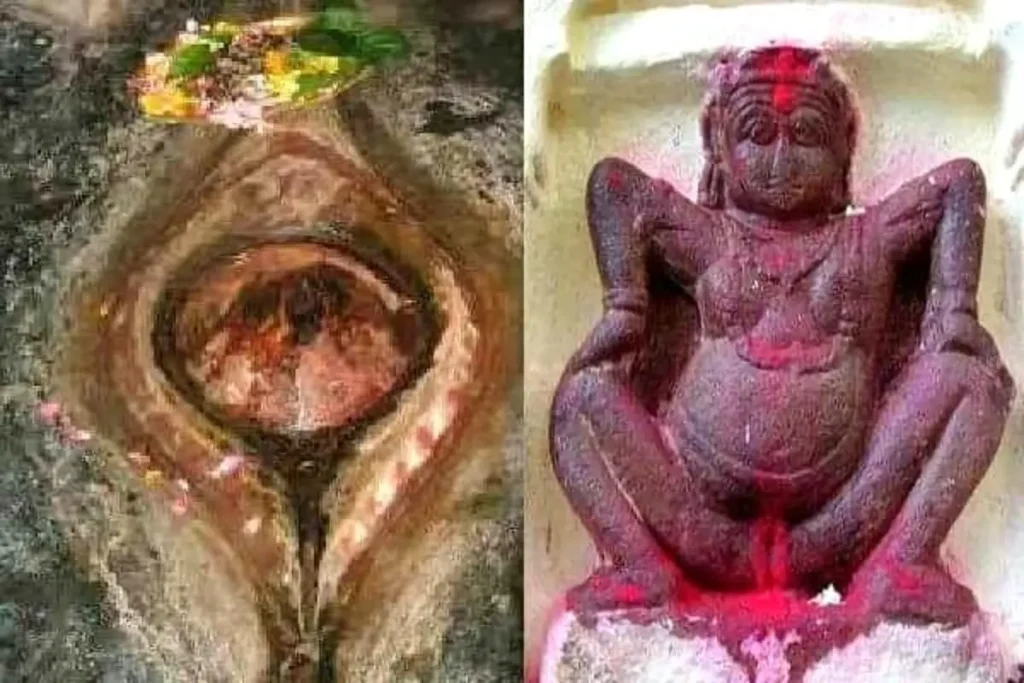
Which Part of Sati Fell in Kamakhya?
At this point, we can answer directly: which part of Sati fell in Kamakhya according to scripture and living tradition? Across Shakta literature, local lore, and temple practice, there is a rare level of agreement that Kamakhya is honoured as the place where Sati’s yoni, her generative center, descended to earth. This is what makes Kamakhya not just a Shakti Peeth, but a Yonimandala, a sacred field organized around the source of creation itself.
The Yoni of Sati
Shakta scriptures such as the Kalika Purana, along with later Tantric and regional traditions, identify Kamakhya as the site where Sati’s yoni fell. Different texts and translations may change the wording some say yoni, others say garbha (womb), reproductive organ, or “source of creation” but they unanimously indicate the same sacred part.
In this context, “yoni” does not refer only to a physical organ. It represents:
- The matrix of life, where beings are conceived and nurtured.
- The seat of Shakti, the power through which the universe manifests.
- The hidden center of desire and creativity, both cosmic and human.
Because of this, Kamakhya is often described as a yoni temple in India, and more specifically as a yoni temple in Assam, where the subtlest idea of feminine power is reverently grounded in a particular landscape Nilachal Hill.
So, scripturally, when someone asks which part of Sati fell in Kamakhya, the answer is clear and consistent:
It is believed that Sati’s yoniher womb, vulva, and creative essence fell here, turning Nilachal into one of the most powerful and unique Kamakhya Shakti peethsites.
This is also why Kamakhya is intimately connected with kama (desire), garbha (womb), and shrishti (creation) in Tantric interpretation. Here, the myth becomes geography, and geography becomes a living symbol of Shakti.
Temple Tradition – Kamakhya Temple Yoni and the Idea of Yonimandala
Beyond the texts, temple tradition tangibly reinforces this understanding. The entire Devi Kamakhya temple complex is conceived as a Yonimandala, a sacred mandala or energy field whose center is the place where Sati’s yoni is believed to have rested.
This has several important implications:
- The main sanctum of the Kamakhya temple does not house a full anthropomorphic idol of the goddess as the central murti.
- Instead, the focus is on the yoni-pitha, the natural rock formation worshipped as Kamakhya herself.
- Smaller images and icons of the goddess appear in outer halls and subsidiary shrines, but the heart of the temple is explicitly aniconic beyond form, yet profoundly present.
Temple priests and local tradition often explain about Kamakhya temple in this way:
Kamakhya is the goddess who is the hill, the spring, the rock, and the energy that binds them. The structure we call Kamakhya dham is built around that original Kamakhya yoni point—the place where heaven’s myth and earth’s geology meet.
Because the fallen part is understood as the yoni, devotees and scholars sometimes refer to Kamakhya, colloquially and controversially, as the “vagina temple.” While the phrase is sensational in casual speech, Tantric and Shakta practitioners approach it very differently:
- For them, this is not about shock or vulgarity.
- It is about honouring the feminine body as sacred, not shameful.
- It is about recognising that the same power that creates life is also capable of leading the seeker beyond ignorance.
Thus, in temple tradition:
- Kamakhya is the central yoni temple in India where the creative principle of Shakti is revered directly.
- The entire hill is structured as a Yonimandala, with the garbhagriha as the innermost bindu.
- The absence of a standing idol and the presence of the Kamakhya temple yoni stone are not omissions, but deliberate, profound choices.
This fusion of scriptural clarity and temple practice is what gives the significance of the Kamakhya temple its extraordinary depth. It is not just another shrine it is the place where the story of Sati, the geography of Nilachal, and the philosophy of Shakti converge in a single, powerful symbol.
How the Yoni Is Worshipped at Kamakhya
Once we know which part of Sati fell in Kamakhya, the next natural question is: how is that part worshipped? Unlike most shrines where deities are represented in anthropomorphic form, the Kamakhya temple in Assam centers its worship around a natural rock formation and a spring. Here, the goddess is not a distant image on a pedestal she is felt in the earth, the water, and the very shape of the land.
The Aniconic Yoni-Shaped Rock and Spring
The core of the Devi Kamakhya temple lies in its garbhagriha, a small, cave-like inner sanctum beneath the main structure. Devotees descend narrow stone steps into a cool, dim chamber. There is no conventional Kamakhya temple idol here. Instead, the focus is on:
- A natural rock fissure, sloping downwards
- A yoni-like depression at the base of that fissure
- A perpetual underground spring keeps the depression filled with water
This combination of rock and living water is worshipped as Kamakhya yoni—the living presence of the Goddess herself. Priests regularly clean and adorn the area with:
- Red cloth
- Hibiscus flowers
- Vermilion (sindoor)
- Offerings of fruits and sweets
When devotees enter this sanctum, they do not “see” the goddess in the usual sense—they experience her through touch, sound, and atmosphere:
- The sound of flowing water
- The coolness of stone
- The scent of incense and flowers
- The hush of collective reverence
This is why Kamakhya is often counted among the most distinctive yoni temple in India and more specifically, the central yoni temple in Assam. It is not a metaphor; the entire ritual system is built around revering the Kamakhya temple yoni as the heart of Shakti.
For some outsiders, this has led to sensational labels like “vagina temple.” But within Shakta and Tantric traditions, such language misses the point. For practitioners and devotees, the yoni here is:
- A sacred gateway, not an object of voyeurism
- A symbol of cosmic birth and renewal, not mere anatomy
- A reminder that body and spirit are not opposed, but deeply interconnected
Thus, the significance of Kamakhya temple lies in its ability to bring worshippers face to face with an unembellished, elemental form of the divine feminine.
Ambubachi Mela and the “Bleeding Goddess”
One of the most powerful expressions of Kamakhya’s uniqueness is Ambubachi Mela, an annual festival that has made Kamakhya dham famous across India. During this period usually in June the temple is closed for three days. Tradition holds that during these days, the goddess is undergoing her annual menstruation.
From a symbolic perspective:
- The underground spring’s water is believed to turn slightly reddish (some say due to natural or ritual substances).
- The temple doors remain shut, representing the goddess’s time of rest and seclusion.
- No regular darshan or worship is performed inside the sanctum.
After three days, the temple reopens with great celebration. Special cloth pieces, previously placed near the yoni-pitha, are distributed to devotees as prasadam. These red-streaked cloths are believed to carry the energy of the “bleeding goddess,” and are kept in homes for blessings, protection, and fertility.
This practice is central to kamakhya temple speciality:
- It directly sacralises menstruation, a bodily function often stigmatized in society.
- It affirms that the rhythms of the female body are divine, not impure.
- It positions Kam devi as a goddess who embraces and elevates the full reality of womanhood.
For many Tantric and Shakta practitioners, Ambubachi is also a time to reflect on the deeper mystery of the yoni as both physical and metaphysical—tied to the cycles of nature, the flow of time, and the pulsation of creative energy in the universe.
Through the ongoing worship of the yoni-pitha and the observance of Ambubachi, Kamakhya temple history shows us a rare temple where theology, ritual, and the human body are integrated rather than separated.
Spiritual Meaning of the Yoni at Kamakhya
Beyond myth and ritual, the deeper question is: what does it really mean that this is the place where Sati’s yoni fell? Answering which part of Sati fell in Kamakhya is only the first step. The fuller understanding lies in the philosophical and spiritual meaning that Shakta and Tantric traditions draw from this truth.
Yoni as Source of Creation and Desire
In Shakta philosophy, the yoni is far more than an anatomical reference. It is the symbol of Shakti itself of the power that conceives, carries, and brings forth all existence. At Kamakhya:
- The yoni represents the primordial womb of the cosmos.
- It is the bindu where formless energy starts to take form.
- It is the seat of kama (desire) and shrishti (creation) together.
Here, desire is not viewed as something to be rejected. Instead:
- Desire is the first stirring that leads to creation.
- Without desire, nothing moves, nothing manifests.
- Kamakhya, as Kam devi, is the goddess who both embodies and sanctifies desire.
This is why Kamakhya Shakti Peeth holds such importance for Tantric practitioners. For them, Kamakhya is the place where:
- Desire is not suppressed, but transformed.
- The yoni becomes a gateway to higher awareness, not a source of shame.
- The seeker learns to move from raw longing to refined spiritual aspiration.
Thus, the significance of the Kamakhya temple goes beyond blessings for fertility, marriage, or worldly success. It invites seekers to understand desire as a cosmic force, one that can bind us or liberate us, depending on how we relate to it.
Feminine Power, Menstruation, and Body-Positivity in Tantra
One of the most radical aspects of the Kamakhya temple story is its unapologetic reverence for the female body and its cycles. At a time when menstruation is still taboo in many places, Kamakhya stands as a theological counterpoint:
- Menstruation is treated as sacred, marked by the Ambubachi Mela.
- The goddess’s reproductive power is honoured, not hidden.
- The very part of Sati that has been stigmatized historically is here made the core of worship.
In Tantric understanding:
- The yoni is a doorway to consciousness, not just to biological birth.
- Meditating on the yoni at Kamakhya is meant to reveal the unity of body, mind, and spirit.
- The same energy that flows as blood, sexuality, and emotion can transform into insight, devotion, and liberation when approached with awareness.
Because of all this, Kamakhya is much more than a shaktipeeth in Assam it is a living challenge to any worldview that treats the feminine body as secondary or impure. It embodies a vision where:
- Female embodiment is central to spiritual cosmology.
- Earth, water, and womb are all linked as forms of Shakti.
- Pilgrimage is not an escape from the body but reconciliation with it.
So when we ask which part of Sati fell in Kamakhya, the deeper answer is:
The part that makes all life possible and the part that this temple teaches us to see, finally, as sacred.
Frequently Asked Questions
1. Which part of Sati fell in Kamakhya?
According to Shakta scriptures and temple tradition, Sati’s yoni (womb/vulva, source of creation) fell at Kamakhya. This is why the site is revered as a Yonimandala and considered one of the most important Kamakhya Shakti Peeth shrines in India.
2. Where exactly is the yoni inside the temple?
Inside Kamakhya temple, the yoni is located in the underground garbhagriha. Devotees descend steps into a small, cave-like chamber where a natural yoni-shaped rock depression filled by an underground spring is worshipped as the goddess. This aniconic form is the central focus of darshan at Devi Kamakhya temple.
3. Why is Kamakhya called the “bleeding goddess”?
Kamakhya is called the “bleeding goddess” because of Ambubachi Mela, an annual festival when the temple remains closed for three days to mark the goddess’s menstruation. When the doors reopen, special cloth believed to be touched by the reddened spring water is distributed as sacred prasadam, symbolising the creative and regenerative power of Shakti.
4. Is there an idol of Sati at Kamakhya Temple?
No. The main form of worship at the Kamakhya temple Assam is the natural yoni-shaped stone and spring, not a full anthropomorphic idol. Smaller images of the goddess can be found in outer halls and nearby shrines, but the core deity is the Kamakhya yoni itself, making it a unique yoni temple in India.