
Understanding who built the Kamakhya temple is not as straightforward as it seems. The temple’s origins stretch across mythology, early indigenous worship, missing historical records, repeated destruction, and multiple reconstructions. This creates a layered story where legend and archaeology coexist. To clarify this complex history, we will explore the Narakasura tradition, early inscriptional evidence, pre-Koch structures, and later Koch Ahom rebuilding phases, including a brief note that “who rebuilt Kamakhya temple” will be covered separately.
Also Read: Who Is Kamakhya Devi? Origins, Legends, Rituals & Spiritual Power Explained
Mythological Account – Narakasura as the First Builder
Mythology provides the earliest and most widely accepted account of who built the Kamakhya temple. According to traditional Assamese belief, the temple’s origins are inseparable from the legendary King Narakasura, an iconic figure whose name still echoes across Nilachal Hill. While historians read these stories with caution, devotees see Naraka as the spiritual founder who first gave Kamakhya her royal identity.
Narakasura in Puranas and Tantric Texts
The figure of Narakasura appears in several ancient sources, including the Harivamsa, Kalika Purana, Yogini Tantra, and regional Assamese traditions. These texts place Naraka as the ruler of Pragjyotisha, the ancient name for Assam, and present him as a devotee and custodian of the goddess.
In the Kalika Purana, Narakasura is closely associated with Nilachal Hill and the worship of Kamakhya. He is described not merely as a king but as someone divinely appointed to protect and glorify the sacred landscape. The Yogini Tantra further reinforces this relationship by outlining the spiritual importance of Kamakhya as the seat of Shakti, guarded and honored by Naraka.
Local traditions in Assam believe that Narakasura either constructed or formalised the earliest shrine of the goddess, an effort that predates the historical Kamarupa dynasties by millennia. This belief is deeply embedded in Assam’s cultural memory, which is why many still say that the Kamakhya temple was built by Narakasura.
Yet, when we interpret the texts closely, a more nuanced picture emerges.
What the Narakasura Story Actually Says About the Temple
The legend does not necessarily describe Naraka building a stone temple from scratch. Instead, it suggests a sacred site that already existed, likely an ancient hill shrine centered around the natural yoni-shaped rock. According to myth, after Krishna defeated the tyrannical version of Narakasura, he installed Naraka’s son Bhagadatta as ruler and instructed him to maintain the worship of Kamakhya.
This detail implies two things:
- Kamakhya was already revered before Naraka.
- Naraka and his lineage formalised or expanded the early shrine.
Thus, the myth points to Narakasura as a developer, protector, and enhancer of an existing sacred space rather than the literal architect of the earliest temple.
A Cautious Historical Reading of the Narakasura Era
Some scholars have attempted to place Narakasura in a historical framework, suggesting a possible reign around 2200–2100 BCE. This timeline aligns with proto-megalithic cultures and early Austroasiatic settlements in the Brahmaputra Valley.
However:
- These dates are speculative and not universally accepted.
- Archaeologists emphasize that Naraka, as described in the texts, blends myth, symbolism, and cultural memory.
- The story preserves spiritual truth rather than architectural history.
From a faith standpoint, Narakasura is the first “builder” who made the goddess’s shrine shine with royal dignity. From a historical standpoint, he represents the earliest mythic phase of development, linked to pre-Vedic and indigenous cults.
Thus, the question of who made the Kamakhya temple cannot be answered without acknowledging both layers mythic devotion and the archaeological evidence.
Earliest Historical Evidence – Before the Koch and Ahoms
After the mythological layer, we enter the realm of archaeology, inscriptions, and early dynastic records. This phase is crucial because it provides the first verifiable clues about who built the Kamakhya temple in a historical sense. The truth is far older and more complex than the commonly cited Koch reconstruction. Nilachal Hill was already a sacred landscape long before the rise of medieval kingdoms, and this section uncovers those earliest layers.
Kamakhya as an Ancient Sacred Hill-Shrine
Before stone temples, royal patronage, or Sanskritic influence reached Assam, Nilachal Hill was a powerful indigenous worship site. Early inhabitants, likely Khasi–Garo communities and Kirata tribes, performed rituals centered around the yoni-shaped stone that still forms the core of Kamakhya worship today.
This phase predates:
- Brahminical Shakta traditions
- Temple architecture
- Written records
- Early Kamarupa dynasties
In anthropological terms, Kamakhya began as an autochthonous fertility and earth-goddess shrine, where the hill itself was considered divine. Offerings were made to the natural rock formation, and rituals celebrated cycles of nature fertility, earth’s rhythms, and the creative force embodied by the sacred spring.
This indigenous origin explains:
- Why Kamakhya has no idol
- Why the Kamakhya temple architecture diverges from typical Hindu temple layouts
- Why tribal, folk, and Tantric traditions coexist in her worship even today
Thus, long before any king was recorded, the land was already holy. The question kamakhya temple was built by whom must therefore also include the anonymous hands of early communities who first recognized the hill as sacred.
The Umachala Rock Inscription and the First “Builder” Identified by History
The earliest inscriptional evidence comes from the 5th century CE, during the rule of King Surendravarman. His famous Umachala rock inscription mentions the construction of a cave temple dedicated to the goddess on Nilachal Hill. This is the first historically confirmed “builder” associated with Kamakhya.
Key points from the inscription:
- Surendravarman commissioned a cave-like shrine on the hill.
- The structure likely incorporated the natural rock formations.
- It formalized an already sacred site into a recognized temple space.
However, archaeology reveals an even older story beneath the surface.
Radiocarbon tests conducted near the sanctum revealed two major subsurface layers:
- ~2200 years old (c. 200 BCE) – suggesting a pre-stone sacred structure or ritual platform.
- ~1500 years old (c. 400–500 CE) – matching the period of Surendravarman’s early temple.
This means:
- A ritual complex existed centuries before Surendravarman.
- The 5th-century king likely remodeled or expanded an older structure.
- The temple’s architectural evolution spans multiple phases, not a single construction.
Therefore, if someone asks, “Kamakhya temple was built by?”, the earliest historically identifiable name is Surendravarman, not Narakasura. But his contribution was a remodeling, not the origin.
Mlechcha and Early Kamarupa Rulers as Patron-Builders
After Surendravarman, the next significant builders appear during the Mlechcha dynasty (7th–8th century CE). Texts such as the Hevajra Tantra and inscriptions like the Tezpur copper plates mention:
- Kamakhya as a pitha (seat of Shakti)
- Patronage from the Mlechcha kings
- Renovations or rebuilding of early stone structures
Architectural evidence suggests that the earliest stone superstructure of the temple was:
- Nagara style, likely influenced by Malava or North Indian designs
- Built with large stone blocks, precise joinery, and early sculptural elements
- More elaborate than Surendravarman’s cave-style structure
This implies:
- The Mlechcha rulers and early Kamarupa kings either constructed the first major stone temple or significantly expanded the earlier one.
- Their period marks the transition from an indigenous shrine → early Hinduized Shakta temple → established Tantric center.
Thus, when we ask Kamakhya temple built by whom, historically, the answer spans multiple contributors:
- Prehistoric indigenous communities (origin of the shrine)
- King Surendravarman (first identifiable temple builder)
- Mlechcha & early Kamarupa rulers (creators of the first major stone temple)
This multi-layered building pattern makes Kamakhya a rare temple that evolved across centuries, absorbing the artistry, devotion, and belief systems of each era.
Layered Building Phases – Who Built What, When?
By now it’s clear that there is no single, simple answer to who built Kamakhya temple. Instead, the site has passed through several distinct phases each adding a new layer of structure, style, and meaning. Understanding these phases helps reconcile faith narratives with archaeological and inscriptional evidence, without dismissing either.
Phase 1 – Indigenous Shrine and Mythic Narakasura
The earliest phase belongs to a time before written history, when Nilachal Hill functioned as an indigenous goddess shrine. Local Khasi–Garo and Kirata communities likely worshipped a powerful earth-mother here, centered around the natural yoni-shaped rock and the spring that flows over it.
This is the pre-Brahminical period:
- No formal temple architecture
- No royal inscriptions
- Rituals focused on fertility, nature, and earth power
Over time, this indigenous memory was absorbed into Puranic and Tantric literature as the age of Narakasura. Faith traditions in Assam describe him as the king who organized the worship, formalised the shrine, and made Kamakhya’s hill “shine with pride and glory”.
From a devotional perspective:
- Many people believe kamakhya temple built by Narakasura in the Dvapara age.
- He is seen as the first king-builder who gave the shrine a royal and organized form.
From a historical perspective:
- Archaeology cannot yet confirm Naraka as a specific individual.
- His story is read as a mythic reflection of early political authority over a pre-existing sacred site.
So in Phase 1, the answer to who made Kamakhya temple depends on one’s lens:
- Faith lens – Narakasura, the first king-builder and custodian of the Devi.
- Scholarly lens – Anonymous indigenous communities, later remembered through the Naraka legend.
Phase 2 – Early Historical Temple (Surendravarman, Mlechchas, Early Kamarupa)
Phase 2 marks the transition from an open hill-shrine to a recognisable temple complex. This is where we first encounter names, dates, and architectural traces that historians can analyze.
The Umachala rock inscription of King Surendravarman (5th century CE) tells us that:
- He commissioned a cave temple on Nilachal Hill.
- This shrine likely incorporated natural rock into its design, bridging indigenous worship with early Shakta practice.
Radiocarbon tests suggest that by around 200 BCE, some form of ritual structure already stood here. By 400–500 CE, this structure had been remodeled into a more formalized temple space. In this sense, if someone asks strictly in historical terms “Kamakhya Temple was built by whom first?”, the earliest name we can give is:
- Surendravarman – builder of the earliest traceable temple structure.
Later, during the Mlechcha dynasty and early Kamarupa rule (7th–8th centuries CE), the site underwent another transformation. Texts and copper-plate inscriptions from this period:
- Explicitly describe Kamakhya as a pitha, a recognized Shakti seat.
- Indicate royal patronage and renovations under Mlechcha kings.
Stylistic remains show that an early Nagara-style stone temple possibly influenced by Malava or North Indian designs was constructed in this phase. This is the first time we see fully articulated kamakhya temple architecture:
- A stone superstructure
- Formal sanctum and mandapa
- Sculptural and decorative elements consistent with early medieval temple design
Thus, Phase 2 offers a historically grounded answer to kamakhya temple built by whom:
- Surendravarman – earliest attested temple-builder (cave shrine).
- Mlechcha and early Kamarupa rulers – patrons of the first major stone temple.
Phase 3 – Destruction and Koch Reconstruction
Phase 3 moves us closer to the temple that visitors see today. By the late medieval period, the original stone superstructure seems to have suffered major damage, most likely during the invasions of Sultan Alauddin Hussein Shah of Bengal in the early 16th century.
Accounts and later traditions suggest that:
- The older Nagara-style superstructure was destroyed or heavily ruined.
- The sanctum area around the yoni-stone survived in some form, preserving the spiritual core of the site.
In response, the Koch rulers of Kamarupa, especially Bishwasingha and Naranarayana, aided by his brother Chilarai undertook a major reconstruction in the 16th century:
- They rebuilt the upper portion and dome of the temple in the distinctive style we see today.
- They likely reused earlier foundations and portions of the older structure.
- Their work restored Kamakhya as a major pilgrimage center after a period of disruption.
So, when modern visitors casually ask “Kamakhya Temple was built by?”, many guides and popular sources mention the Koch kings. This is accurate for the present visible superstructure but it does not reflect the much older layers beneath.
The details of this Koch reconstruction and later Ahom expansions form a dedicated historical story in themselves and fit better into a companion article focusing on who rebuilt Kamakhya temple, how the political context evolved, and how the iconography and layout were reshaped.
Reconciling Devotees’ Belief and Historians’ View
The more we explore, the clearer it becomes that who built the Kamakhya temple is not just a factual question—it is also an emotional and spiritual one. For devotees, the answer is woven into faith, stories, and lived tradition. For historians, it lies in inscriptions, radiocarbon dates, and architectural layers. Both lenses are meaningful, and understanding Kamakhya fully means acknowledging both.
Faith Perspective – Narakasura as the Temple’s First King-Builder
In devotional narratives across Assam, there is little ambiguity about who made the Kamakhya temple in the spiritual sense. The answer is Narakasura. He is remembered as the king who:
- Recognised Nilachal Hill as the throne of the goddess.
- Organised and formalised her worship.
- Linked royal authority with the protection of the shrine.
Traditional accounts describe the Kamakhya temple, built by Narakasura in the Dvapara age, well before the rise of Kamarupa or later dynasties. In these stories, he is not merely a political ruler but the goddess’s chosen custodian, someone entrusted with making her fame spread across the land.
For devotees, this belief serves several important purposes:
- It preserves the spiritual continuity of the site, regardless of how many times the structure was damaged or rebuilt.
- It connects Kamakhya with a sacred royal lineage, reinforcing her status as the heart of ancient Pragjyotisha.
- It offers a clear, emotionally satisfying answer when people ask, in simple terms, “Kamakhya Temple was built by whom?”
In this view, later builders, Surendravarman, Mlechcha kings, Koch rulers, are seen as renovators or restorers. The original honor still belongs to Naraka, whose devotion and kingship are inseparable from the goddess’s story.
Scholarly Perspective – A Continuously Evolving Temple
Historians, archaeologists, and epigraphists approach the same question differently. When they examine kamakhya temple architecture, inscriptions, and radiocarbon samples, a pattern emerges: Kamakhya is not a single-phase monument but a continuously evolving temple complex.
From this perspective:
- Phase 1 reflects an indigenous hill-shrine, rooted in tribal goddess worship.
- Phase 2 introduces Surendravarman’s cave temple and the later Mlechcha and Kamarupa stone superstructure.
- Phase 3 brings the Koch reconstruction and subsequent Ahom additions, resulting in the present form that visitors see today.
So, if someone asks a historian who built the Kamakhya temple, the answer will be:
- Spiritually and mythologically, Narakasura, as preserved in faith narratives.
- Historically –
- Surendravarman, who first left inscriptional proof of a temple on Nilachal Hill.
- Mlechcha and early Kamarupa rulers, who raised the earliest stone temple.
- Koch kings Bishwasingha and Naranarayana, who rebuilt the superstructure after its destruction.
In other words, Kamakhya temple built by one person or dynasty is a simplification. The site is better understood as:
- A living temple, reshaped by different eras.
- A confluence of indigenous, Shakta, Tantric, and royal traditions.
- A sacred space where myth and history flow together rather than cancel each other.
This scholarly view does not deny Narakasura’s importance; instead, it interprets him as a mythic memory of early rulers who controlled and sanctified the hill. It also honors the role of unnamed indigenous worshippers whose devotion predates every inscription.
By holding both views together, we get a more complete picture:
- Faith preserves meaning and continuity.
- History explains sequence and structure.
And between them stands Kamakhya herself unchanged in essence, even as her temple has been built, rebuilt, and reimagined over thousands of years.
Frequently Asked Questions
1. Was Narakasura a real historical king who built Kamakhya?
Tradition says that Kamakhya temple was built by Narakasura, who is portrayed in the Kalika Purana and Harivamsa as the first king-builder and custodian of the shrine. Historically, Narakasura’s existence remains debated. Some scholars tentatively place him around 2200–2100 BCE, but there is no archaeological proof. Thus, Naraka is accepted as the mythic founder, not the confirmed historical architect.
2. Who is the first historically known king associated with building Kamakhya?
The earliest identifiable builder in history is King Surendravarman, mentioned in the 5th-century Umachala rock inscription as constructing a cave temple on Nilachal Hill. After him, Mlechcha and early Kamarupa rulers significantly expanded the stone temple. If one asks strictly from historical records who built Kamakhya temple, Surendravarman is the earliest documented name.
3. Is the current Kamakhya Temple the original structure?
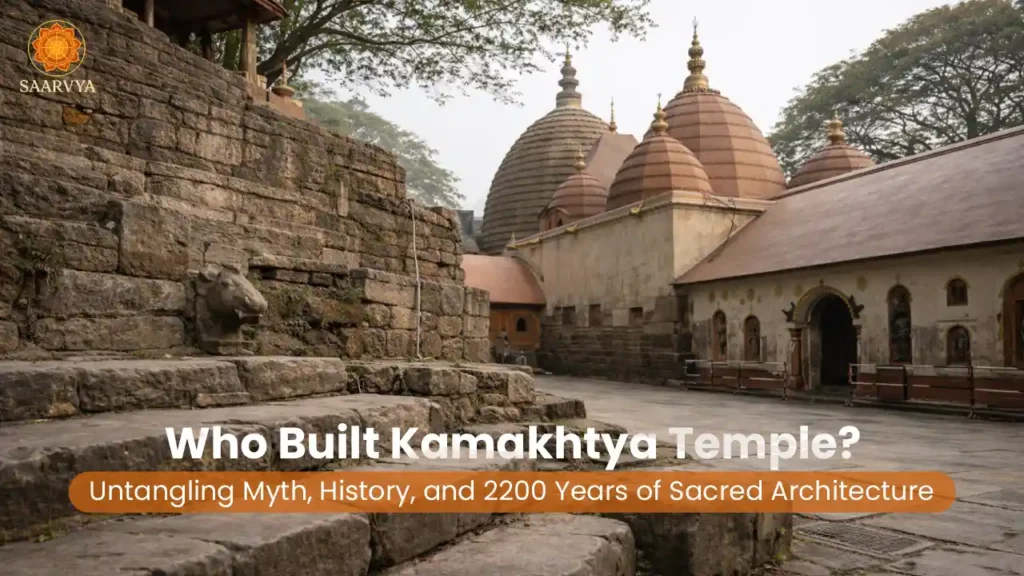
No. The present visible superstructure is largely a 16th-century Koch reconstruction built over much older foundations. Multiple earlier layers exist beneath it, including indigenous shrines, Surendravarman’s cave temple, and early medieval stone architecture. The sanctum’s natural yoni-stone is ancient, but the upper temple is not the original one.
4. How old is Kamakhya Temple, really?
Kamakhya’s origins span multiple eras. Radiocarbon testing shows ritual layers around 2200 years old, a remodeled structure from 1500 years ago, and inscriptional evidence from the 5th century CE. The stone superstructure dates to the 7th–9th centuries, while the present dome is 16th century. Therefore, Kamakhya is best described as a multi-layered temple complex, not a single-date monument.
5. Who made the Kamakhya Temple, according to mythology?
Mythology teaches that the Kamakhya temple was built by Narakasura in the Dvapara age. He is remembered as the king who organised worship, protected Nilachal Hill, and glorified the shrine. While symbolic, this narrative remains central to devotional tradition.
6. What does archaeology say about early Kamakhya Temple structures?
Archaeology indicates that the earliest Kamakhya shrine was an indigenous hill-worship site. Later, Surendravarman built a cave temple, followed by the Mlechcha–Kamarupa kings who constructed a Nagara-style stone temple. These findings highlight gradual development rather than one-time construction.
7. When was Kamakhya Temple rebuilt?
After the original stone superstructure was likely destroyed during Sultan Hussain Shah’s invasion (c. 1498–1505 CE), Koch kings Bishwasingha and Naranarayana rebuilt the upper portion and dome around the mid-16th century. This rebuilding phase is treated separately in the article “Who Rebuilt Kamakhya Temple?”.
8. What style of architecture does Kamakhya Temple have?v
Kamakhya temple architecture is a blend of indigenous, early Nagara, and 16th-century Koch styles. The lower layers reflect early medieval stonework, while the upper dome and beehive-shaped shikhara belong to Koch reconstruction. The sanctum’s natural rock form predates all architectural phases.
9. Kamakhya Temple was built by which dynasty in historical times?
Historically, the first major stone temple was raised by the Mlechcha and early Kamarupa dynasties, after Surendravarman’s cave shrine. The Koch dynasty later rebuilt and expanded it, while the Ahoms undertook further repairs and extensions. Thus, multiple dynasties contributed across centuries.
10. Kamakhya Temple is located in which state?
Kamakhya Temple is located in the state of Assam, on Nilachal Hill in Guwahati. It is one of India’s most important Shakti Peethas and a major center of Shakta and Tantric worship.