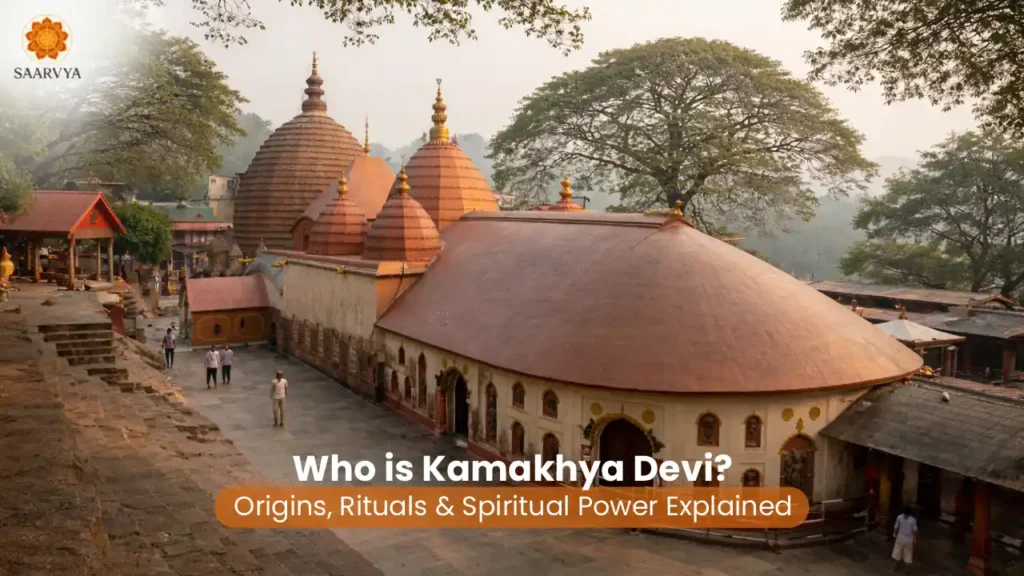

Who is Kamakhya Devi is a question that often awakens deep curiosity among devotees, scholars, and anyone drawn to the mysteries of divine feminine power. She is revered as one of the most unique manifestations of Shakti in Hindu spirituality, celebrated not through an idol, but through a sacred symbol representing creation itself. Rooted in ancient traditions, Kamakhya stands at the confluence of mythology, Tantra, and timeless devotion.
Among Hindu goddesses, goddess Kamakhya occupies a rare and powerful position. While many deities are worshipped in anthropomorphic form with clearly defined faces, limbs, and postures, Kamakhya is primarily venerated as a living symbol of the womb and creative energy. This makes her not just a deity of devotion but a profound reminder of how the entire cosmos is born, sustained, and nourished through the divine feminine principle.
In the broader canvas of Shakta traditions, Kamakhya is seen as the embodiment of Adi Shakti the primordial power from which all other forms of the goddess arise. For practitioners of Tantra, she is not only a mother figure but also the gateway to deeper spiritual experiences. The very geography of her abode on Nilachal Hills in Assam is considered charged with subtle energies, where outer pilgrimage and inner transformation go hand in hand.
Within Tantric paths, especially those linked to eastern India, seekers often look to Kamakhya as the one who unites desire and liberation. She does not reject human emotions or worldly life; instead, she transforms them. In this vision, devotion to Kamakhya is not about escaping the world but about understanding its sacredness body, mind, desire, and all. As you explore her stories, symbols, and temple traditions, you begin to see why she is regarded as both an ancient goddess and a very contemporary spiritual presence.
Origins of Kamakhya Devi
The origins of Kamakhya Devi stretch far beyond the boundaries of a single scripture or era. Her presence is layered, rooted in Vedic imagination, enriched by Puranic narratives, and shaped by ancient tribal worship that predates organized temple traditions. This convergence is what makes Kamakhya Devi one of the most compelling and multidimensional goddesses in the Indian spiritual landscape.
Roots in Vedic, Puranic, and Tribal Traditions
Early Vedic literature often references cosmic feminine energy forces that create, nurture, and dissolve existence. While Kamakhya is not mentioned explicitly in these texts, her essence resonates with Vedic ideas such as Shakti, Ratri, and Aditi. These divine principles represent fertility, cosmic rhythm, and the endless womb of creation, qualities deeply aligned with what we later recognise in Kamakhya.
However, her strongest foundation lies in the indigenous beliefs of the tribes of the Brahmaputra Valley. Long before the temple was built, Nilachal Hill was revered as a sacred site associated with fertility, earth worship, and powerful mother spirits. The yoni-shaped stone found inside the Kamakhya temple today reflects this ancient link with the primordial goddess of the land. This non-anthropomorphic symbol, rather than a sculpted form, suggests a continuity of tribal worship where divinity is felt through nature rather than idols.
Over time, as Hinduism expanded and interacted with regional cultures, these tribal beliefs merged seamlessly with mainstream Shakta practices. This blending created a goddess who was both intensely local and universally revered a rare spiritual synthesis.
Key Scriptural Basis: Kalika Purana & Yogini Tantra
Two important texts solidified the place of Kamakhya in the Hindu spiritual canon: the Kalika Purana and the Yogini Tantra.
The Kalika Purana
Written around the 10th century CE in Kamarupa (ancient Assam), this text forms the theological backbone of Kamakhya worship. It:
- Identifies her as the supreme goddess above all forms of Shakti.
- Describes her abode on Nilachal Hill.
- Lists rituals, philosophies, and stories tied to Kamakhya Shakti Peeth.
- Highlights her role in granting both worldly desires and spiritual liberation.
The Kalika Purana also records early temple traditions, festivals, and the sanctity of the site where creation itself is symbolized.
Yogini Tantra
Composed later, the Yogini Tantra weaves together Tantric rituals, esoteric practices, and metaphysical explanations associated with Kamakhya. It emphasizes:
- The power of feminine energy.
- The union of Shiva and Shakti as the basis of existence.
- The role of Kamakhya as both a compassionate mother and a potent Tantric force.
This scripture offers an inner view of how practitioners perceived Kamakhya not merely as a mythological figure, but as living spiritual consciousness accessible through devotion, meditation, and disciplined Tantric practice.
Who is Kamakhya Devi in Mythology and Legends?
In mythology, who is Kamakhya Devi answered through powerful stories of love, loss, creation, and liberation. She is the Shakti who emerges at a turning point in the cosmic drama of Sati and Shiva, and her seat at Nilachal Hill is revered as one of the most sacred centers of divine feminine energy in the Shakta tradition.
These legends are not just stories; they are symbolic maps that explain why goddess Kamakhya is associated with desire, fertility, transformation, and the deep, hidden layers of human consciousness.
Story of Sati, Shiva, and the Shakti Peethas
One of the most important strands in the Kamakhya Devi story begins with Sati, the first consort of Lord Shiva. Sati marries Shiva against her father, Daksha’s wishes. When Daksha performs a grand yajna (sacrificial ritual) and deliberately does not invite Shiva, Sati still decides to attend, hoping for reconciliation. Instead, she faces intense humiliation.
Unable to bear the insult to her husband, Sati sacrifices herself in the sacred fire. When Shiva learns of this, he is consumed by grief and fury. He lifts Sati’s lifeless body onto his shoulders and begins the tandava, a fierce dance that shakes the cosmos. To restore balance, Lord Vishnu uses his Sudarshana Chakra to gently dismember Sati’s body, so that Shiva’s grief may gradually calm.
Wherever a part of Sati’s body falls, a Shakti Peetha is said to be established. These places become centers of Shakti worship, each representing a specific aspect of the goddess. Traditions differ on the total shaktipeeth count; some speak of 51, others 52 or more but Kamakhya is consistently honored among the most important and powerful of them all.
In this sacred geography of Kamakhya Shakti Peeth, the focus is on the yoni, the creative, generative center of existence. This is what makes Kamakhya distinct from many other forms of the divine mother.
Story of Kamakhya Devi and Nilachal Hill
The story of Kamakhya Devi is deeply tied to Nilachal Hill in present-day Guwahati, Assam. According to traditional belief, the yoni of Sati, the symbol of her creative power, fell here. Instead of being represented through a statue, it manifests as a natural, womb-like stone formation in the sanctum. A subterranean spring keeps this stone moist, symbolizing ceaseless life and regeneration.
This is why devotees do not see a typical idol inside the Kamakhya temple. Instead, they bow before the sacred yoni, which is covered with red cloth, flowers, and offerings. This non-anthropomorphic worship makes the Kamakhya story uniquely intimate and profound. Here, the earth itself is the goddess, and the temple becomes a meeting point of sky, soil, water, and subtle energy.
In many retellings, when seekers ask who is Kamakhya Devi, elders explain that she is the power of creation that remains even when forms change, and stories fade. Her temple on Nilachal Hill is thus not just a structure, but a living reminder that divinity is rooted in the very source from which all life emerges.
Kamadeva, Desire, and the Rebuilding of Kamakhya Devalaya
Another important layer of kamakhya devi story involves Kamadeva, the god of desire. According to legend, Kamadeva once tried to disturb Shiva’s deep meditation in order to help the gods defeat a powerful demon. Shiva, angered by this interruption, opened his third eye and burned Kamadeva to ashes, leaving him bodiless.
Later, seeking to regain his form and strength, Kamadeva is advised to worship kamakhya mai on Nilachal Hill. He undertakes intense penance here, honoring the goddess as the source of all legitimate desire and love. Pleased with his devotion, Kamakhya blesses him, helping him regain his ethereal presence. For this reason, she is sometimes regarded as the deity who harmonizes desire, devotion, and destiny.
Many traditions also associate Kamadeva with the construction or restoration of kamakhya devalaya the temple complex dedicated to the goddess on Nilachal Hill. While historians connect the current structure to royal patronage in later periods, the Kamadeva legend preserves a spiritual truth: that desire itself can become a path to the divine when offered to the goddess with sincerity and discipline.
Here we see another dimension of who is Kamakhya Devi in the spiritual imagination she is not a goddess who rejects human emotion, but one who refines it. She teaches that desire is not inherently impure; it becomes sacred when aligned with higher awareness.
Naraka, Kamakhya Mai, and the Kingdom of Kamarupa
The legendary king Naraka (often called Narakasura) is also closely linked to kamakhya mai and the land of Kamarupa. In local lore, Naraka is portrayed in multiple shades, sometimes as a devout king favored by the goddess, sometimes as a ruler who gradually falls into ego and adharma.
One popular narrative tells that Naraka wished to marry Kamakhya. The goddess, wanting to test his determination, set a condition: he must build a staircase from the foothills to the top of Nilachal Hill in a single night. Naraka almost succeeds, but Kamakhya tricks him by making a rooster crow before dawn. Believing morning has arrived and his time is up, Naraka stops his work midway. Parts of the incomplete stone staircase are still pointed out by locals as silent witnesses to this kamakhya story.
In another stream of legend, Naraka is seen as a devotee who expanded the fame of Kamakhya across his kingdom, thus strengthening the identity of Kamarupa as a major Shakti center. Over time, political rulers came and went, but the bond between the land, its people, and goddess Kamakhya remained unbroken.
Through these stories of Sati, Shiva, Kamadeva, and Naraka the image of Kamakhya becomes clearer. She is the goddess of beginnings and endings, love and loss, desire and detachment. When someone asks who is Kamakhya Devi, the answer is not found in a single tale, but in the rich tapestry of myths, legends, and local memory that surround her.
Historical and Archaeological Insights
The spiritual aura of Kamakhya is not just mythological; it is also deeply historical. The hill on which Kamakhya Devalaya stands, Nilachal Hill, has been a sacred landscape for centuries, even before the rise of classical temple architecture. Archaeological traces, old inscriptions, and textual references together suggest that devotion here evolved from simple earth-based worship to a fully developed Shakti pilgrimage center.
Kamakhya Devalaya Through the Ages
Long before stone temples were raised, Nilachal Hill was likely a site of fertility and mother-goddess worship among local communities. The focus on a natural rock formation, rather than a sculpted idol, hints at a time when people revered the earth itself as the living divine. Over time, this primal form of worship became layered with Vedic, Puranic, and Tantric meanings, eventually emerging as the powerful cult of Kamakhya Devi.
By the early medieval period, references to Kamarupa the ancient kingdom that covered much of present-day Assam, begin to appear in inscriptions and texts. These sources mention powerful kings who patronized Shakta and Tantric traditions, indicating that Nilachal Hill was already recognized as a major center of goddess worship. The sacred geography tied to Kamakhya Shakti Peeth likely drew pilgrims, practitioners, and scholars from distant regions, slowly turning the site into a spiritual crossroads.
Royal Patronage and the Koch Dynasty
The present structure of the temple owes much to royal patronage, especially from the Koch dynasty. Historical accounts suggest that earlier structures on the hill suffered damage and were later rebuilt, with the Koch rulers playing a central role in restoring and enhancing the shrine. King Naranarayan and his brother Chilarai are frequently remembered in local tradition as key patrons who revived the temple and re-established regular worship.
Under their care, Kamakhya Devalaya was not only reconstructed but also framed as a symbol of political power and divine sanction. Supporting the goddess was a way of aligning the kingdom with a revered form of Shakti, strengthening both religious and royal authority. Over time, other rulers and local elites also contributed to the upkeep of the temple, commissioning renovations, subsidiary shrines, and ritual endowments.
Architecture, Layout, and What Lies Inside Kamakhya Temple
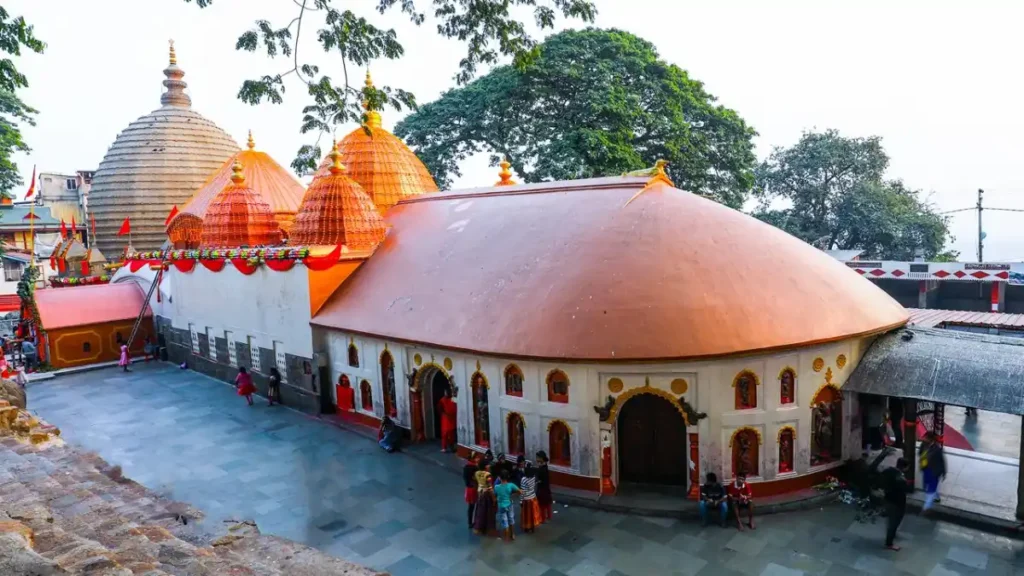
Architecturally, the temple is a fascinating blend of regional styles. Its shikhara (tower) and rooflines echo elements of North Indian and local Assamese forms, while the complex around it includes multiple smaller shrines, courtyards, and pathways. But what truly sets it apart is what lies inside the Kamakhya temple.
Instead of entering a sanctum to see a carved idol, devotees descend a few steps into a small, cave-like chamber. There, in the soft light and cool, moist air, they encounter the sacred yoni-shaped stone, continuously bathed by an underground spring. This simple yet profound symbol conveys the essence of creation more powerfully than any elaborate sculpture could. Flowers, vermilion, red cloth, and offerings transform the space into an intimate meeting point between human devotion and cosmic energy.
The layout of the temple complex reinforces this experience. Outer courtyards host everyday rituals, circumambulation, and social interactions, while the inner sanctum draws attention inward towards the source. Smaller shrines to other deities, including various forms of Shakti and Shiva, remind visitors that Kamakhya is part of a vast spiritual network. Yet the heart of the complex remains the sacred stone, the silent answer to anyone who inwardly wonders who is Kamakhya Devi beyond names and forms.
In this way, history, architecture, and archaeology all converge to support the same truth: Kamakhya is not just a temple built in stone, but a living tradition that has continuously adapted while preserving its most ancient core the worship of the creative divine feminine.
Iconography and Symbolism
The identity of kamakhya devi becomes even more captivating when we explore her iconography both the visual depictions found in scriptures and the non-anthropomorphic symbol worshipped within the temple. Unlike many Hindu goddesses who are represented through well-defined idols, Kamakhya’s primary presence is experienced through a sacred natural formation. Yet classical texts still describe her form in rich detail, helping devotees connect the symbolic with the spiritual.
The Six-Headed, Twelve-Armed Form of Kamakhya
Scriptural descriptions especially those aligned with the Kalika Purana and esoteric Tantric traditions portray Kamakhya as a radiant goddess with six heads of different colors and twelve arms, seated on a blooming lotus. Each head represents a distinct aspect of the cosmic feminine force:
- Compassion, reminding devotees of her nurturing presence.
- Radiance, symbolizing illumination and clarity.
- Strength, conveying her fierce protective nature.
- Harmony, depicting balance in worldly and spiritual life.
- Wisdom, representing deeper understanding and intuitive knowledge.
- Desire, the fundamental force she governs and refines.
Her six heads also suggest that the goddess perceives reality from multiple dimensions simultaneously, transcending the limitations of human perception.
The twelve arms hold various objects, each loaded with symbolic meaning lotus for purity, weapons for protection, mudras for blessings, and ritual items associated with Tantric worship. Together, they reveal a deity who is gentle yet powerful, compassionate yet uncompromising, a mother who nourishes and a force who transforms.
Lotus Seat, Red Sari, and Hibiscus Flowers
Kamakhya is often depicted as sitting on a lotus, a universal symbol of purity and transcendence. Just as a lotus rises unstained from muddy waters, the goddess represents the ability to elevate oneself above limitations while still remaining connected to life.
Her red sari carries complex significance. Red is the color of life-force, fertility, passion, and sacred energy in the Shakta tradition. It embodies the essence of Shakti active, dynamic, and ever-creative. This is why devotees often offer red flowers, especially hibiscus, which is considered one of her favorite offerings. The flower’s vivid color represents both her fiery power and her protective grace.
The adornment of jewels, especially those associated with the earth and natural elements, further emphasizes her role as the goddess of desire, fulfillment, and transformation.
The Yoni-Shaped Stone: Kamakhya’s Most Sacred Symbol
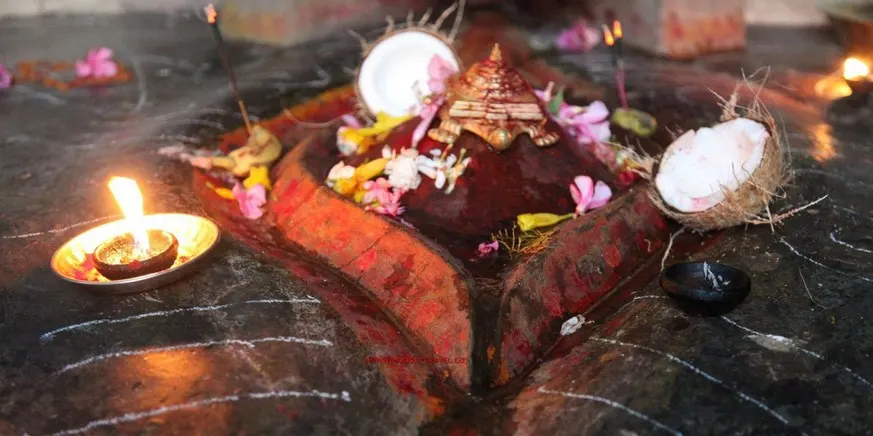
While classical depictions enrich our understanding, the real mystery unfolds when we step inside the Kamakhya temple. Here, the goddess is not represented through an idol but through a natural, yoni-shaped stone formation continuously bathed by a gentle subterranean spring. This symbol is deeply meaningful:
- It represents the source of creation the cosmic womb from which life arises.
- It emphasizes the eternal feminine principle, not in form but in essence.
- It honors the earth as divine, blurring the boundary between nature and worship.
- It reflects the union of body and spirit, form and formlessness.
This non-anthropomorphic worship is a profound reminder that divinity is not confined to statues or images; it is intertwined with the very elements that sustain life. When pilgrims descend the small staircase into the inner chamber, the air shifts cooler, quieter, more sacred. Flowers, red cloth, and spring water merge to create an atmosphere that feels ancient, intimate, and deeply powerful.
Symbolism of the Objects Held in Her Hands
Different scriptures describe Kamakhya holding various symbols each one representing an aspect of her energy:
- The sword signifies her ability to cut through ignorance and illusion.
- The noose represents control over the wandering mind.
- The goad symbolizes direction and discipline for spiritual seekers.
- The lotus embodies purity and transcendence.
- The skull-cup in Tantric imagery reflects the transformation of ego into wisdom.
- Mudras in some depictions convey protection, blessing, and the assurance of divine support.
These attributes help answer the question who is Kamakhya Devi not only through stories but also through symbols each reinforcing her identity as the creative, protective, and transformative force of the universe.
The Power of the Symbol Over the Form
In many traditions, the form of the goddess helps devotees connect emotionally. But in Kamakhya’s case, the symbol is more powerful than the form. The sanctum’s yoni stone speaks directly to the essence of creation, bypassing the need for a bodily representation. This distinguishes Kamakhya from many other deities and reveals why she holds such a unique place among the total shaktipeeth.
Her symbolism teaches that the divine is not always meant to be visualized it can also be felt, experienced, or intuited. In this sense, Kamakhya is both a goddess of the earth and a gateway to a deeper understanding of the self.
Spiritual Significance
Understanding who is Kamakhya Devi becomes even deeper when we step into the realm of spiritual philosophy. In Shakta and Tantric traditions, Kamakhya is not merely a goddess to be worshipped she is the very principle that makes worship possible. She is the pulse of creation, the seat of desire, the force behind transformation, and the hidden wisdom that guides seekers from the outer world to the inner one.
Kamakhya as the Heart of the Shakta Tradition
In the Shakta worldview, the universe is sustained by Shakti the dynamic energy that animates everything. Kamakhya stands at the center of this vision. She is revered as the Adi Shakti, the original creative force from which all other forms of the goddess emerge. Whether it is Durga, Kali, Tripura Sundari, or any of the Mahavidyas, their energies trace back to the primal essence found at Nilachal Hill.
Devotees often describe Kamakhya as the mother who does not differentiate between devotees based on caste, class, or background. Her worship is accessible, inclusive, and rooted in the recognition that every human being carries the seed of divine power within.
She is also regarded as the goddess who both grants worldly desires and illuminates the path to liberation. This dual blessing bhukti (worldly fulfillment) and mukti (spiritual freedom) makes her worship deeply meaningful for seekers at all stages of life.
Kamakhya in Tantra: The Transformative Force
In the Tantric tradition, Kamakhya is not just a deity; she is a gateway. Nilachal Hill is considered one of the most potent centers for spiritual practice because it embodies a rare convergence of physical, energetic, and mythic elements.
Tantra views desire as a powerful energy that can elevate a seeker when approached with awareness and devotion. This is where Kamakhya plays a central role she governs the delicate balance between desire and transcendence. Rather than rejecting human emotion, she helps purify and redirect it.
Tantric practitioners often meditate on her symbol, not as a physical organ, but as the cosmic point where creation begins. This symbolic focus allows the mind to travel inward, peeling away layers of illusion to reach deeper truths. In this sense, Kamakhya’s worship becomes a transformative journey from the outer world of form to the inner world of pure consciousness.
The Sanctity of Kamakhya Shakti Peeth
Among the many total shaktipeeth, Kamakhya holds a unique place. It is regarded as one of the Siddha Peethas sites where the goddess’s power is especially potent and responsive. The belief is not based on fear or superstition but on centuries of collective spiritual experience. Yogis, saints, scholars, kings, and ordinary devotees have all felt a profound presence on Nilachal Hill.
The very nature of the sanctum where water, stone, earth, and silence converge creates a spiritual atmosphere unlike any other temple. Many devotees say that stepping into the inner chamber feels like entering the heart of the earth itself. This physical experience of descent mirrors the inner descent into consciousness that Tantra emphasizes.
Association with the Mahavidyas
Kamakhya’s spiritual significance expands further through her connection with the ten Mahavidyas wisdom goddesses who represent the stages of spiritual evolution. Traditions hold that the Mahavidyas are present on Nilachal Hill, each occupying a specific space around the main shrine. These goddesses include Kali, Tara, Tripura Sundari, Bhuvaneshwari, Bhairavi, Chhinnamasta, Bagalamukhi, Matangi, Kamala, and Dhumavati.
This sacred geography symbolizes how all forms of divine wisdom circle around Kamakhya, the central force that binds them together. Worship here is therefore seen as a union of knowledge, energy, and spiritual realization.
Local and Pan-Indian Reverence
While Kamakhya has its deepest roots in Assam, her worship extends far beyond. Practices associated with her especially during festivals like Ambubachi attract devotees from every corner of India and beyond. Her temple is not just a regional shrine; it is a national spiritual magnet.
Regions outside Assam often incorporate the kamakhya devi story in their own local traditions, recognizing her as a goddess who removes obstacles, strengthens intuition, and empowers individuals to face life’s challenges with clarity and courage.
Desire, Fulfillment, and Spiritual Empowerment
Kamakhya’s association with desire is often misunderstood. In Tantric philosophy, desire is not inherently negative it is the initial spark that leads to action, growth, and even spiritual seeking. Without desire, there is no movement; without movement, there is no evolution.
Kamakhya teaches that desire must be understood, purified, and aligned with one’s higher purpose. In this sense, she becomes the goddess who empowers individuals to fulfill their aspirations while guiding them toward inner transformation.
Her energy is associated with:
- Fertility, symbolizing new beginnings and creative potential
- Healing, both emotional and physical
- Prosperity, not just in wealth but in personal growth
- Intuition, helping devotees make wise choices
- Courage, offering strength during challenging times
These qualities make Kamakhya a deeply relevant goddess in the modern world, where people seek balance between outer achievements and inner peace.
Kamakhya Temple and Pilgrimage
The Kamakhya Temple is not merely a sacred structure it is an experience, a journey into one of the oldest spiritual landscapes of India. When devotees ask who is Kamakhya Devi, the answer becomes clearer the moment they ascend the slopes of Nilachal Hill, where the temple stands overlooking the Brahmaputra River. The journey itself feels symbolic: a gradual movement from the outer world to the inner one, from noise to silence, from questions to understanding.
The Temple on Nilachal Hills: A Sacred Geography
Nilachal Hill in Guwahati is believed to hold a powerful concentration of spiritual energy. In ancient traditions, hills were seen as meeting points between earth and sky, places where divine presence feels more accessible. Kamakhya Temple sits at this very intersection, making the act of climbing the hill an integral part of the pilgrimage.
As one moves closer to kamakhya devalaya, the atmosphere changes sounds soften, scents of incense blend with mountain air, and the surroundings evoke a sense of reverence. The temple’s architecture, with its distinctive beehive-like shikhara and octagonal base, reflects both regional Assamese aesthetics and older, pan-Indian influences.
Inside the premises, the temple complex expands into a network of courtyards, smaller shrines, natural springs, stone pathways, and ritual spaces. This sense of a “spiritual campus” reinforces the idea that Kamakhya is not confined to one sanctum her presence pervades the entire hill.
The Sanctum: What Lies Inside Kamakhya Temple
The inner sanctum of the temple the Garbhagriha is unlike any other place of worship. Instead of a sculpted idol, devotees descend down a few stone steps into a womb-like chamber. Here lies the sacred yoni-shaped stone, continuously bathed by a natural subterranean spring.
This symbol is more than a physical representation; it is the spiritual heart of the temple. The water that flows over the stone is believed to embody purity, fertility, cosmic creation, and the uninterrupted rhythm of life. The sanctum’s simplicity creates an intimacy that resonates deeply with seekers, scholars, Tantric practitioners, and ordinary devotees alike.
Entering this chamber is a transformative moment. The coolness of the air, the sound of flowing water, the scent of flowers, and the glow of lamps create an atmosphere that feels both ancient and eternal. Many describe it as experiencing the earth’s heartbeat a direct encounter with goddess Kamakhya in her most elemental form.
Festivals That Celebrate the Goddess
Kamakhya Temple is known for its vibrant festivals, each revealing a different aspect of the goddess’s energy and symbolism.
Ambubachi Mela: The Festival of the Earth’s Menstruation
The most significant festival here is Ambubachi Mela, often called the “Mahakumbh of the East.” It marks the annual menstruation of the goddess an acknowledgment of the sacredness of the feminine biological cycle. During Ambubachi, the temple remains closed for three days as it is believed that Kamakhya is resting.
This unique celebration honors the creative force of womanhood and affirms that fertility, menstruation, and bodily functions are not impure but divine. When the temple reopens, lakhs of devotees gather to receive blessings. Sadhus, Tantrics, ascetics, farmers, students, families, and travelers people from all walks of life come together to celebrate creation in its most natural form.
Ambubachi is not merely a ritual; it is a profound statement about the dignity of the feminine principle.
Durga Puja and Navaratri
While Ambubachi reflects Kamakhya’s raw, earth-embracing aspect, Durga Puja and Navaratri celebrate her warrior, nurturing, and transformative forms. These festivals highlight the interconnectedness of Kamakhya with other Shakta goddesses such as Durga, Kali, and Tripura Sundari.
During these times, the temple complex comes alive with rituals, chanting, lamps, and offerings. Devotees often reflect on inner battles, seeking strength, clarity, and renewal. This blend of celebration and introspection makes Kamakhya’s festivals significant not only for traditional followers but also for the younger generation seeking deeper meaning in spirituality.
The Pilgrimage Experience
For many, pilgrimage to Kamakhya is not a single event but a recurring journey. Devotees visit during life’s transitions marriage, childbirth, new beginnings, healing, or moments of uncertainty. The goddess is often approached as a guide, a mother, and a force who helps one reconnect with inner truth.
Some come in silence, simply sitting on the temple steps, watching the Brahmaputra in the distance. Others participate in detailed rituals, some seek blessings for fertility, while others meditate near the sanctum. Pilgrimage here has no fixed rule; each person finds their own way to connect with the goddess.
The temple’s location also makes it accessible to people across India and beyond. Its spiritual gravity attracts Tantric practitioners from Nepal, Bhutan, Bengal, Odisha, and South India, making Kamakhya a cosmopolitan spiritual hub.
The Power of Collective Devotion
One of the most striking aspects of Kamakhya Temple is the diversity of its devotees scholars, rural families, travelers, monks, young seekers, and elderly worshippers all stand together in the same queue. This sense of equality reflects the core belief embedded in the kamakhya devi story: the divine mother embraces everyone.
The crowds during festivals, the chants echoing through the hills, and the quiet reverence inside the sanctum all contribute to an environment where the individual and the collective merge. Devotion becomes a shared experience, drawing strength from the goddess and from each other.
Rituals and Worship Practices
Rituals at Kamakhya are unlike those of any other Shakti temple. Because the goddess is worshipped in her elemental form, the practices here carry a blend of ancient tribal customs, classical Shakta worship, and esoteric Tantric traditions. When people ask who is Kamakhya Devi, her rituals reveal a clear answer: she is the goddess who accepts, transforms, and elevates every aspect of existence including those that society often misunderstands or avoids.
Why the Main Sanctum Has No Idol
One of the most distinctive elements of kamakhya devalaya is the absence of a traditional idol. Instead of a sculpted form, devotees worship the natural yoni-shaped stone bathed by a perennial spring. This choice is profoundly symbolic:
- It honors the primordial feminine principle creation in its purest form.
- It embodies a living presence, continually nourished by flowing water.
- It reflects non-duality, where the divine is not separate from nature.
- It emphasizes the idea that the goddess is formless yet fully present.
In this shrine, faith becomes experiential. Devotees do not gaze upon the goddess they feel her, through the cool stone, the sound of the spring, and the sanctum’s serene darkness.
Tantric and Folk Traditions at Kamakhya
Kamakhya Temple is one of the most important centers of Tantra in India. However, Tantra here does not necessarily mean extreme rituals it encompasses a wide spectrum of practices aimed at understanding and harnessing energy.
Vamachara (Left-Hand Path)
Some lineages of practitioners follow Vamachara, the left-hand Tantric path, which emphasizes:
- Freedom from rigid social conditioning
- Transformation of desire into awareness
- Rituals that merge symbolism with inner discipline
- Spiritual exploration through experiential methods rather than doctrinal rules
These practices are traditionally misunderstood outside spiritual contexts, but at Kamakhya, they serve deeper meditative and philosophical purposes. They require strict discipline, guidance from gurus, and ethical grounding making them inaccessible to the casual seeker.
Dakshinachara (Right-Hand Path)
Alongside Vamachara, more conventional ritual worship Dakshinachara is equally prevalent. This includes offerings of flowers, incense, prayers, and recitation of Shakta mantras.
Local folk traditions blend seamlessly with Tantric rituals devotees tie red threads on temple trees, offer hibiscus flowers, light lamps, or whisper prayers directly to the earth. These practices are intimate and personal, reflecting the strong cultural bond with goddess Kamakhya.
Daily Rituals at the Temple
Kamakhya Temple follows a structured sequence of rituals every day, symbolizing different stages of cosmic life:
- Snana (Bathing) – The sanctum’s natural spring flowing over the yoni is considered the goddess’s self-purifying bath.
- Nitya Puja (Daily Worship) – Priests perform offerings of flowers, incense, red cloth, fruits, and sacred water.
- Bhoj (Offerings of Food) – Devotees present cooked rice, coconut, and local delicacies to honor the goddess.
- Arati (Ceremonial Lamps) – Lamps are waved around the sanctum and the outer shrines, filling the hill with soft golden light.
Visitors often remark that even the temple’s routine rituals feel ancient, grounded, and intensely alive.
Home Worship (Puja Vidhi) for Kamakhya Devi
Many devotees wish to worship Kamakhya at home. While elaborate Tantric rituals require strict guidance, simple devotional puja can be performed safely and respectfully.
A Gentle Home Puja Method
- Clean the space
Choose a quiet corner, preferably facing east, and place a red cloth on a clean surface. - Set a symbolic representation
You may use a red stone, lotus image, lamp, or simply visualize the goddess physical objects are optional. - Offer flowers (preferably hibiscus)
Red flowers are symbolic of Kamakhya’s energy, but any honest offering is acceptable. - Light a lamp and incense
This symbolizes inner illumination and purity of intention. - Chant a simple mantra like:
“Om Hreem Kamakhyaye Namah”
This gentle invocation aligns the mind with the goddess’s energy. - Pray for clarity, strength, and inner harmony
Kamakhya is known as the goddess who listens when approached sincerely. - Close the puja with gratitude
End with silence, reflection, or a simple bow.
This straightforward method honors the goddess without requiring complex procedures. It respects her tradition while keeping the practice accessible.
The Spiritual Purpose Behind Rituals
Kamakhya’s rituals are not meant to perform miracles; they are designed to shift the devotee’s consciousness. Worship here teaches several lessons:
- Desire is sacred when understood and directed wisely.
- Nature is divine not separate from spirituality.
- Creation is continuous and interconnected.
- Inner transformation requires both acceptance and discipline.
These insights help devotees see that Kamakhya is not just a goddess of rituals but a living force guiding one’s spiritual growth.
Kamakhya Devi’s Relevance Today
As one journeys through the stories, symbols, and rituals connected to the goddess, the question who is Kamakhya Devi naturally expands beyond mythology. She is not just a figure from ancient scriptures she is a living spiritual presence whose relevance continues to grow in the modern world. Her energy resonates with people navigating contemporary challenges, emotional complexities, and the deeper search for meaning.
A Goddess for Modern Aspirations and Inner Healing
One of the reasons devotees feel drawn to Kamakhya today is her association with fertility, healing, and emotional rejuvenation. Whether someone seeks clarity, renewal after loss, strength during personal struggles, or the courage to make new beginnings, Kamakhya is approached as a mother who understands the human heart.
Her symbolism of creation touches many aspects of life:
- Fertility and New Beginnings:
Women and couples visit Kamakhya seeking blessings for motherhood, but the idea of “fertility” extends beyond childbirth it includes creativity, new opportunities, and fresh chapters. - Healing and Emotional Strength:
Devotees often share stories of feeling calmer, more centered, or emotionally lighter after praying to the goddess. This reflects her role as the one who helps devotees release inner burdens. - Prosperity and Grounded Growth:
Prosperity in Kamakhya’s tradition is not merely financial; it refers to inner abundance confidence, clarity, discipline, and balanced desire.
In a fast-paced world where people often struggle with stress, uncertainty, and emotional fragmentation, Kamakhya represents a source of grounding a reminder that renewal is always possible.
Contemporary Devotees and Faith Stories
Across India and South Asia, thousands of devotees share personal accounts of how goddess Kamakhya has guided, protected, or inspired them. These stories are not framed as miracles but as experiences of inner transformation:
- A young student from Assam who felt overwhelmed by life found confidence through simple daily prayers.
- A couple who struggled with emotional disconnect used worship as a way to rebuild trust and understanding.
- Artists, writers, and musicians often travel to Nilachal Hill seeking creative inspiration.
- Travellers from distant states visit to understand Tantric philosophy in a practical, grounded way.
These personal narratives show that Kamakhya embodies both the maternal softness that comforts and the powerful energy that empowers.
Kamakhya and Women’s Empowerment
In today’s world, where conversations around women’s rights, dignity, and independence are becoming central, Kamakhya stands as a symbol of:
- Agency
- Sacred femininity
- Creation without subservience
- Strength with compassion
Her most celebrated festival Ambubachi redefines how society perceives menstruation. Instead of treating it as a taboo, it is embraced as powerful, cyclical, and divine. This simple reversal of narrative has inspired many discussions around bodily autonomy and dignity.
Kamakhya’s mythology also presents women not as secondary characters, but as holders of cosmic power. Young devotees often find her stories empowering because they bring visibility to feminine strength physically, emotionally, and spiritually.
A Meeting Point of Cultures and Disciplines
Kamakhya draws people from diverse backgrounds:
- Spiritual seekers exploring Shakta traditions
- Tantric practitioners seeking deeper meditative experiences
- Historians and archaeologists studying ancient worship forms
- Anthropologists examining tribal, folk, and Vedic integration
- Pilgrims seeking blessings
- Youth curious about mythology and alternative spiritual paths
This blend of perspectives has made Kamakhya a cultural and intellectual hub, where tradition coexists with contemporary understanding.
Influence Beyond Assam
Though the temple is located in Guwahati, the influence of Kamakhya has spread far across India and into neighboring countries:
- In Bengal, she is honored as a powerful form of Shakti.
- In Nepal and Bhutan, Tantric practitioners revere her as an essential goddess.
- In Odisha and Bihar, her name appears in regional folk songs and rituals.
- Across South India, her connection with the Mahavidyas inspires philosophical study.
Even outside the subcontinent, diaspora communities are increasingly drawn to the kamakhya devi story, exploring the goddess’s symbolism in yoga, meditation, and feminine spirituality circles.
Why Kamakhya Resonates with Today’s Generation
The modern youth especially those aged 18 to 45 often look for spirituality that feels authentic, experiential, and free from excessive dogma. Kamakhya offers exactly that:
- Her temple does not impose rigid rules.
- Her worship emphasizes connection with nature.
- Her stories embrace human emotions rather than suppressing them.
- Her philosophy encourages self-understanding and inner alignment.
Young seekers often feel that Kamakhya does not ask them to escape life; she encourages them to understand life more deeply.
A Goddess of Both Desire and Detachment
One of the most profound aspects of Kamakhya’s relevance today is her ability to harmonize two seemingly opposite forces:
- Desire, which drives the human journey
- Detachment, which frees the soul
In her worship, desire is not shamed it is acknowledged, purified, and directed toward meaningful goals. This is why so many modern devotees resonate with her: she understands that life cannot be lived without longing, and yet true fulfillment comes when longing leads to awareness.
Kamakhya thus becomes a guide for anyone navigating love, ambition, identity, or emotional growth.
Lesser-Known Stories and Local Folklore
While scriptures and well-known legends explain much about who is Kamakhya Devi, the heart of her identity lives equally in the stories whispered across villages, passed down through generations. These narratives sometimes poetic, sometimes cautionary, sometimes deeply mystical paint her as both a protector and a powerful presence woven into the land of Assam.
Local folklore adds layers of meaning to the kamakhya devi story, revealing aspects of the goddess that formal texts rarely capture. These stories reflect how people experience her: not as a distant deity, but as a mother who walks with them through daily life.
The Silent Stones of Nilachal Hill
One of the quieter, lesser-known stories says that the stones scattered across Nilachal Hill are not just geological formations they are witnesses to centuries of devotion, penance, and mystical practices. According to elders, some stones glow faintly under moonlight, especially during Ambubachi. This glow, they say, is the energy of Kamakhya radiating through nature.
People believe these stones have absorbed prayers, tears, hopes, and meditations of countless seekers, becoming repositories of spiritual memory. Whether taken literally or symbolically, the story expresses an intimate truth: the hill itself feels alive.
The Folklore of the Invisible Guides
Travelers in earlier centuries often spoke of “invisible guides” on the pathways to kamakhya devalaya. These were described not as spirits meant to frighten, but as gentle presences helping pilgrims avoid missteps in the rocky terrain.
Villagers say these guides were manifestations of the goddess, ensuring that anyone who approached her with sincerity reached safely. Even today, some devotees claim that during early morning visits, they feel as if someone is walking just a few steps ahead light, reassuring, and protective.
While such experiences are personal, they deepen the mystery around Kamakhya’s sacred land.
The Cautionary Tale of the Koch Dynasty
One of the most famous local legends linked to Kamakhya is the tale of the Koch dynasty particularly King Naranarayan and his brother Chilarai, who historically rebuilt the temple.
According to folklore, after the reconstruction of kamakhya devalaya, the king became extraordinarily proud of his achievement. Over time, this pride grew into arrogance, and he began seeing himself as the goddess’s equal. This shift in attitude displeased Kamakhya.
The legend says that the dynasty soon faced internal strife, unexpected losses, and gradual decline. While history records political and administrative reasons for this, the folklore interprets it differently: Kamakhya teaches humility, and those who forget this lesson face consequences.
This narrative serves as a cultural reminder that devotion must always be accompanied by humility and gratitude.
The Weaver Woman and the Goddess
A beautiful lesser-known story tells of a humble weaver woman who lived near Nilachal Hill centuries ago. She was too poor to offer expensive items to Kamakhya, so she wove a small red cloth every year and placed it outside the temple door at dawn.
One year, a heavy storm made it impossible for her to walk up the hill. Heartbroken, she prayed from her hut, asking the goddess to accept her devotion from afar. When the temple doors opened the next morning, priests found a fresh red cloth neatly placed on the sanctum steps woven in the same style as the woman’s yearly offerings.
Villagers still repeat this tale as proof that Kamakhya listens not to the size of the offering but the sincerity behind it.
The Hidden Temple Under the Hill
Another folk belief speaks of a hidden, ancient chamber somewhere deep within Nilachal Hill. It is said to contain inscriptions, ritual tools, and remnants of early Tantric practices. According to local storytellers, only those with pure intent would ever find it and only if the goddess herself permitted.
Whether a metaphor or a mystical truth, this story symbolizes something profound: spiritual knowledge is hidden within, accessible only to those who seek with honesty and discipline.
Cultural Influence Across Northeast India
The kamakhya story has long influenced the cultural fabric of Assam and surrounding regions. Songs, folktales, dances, and harvest rituals often reference the goddess in subtle ways:
- Bihu songs celebrate feminine energy and fertility, resonating with Kamakhya’s symbolism.
- Tribal communities in Karbi and Khasi areas maintain rituals that echo her ancient earth-worship traditions.
- Traditional healers in rural Assam invoke her name during ceremonies meant to harmonize body, mind, and nature.
- Artists paint her not as a royal goddess but as a mother of the land wild, free, and nurturing.
These connections reflect how Kamakhya is not confined to one temple; she is embedded in the region’s identity, psyche, and everyday life.
A Living Presence in Local Belief
Many villagers near Nilachal Hill consider Kamakhya not just a deity but an unseen guardian of their homes and families. Farmers pray to her before sowing seeds, boatmen invoke her before crossing the Brahmaputra, and children learn early that the hill is sacred ground.
Some families even keep a small stone from the hill (not from the sanctum, but from nearby paths) as a symbol of protection. To them, the stone is not an object it is a reminder of the goddess’s steady presence.
Why These Stories Matter
These lesser-known narratives fill gaps that formal texts cannot. They show Kamakhya as:
- A goddess of the people
- A guardian of the land
- A presence woven into daily life
- A symbol of humility and devotion
- A power who responds to sincerity rather than status
Together, they enrich the overarching story of Kamakhya Devi, reminding us that her identity is not static. It grows through myths, history, personal experiences, and the collective consciousness of those who love and revere her.
Conclusion
The journey to understand who is Kamakhya Devi is not one that ends with a single story, symbol, or scripture. She is a goddess whose presence stretches across mythology, history, ritual, folklore, and personal experience. Each layer reveals a different truth, yet they all converge into one essence: Kamakhya is the creative pulse of the universe the Shakti that breathes life into everything.
From the fall of Sati’s yoni on Nilachal Hill to the natural spring flowing over the sacred stone inside the temple, Kamakhya embodies the origin point of creation. Her non-anthropomorphic worship breaks the boundaries of conventional idol tradition, reminding devotees that divinity is not confined to form; it is felt in nature, in the earth, in the body, and in the hidden rhythms of life.
Her stories with Shiva, Sati, Kamadeva, and Naraka show her as a goddess who understands human emotion in all its complexity. Her historical and architectural legacy reveals how deeply communities, kings, and seekers have shaped and preserved her worship over thousands of years. Her iconography as a six-headed, twelve-armed goddess explains the limitless dimensions of her wisdom, compassion, and transformative power.
Spiritually, Kamakhya stands at the heart of Shakta and Tantric traditions. She represents the balance between desire and liberation, grounding and transcendence, the earthly and the cosmic. Her festivals especially Ambubachi redefine femininity as sacred, powerful, and cyclical. Her rituals guide devotees to connect with her not through fear or miracle-seeking, but through sincerity, humility, and awareness.
In the modern world, her relevance only grows. She is the goddess who embraces both the aspirations of today’s seekers and the timeless truths of ancient wisdom. Through fertility, healing, intuition, emotional strength, and inner realignment, she continues to touch lives across India and beyond. The kamakhya devi story survives not because it is an old tale, but because it resonates deeply with anyone searching for grounding, clarity, and connection.
The lesser-known stories and folklore further enrich her presence whispered legends of the hill, tales of devotion, and symbolic warnings that humility is essential in spiritual paths. These remind us that Kamakhya is not just a deity to be worshipped; she is a living consciousness that responds to sincerity and reverence.
As you conclude this exploration, the essence of Kamakhya becomes clearer: she is the divine mother who lives in the land, the water, the body, the breath, and the space between thoughts. She is creation itself unbounded, compassionate, and eternally present.
To truly understand her is not merely to read about her but to experience her. Through pilgrimage to kamakhya devalaya, through quiet home worship, through reflection on her stories, or simply through acknowledging her presence in nature, one can feel her guiding energy.
Kamakhya calls each devotee differently sometimes through wonder, sometimes through healing, sometimes through introspection. And when you follow that call, you step closer to the mystery she represents: the sacred feminine power that holds the universe together.
Frequently Asked Questions
1. Who is Kamakhya Devi according to Hindu tradition?
Kamakhya Devi is revered as a powerful form of Shakti, worshipped primarily on Nilachal Hill in Assam. She represents the creative feminine force and is honored through a natural yoni-shaped stone rather than an idol. Her temple is one of the most significant and ancient Shakti Peethas in India.
2. Why is the Kamakhya Temple considered a Shakti Peetha?
Kamakhya Temple is believed to be the site where the yoni of Goddess Sati fell when Lord Vishnu dismembered her body during Shiva’s grief-stricken dance. This makes it one of the most spiritually potent locations among the traditional Shakti Peethas.
3. What is unique about what lies inside Kamakhya Temple?
Inside the sanctum, there is no idol. Instead, devotees worship a naturally formed yoni-like stone soaked by a perennial underground spring. This symbolizes creation, fertility, and the eternal feminine power of the universe.
4. What is the significance of the Ambubachi Mela?
Ambubachi Mela marks the annual menstruation of the goddess. The temple closes for three days, signifying rest and renewal, and reopens with grand celebrations. It honors womanhood, fertility, and the sacredness of natural cycles.
5. Are there any specific rituals associated with Kamakhya Devi?
Rituals range from traditional offerings of flowers, incense, and lamps to Tantric practices preserved by specific lineages. Daily puja, snana, arati, and special festivals are observed, while deeper Tantric rituals require guidance and discipline.
6. Can people perform Kamakhya Devi puja at home?
Yes. A simple home puja involves offering red flowers, lighting a lamp, chanting a gentle mantra such as “Om Hreem Kamakhyaye Namah”, and meditating with sincerity. Elaborate Tantric rituals should only be practiced under proper guidance.
7. Why is Kamakhya associated with desire and fulfillment?
Kamakhya symbolizes iccha shakti the power of desire that initiates creation. In Tantra, desire is not rejected but purified and elevated. Devotees approach her for emotional strength, clarity, fertility, and new beginnings.
8. How old is Kamakhya Temple?
Historical and archaeological evidence suggests the site has been sacred since prehistoric times. The present temple structure was reconstructed during the Koch dynasty in the 16th century, though worship on Nilachal Hill predates organized temple construction.
9. Is Kamakhya Temple connected with the Mahavidyas?
Yes. According to tradition, the ten Mahavidyas wisdom goddesses representing various cosmic energies reside on different parts of Nilachal Hill surrounding the main temple. This makes Kamakhya a central seat of Tantric wisdom.
10. Why do people from different cultures visit Kamakhya?
Kamakhya attracts devotees, Tantric practitioners, scholars, and spiritual seekers from India and abroad. People come for blessings, healing, philosophical study, or to explore the goddess’s deep connection with nature, desire, and transformation.