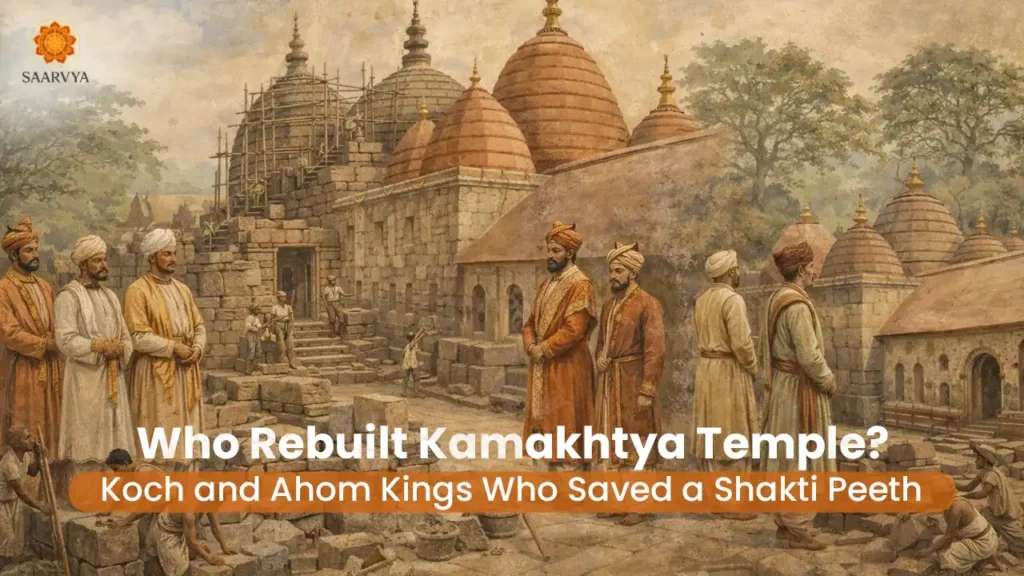

Understanding who rebuilt Kamakhya temple requires tracing a dramatic chapter in Kamakhya mandir history, an era when the original stone structure was severely damaged and had to be reconstructed into the iconic Nilachal-style shrine we see today. This article continues from “Who Built Kamakhya Temple?” and now shifts focus to the reconstruction: the invasions that damaged the temple, its rediscovery, the Koch-era rebuilding, and the later Ahom restorations that shaped its enduring legacy.
Why Did Kamakhya Temple Need Rebuilding?
The question of who rebuilt the Kamakhya temple cannot be answered without first understanding why the temple needed reconstruction in the first place. Kamakhya mandir history reveals a turbulent period during which the earlier stone structure, likely a Nagara-style temple built by early Kamarupa rulers, suffered extensive damage. What followed was a phase of neglect, scattered ruins, and partial survival of only the sacred core. This destruction set the stage for one of the most significant restoration efforts in Eastern Indian temple history.
Invasions and Destruction of the Earlier Stone Temple
The late medieval political landscape of Kamrup was marked by repeated conflicts involving the Turko-Afghan sultanates of Bengal. During this period, several temples in the region faced damage or desecration, and Kamakhya was no exception. Traditional narratives often associate the destruction of the old structure with Kalapahar, a general under the Bengal Sultanate who became infamous in Assamese memory for temple desecrations. However, a closer examination of Kalapahar’s history and regional chronicles suggests that the destruction at Nilachal Hill is more credibly linked to Sultan Alauddin Hussein Shah’s invasion around the early 16th century (c. 1498–1505 CE).
Historians note:
- Hussein Shah’s campaigns penetrated deep into Kamrup, a time when Kamakhya likely faced attack.
- Architectural fragments from the earlier Nagara-style temple appear scattered around the site, indicating violent dismantling.
- The Kalapahar attribution emerged later and might reflect broader cultural memory rather than precise chronology.
Thus, the older Kamakhya structure did not fall to a single act of desecration but to a series of military incursions that weakened the region politically and spiritually. This is a crucial turning point in Kamakhya Temple history, marking the transition from ancient stone temple to near ruin.
Also Read: Who Is Kamakhya Devi? Origins, Legends, Rituals & Spiritual Power Explained
The State of Nilachal Hill Before Reconstruction
By the time the Koch rulers arrived in the 16th century, Nilachal Hill was no longer the bustling pilgrimage center it once was. Accounts preserved in Assamese chronicles and local memory describe the temple site as:
- Ruined, with the main stone superstructure largely collapsed
- Covered in scattered sculptural fragments, broken pillars, and weathered masonry
- Partially buried foundations still visible amidst vegetation
- Devoid of structured ritual activity that once defined Kamakhya’s prominence
Yet, the most sacred element the yoni-pitha remained untouched by time and destruction. The underground spring continued to flow, keeping the sanctum alive. Even in ruin, locals preserved minimal forms of worship, visiting the hill discreetly and offering prayers at the natural rock fissure. This continuity ensured that Kamakhya’s spiritual core remained unbroken, even if her temple lay shattered.
This period represents a symbolic paradox in kamakhya temple story: a divine site in physical decay, awaiting the right patronage to rise again. The sanctity remained; what the goddess needed was a dynasty capable of restoring her earthly home.
Koch Dynasty – The Main Rebuilders of Kamakhya
Any attempt to understand who rebuilt Kamakhya temple inevitably leads to the Koch dynasty. It was under their vision, political consolidation, and deep devotion that Kamakhya rose again from a fragmented ruin to the Nilachal-style masterpiece that defines its silhouette today. The Koch rulers did not merely repair a damaged shrine; they reimagined and re-established Kamakhya as the spiritual and political heart of their expanding kingdom.
Vishwasingha’s “Rediscovery” and Revival of Worship
Vishwasingha (also spelled Biswa Singha), founder of the Koch kingdom (c. 1515–1540 CE), is traditionally credited with rediscovering the ruined Kamakhya Temple. When he ascended the Nilachal Hill, he is said to have found:
- Collapsed stone structures
- Scattered sculptural fragments
- Overgrown vegetation covering the remnants of the older Nagara-style temple
- But importantly the yoni-pitha, still active and venerated quietly by locals
Recognising the spiritual potency of the site, Vishwasingha revived formal worship by:
- Reestablishing priestly traditions
- Bringing attention back to the sacred hill
- Offering royal patronage to the goddess
- Restoring Kamakhya’s importance within kamrup kamakhya temple traditions
This move was not only devotional it also strengthened his political legitimacy. A ruler who restored a major Shakti Peeth displayed both dharmic authority and regional sovereignty. To rule over Kamrup, one had to honor Kamakhya.
Historical sources suggest that Vishwasingha may have initiated early reconstruction efforts, but the full rebuilding belonged to the next generation.
Nara Narayan and Chilarai – Architects of the Present Temple
Most historical accounts, inscriptions, and architectural studies agree that King Nara Narayan (1540–1587 CE) is the central figure in answering who rebuilt Kamakhya temple. He completed the reconstruction in 1565 CE, giving the temple its modern form.
His reconstruction was strategic, spiritual, and monumental in scale.
His brother, the legendary Koch general Chilarai, played a crucial supervisory role. Under Chilarai’s direction:
- Earlier stone blocks from the ruined temple were reused in foundations and walls
- Sculptural remnants were integrated into the new structure
- The sacred topography of the hill was preserved while adapting to new forms
- Artisans were commissioned to experiment with new architectural solutions
Local traditions further credit Chilarai with protecting the site during the tense political environment of the 16th century, enabling uninterrupted reconstruction.
Thus, historically speaking, if one asks kamakhya temple was rebuilt by whom in its visible form today, the answer is:
Koch King Nara Narayan, with Chilarai as chief visionary and executor (1565 CE).
Creation of the “Nilachal Type” Architecture
During the reconstruction, the Koch artisans attempted to restore the original Nagara-style shikhara (tower) that had once crowned the older stone temple. However:
- Multiple attempts to rebuild the stone superstructure reportedly collapsed
- The older style could not be perfectly replicated due to structural stability issues
- The need for a new architectural solution became urgent
At this point, a master artisan named Meghamukdam (often mentioned in temple lore) proposed an innovative approach. Instead of a traditional stone shikhara, he designed a brick-based hemispherical dome placed over a cruciform (cross-shaped) base.
This new design featured:
- A powerful central dome inspired partly by Islamic domical styles
- Four cardinal projections forming a cruciform ground plan
- A ring of miniature towers (shikharas) around the base
- Integration of surviving stone elements from the earlier temple
- Decorative features blending Assamese, medieval North Indian, and Indo-Islamic motifs
This architectural synthesis resulted in what is now known as the “Nilachal type” a distinctive style seen in Kamakhya and a few other temples on the hill.
The significance of this innovation cannot be overstated:
- It gave Kamakhya an identity unlike any other temple in India
- It ensured structural stability for centuries
- It embodied cultural fusion local, classical, and Islamic influences coexisting harmoniously
- It redefined kamakhya temple architecture and set a template for future hill-temple construction in Assam
Thus, the Koch dynasty did not just rebuild a temple; they created a new architectural legacy tied to Kamakhya’s rebirth.
Ahom Kings – Renovators, Not Original Rebuilders
After the Koch era firmly answered who rebuilt the Kamakhya temple in terms of the main superstructure, the story of Kamakhya enters a new chapter under the Ahom kings. By the late 17th century, political power in western Assam shifted once again, and with it came a renewed wave of patronage, repairs, and expansions. The Ahoms did not start from ruins; they inherited a functioning Koch-built shrine and chose to strengthen, embellish, and integrate it into their own royal vision.
Ahom Patronage after the Conquest of Kamrup
When the Ahoms extended their influence into Kamrup, they understood very clearly that whoever controlled kamrup Kamakhya temple held not just territory, but spiritual legitimacy. Kamakhya was more than a local shrine it was a Shakti Peeth, a symbolically charged power center that deeply shaped regional identity.
Key Ahom rulers like Rudra Singha (Rajeswar Sinha) and Siba Singha emerged as important patrons in later kamakhya temple history:
- They granted large tracts of land to the temple for its maintenance.
- They brought in Shakta priests and scholars, aligning Ahom state rituals with Kamakhya’s worship.
- They sponsored festivals, daily rituals, and offerings, turning the temple into a major state-supported institution.
Under Ahom rule, Kamakhya’s status shifted from a primarily Koch-royal shrine to a pan-Assamese Shakta center, woven into the administrative and ritual fabric of the Ahom kingdom.
This patronage also had a political dimension:
- Supporting Kamakhya helped the Ahoms legitimize their rule in newly annexed regions.
- It allowed them to symbolically present themselves as guardians of the same goddess whom previous dynasties had revered.
In this way, Kamakhya temple story became a thread connecting multiple regimes, each demonstrating loyalty to the Devi to affirm their own right to rule.
Structural Additions and Renovations Under the Ahoms
Architecturally, the Ahoms are best described as renovators and expanders, not original rebuilders. They did not replace the Koch-made shikhara or core garbhagriha; instead, they enhanced the complex around it.
Key Ahom-period additions include:
- The natamandir (assembly or dance hall) in front of the main sanctum, often attributed to later rulers such as Rajeswar Singha.
- Outer halls, mandapas, and subsidiary structures bearing inscriptions of Rajeswar Singha and Gaurinath Singha.
- Repairs to stairways, pathways, and boundary walls that improved access to the hill shrine.
These works:
- Expanded the temple’s ritual capacity, allowing larger gatherings, festivals, and cultural performances.
- Reinforced the physical stability of the complex.
- Added another stylistic layer atop what the Kochs had already established.
From an architectural point of view, Ahom interventions are crucial for understanding kamakhya temple architecture as a living, evolving form. The core Nilachal-style superstructure remained Koch, but the temple campus as devotees see it today natamandir, outer halls, ancillary shrines reflects significant Ahom influence.
Thus, when examining Kamakhya mandir history, it’s important to draw a clear distinction:
- Koch kings rebuilt the damaged core temple in the 16th century.
- Ahom kings renovated, embellished, and expanded the complex from the late 17th century onward.
They are all part of the same long story, but their roles are distinct.
Other Historical Phases of Repair and Administration
Even after the Koch and Ahom periods, Kamakhya’s story did not freeze in time. As a living temple, it continues to undergo repairs, administrative changes, and conservation efforts. These later phases may not redefine who rebuilt Kamakhya temple, but they deeply influence how the shrine is preserved, governed, and experienced today.
Post-Ahom Management and Modern Repairs
With the fall of the Ahom kingdom and the arrival of colonial and later modern state structures, the way kamakhya mandir history unfolded took a new direction. The temple gradually moved from exclusive royal patronage to a more complex framework involving local priestly lineages, public trusts, and state oversight.
Over the 19th and 20th centuries:
- The temple’s daily rituals and festivals continued under hereditary priestly families, preserving traditional Shakta and Tantric practices.
- Maintenance and smaller repairs were typically funded through donations, endowed lands, and community contributions.
- Natural wear, monsoon damage, and heavy footfall from pilgrims necessitated periodic strengthening of walls, staircases, and roofs.
In more recent decades, legal and administrative interventions have further shaped Kamakhya Temple’s history:
- Questions around management, transparency of funds, and heritage protection led to court-monitored changes in administration.
- Government bodies and archaeological agencies became involved in conservation and structural safety, especially as pilgrim numbers increased.
- Modern materials like reinforced concrete, lime-based mortars, and protective coatings have occasionally been used to stabilise older brick and stone components, carefully balancing preservation with safety.
These efforts are not about altering the original design, but about ensuring that the Koch-era Nilachal dome, Ahom-period halls, and earlier foundations remain structurally sound for future generations.
Through all these phases, one constant remains: the kamakhya temple speciality lies in being both an active place of worship and a heritage monument. Any repair must therefore respect ritual needs as much as archaeological integrity.
Distinguishing “Rebuilding” from “Renovation”
When talking about who rebuilt Kamakhya temple, it is crucial to use language precisely. In everyday speech, people often say “rebuilt,” “repaired,” and “renovated” interchangeably, but in the context of Kamakhya these terms have different meanings.
- “Rebuilt” most accurately applies to the 16th-century Koch reconstruction.
- The earlier Nagara-style stone temple had suffered major destruction.
- Koch king Nara Narayan, guided by Chilarai and architect Meghamukdam, created a new superstructure the Nilachal-style dome over a cruciform brick base reusing older fragments.
- This was a structural and stylistic re-creation, not just patchwork repair.
- “Repaired / Renovated / Expanded” better describes what came later:
- Ahom rulers reinforced walls, added the natamandir and outer halls, and endowed the shrine, but did not replace the Koch-built core.
- Post-Ahom and modern interventions focus on conservation, surface repair, and administrative restructuring, rather than rebuilding the garbhagriha or shikhara.
Understanding this distinction helps prevent historical confusion. When we speak of kamakhya temple architecture as it stands today, we are mostly looking at:
- A Koch-built main superstructure (1565 CE).
- Ahom-period halls and expansions in front and around it.
- Later repairs and modern protective work overlaying older materials.
So, while many hands have cared for and modified the temple, the phrase “who rebuilt Kamakhya temple” rightfully points to the Koch era, whereas Ahom and subsequent contributions are better honored as renovations, enhancements, and guardianship over time.
Putting It Together – So Who Rebuilt Kamakhya Temple?
After tracing myths, invasions, royal patronage, architectural innovations, and centuries of renovations, we can now answer the central question with clarity and depth. The story of who rebuilt Kamakhya temple is not confined to a single figure; it is a layered narrative involving multiple dynasties, each contributing to the temple’s rebirth and evolution. Yet, historically and architecturally, one phase stands out as the true “rebuilding.”
From a strictly historical and architectural perspective, the answer is clear:
Kamakhya Temple was rebuilt in 1565 CE by Koch King Nara Narayan, under the guidance of his brother Chilarai and the artisan Meghamukdam.
This reconstruction:
- Replaced the ruined earlier Nagara-style stone temple
- Introduced the now-iconic Nilachal-style hemispherical dome
- Integrated fragments of the older structure into a new design
- Rejuvenated Kamakhya as a major Shakti Peeth and political symbol of the Koch kingdom
Therefore, when one asks who rebuilt Kamakhya temple, the primary historical answer is:
- Nara Narayan (principal patron)
- Chilarai (chief strategist and supervisor)
- Meghamukdam (principal architect of the Nilachal dome)
However, the full truth requires acknowledging the long chain of contributors:
- Indigenous worshippers preserved the sanctity of the site from prehistoric times.
- Surendravarman and early Kamarupa rulers built and expanded the earlier stone temple.
- Ahom kings renovated and enriched the complex, adding structures like the natamandir.
- Modern conservation bodies continue to protect and maintain the temple today.
Thus, Kamakhya is not a monument with a single rebuilder it is a living temple shaped across centuries.
Faith, Memory, and Political Legitimacy
While historians emphasize architecture, inscriptions, and chronologies, faith communities remember the temple differently. For many devotees, the idea of rebirth is tied not only to the 16th-century reconstruction but also to the spiritual continuity of the goddess herself.
Different groups remember different “rebuilders” because restoration is not just an architectural act it is an act of devotion and sovereignty.
- Koch narratives highlight Vishwasingha and Nara Narayan as the rightful restorers of Kamakhya and thus legitimate rulers of Kamrup.
- Ahom-era traditions emphasize their kings’ role as protectors and patrons of the goddess, aligning political power with divine sanction.
- Local oral histories often interweave older dynasties, such as the Mlechchas and early Kamarupa kings, stressing the temple’s antiquity and sacred continuity.
- Devotees see reconstruction as part of Kamakhya’s unfolding grace each ruler who restored her temple did so because the goddess allowed and blessed it.
This is why the memory of Kamakhya Mandir’s history does not rest solely on one period. Restoration becomes a symbolic act of:
- Loyalty to the goddess
- Cultural identity
- Political legitimacy
- Spiritual stewardship
Recognising this layered memory does justice to the temple’s role in the region’s sacred geography.
The Temple as a Layered Monument
In truth, Kamakhya is best understood as a multi-period, multi-dynasty sacred complex, where:
- The core sanctum carries prehistoric and indigenous echoes.
- The stone foundations recall early Kamarupa craftsmanship.
- The Nilachal dome reflects Koch innovation and architectural synthesis.
- The outer halls and platforms showcase Ahom patronage and artistic vision.
- The modern repairs safeguard the living temple for millions of devotees.
Thus, the question of who rebuilt the Kamakhya temple cannot be restricted to a single ruler or dynasty without losing the richness of its story.
The answer is layered, just like the temple itself:
- Nara Narayan rebuilt it.
- Chilarai engineered it.
- Meghamukdam designed it.
- Ahom kings expanded and preserved it.
- And generations of devotees kept it alive.
Kamakhya stands today not as the work of one hand—but as the creation and re-creation of countless hands, hearts, and eras.
Frequently Asked Questions
1. Who rebuilt Kamakhya Temple after it was destroyed?
Kamakhya Temple was rebuilt in 1565 CE by Koch king Nara Narayan, with his brother Chilarai supervising the work and the artisan Meghamukdam designing the Nilachal-style dome. This reconstruction forms the core of the temple seen today.
2. What destroyed the earlier Kamakhya Temple?
Historical analysis suggests the earlier Nagara-style stone temple was damaged during Turko-Afghan invasions, most credibly under Sultan Alauddin Hussein Shah, rather than Kalapahar. This event marks a key turning point in the history of Kamakhya Temple.
3. What was the condition of the Kamakhya Temple before the Koch reconstruction?
Before rebuilding, Nilachal Hill contained ruins of the older structure, scattered stone fragments, and partially buried foundations. The sacred yoni-pitha and spring, however, remained intact and continued to be worshipped.
4. What architectural style did the Koch kings introduce?
The Koch dynasty introduced the distinctive Nilachal-style architecture a brick hemispherical dome over a cruciform base, surrounded by smaller towers. This style blends older Nagara elements with Indo-Islamic dome influences, defining kamakhya temple architecture today.
5. Who rediscovered the ruined Kamakhya Temple?
Koch king Vishwasingha is traditionally credited with rediscovering the ruined shrine, reviving worship, and preparing the groundwork for full reconstruction. His efforts restored Kamakhya’s political and spiritual importance in Kamrup.
6. What role did the Ahom kings play in Kamakhya Temple’s restoration?
Ahom rulers like Rudra Singha and Siba Singha did not rebuild the core temple but renovated and expanded the complex. They added structures like the natamandir and reinforced ritual activity, influencing kamakhya mandir history significantly.
7. Is the present Kamakhya Temple the same as the ancient one?
No. The visible structure is largely the 16th-century Koch reconstruction. The original early medieval stone temple was destroyed, though parts of it survive in the foundation and reused sculptural fragments.
8. What is the speciality of Kamakhya Temple’s architecture?
Kamakhya’s unique speciality lies in its Nilachal-type dome, the natural yoni-shaped rock as the deity (instead of an idol), and its fusion of indigenous, Tantric, Nagara, and Indo-Islamic architectural elements making it unlike any other Indian temple.
9. What is the connection between Kalapahar and Kamakhya Temple?
Popular folklore links Kalapahar with temple destruction, but historians argue the damage was more likely caused earlier by Hussein Shah’s forces. Kalapahar’s association in Assamese memory reflects cultural trauma more than verified chronology, forming part of Kalapahar‘s history.
10. Where is Kamakhya Temple located?
Kamakhya Temple is located on Nilachal Hill in Guwahati, Assam. It is one of India’s most important Shakti Peethas and a key landmark in the Kamakhya temple story and regional spiritual identity.